
Table of Contents
Introduction
When evaluating automotive sound insulation materials, it’s essential to compare design intent, structural features, and application fit. This article presents a side-by-side look at two source-verified options: the GOSCHE 394 mil 10mm Sound Deadening Mat and the AggSound 394 mil 10mm Automotive Sound Deadening Mat. Each product brings a distinct configuration to noise and heat control in vehicles.How This Comparison Was Built
All information presented here is derived exclusively from official product documentation and source-aligned materials. The focus is on stated design, use-case intent, and material properties, without speculation or inferred claims. Findings from the full product reviews are available at the following links: GOSCHE product review and AggSound product review.Key Decision Factors Identified From the Source Content
Buyers comparing these products will want to consider: – Material layering and adhesive differences – Application-specific usage examples – Installation handling across curved or confined areas – Differences in stated compression resistance and flexibility – Panel clearance suitability and adhesive reinforcement needsGOSCHE 394 mil 10mm Sound Deadening Mat Overview

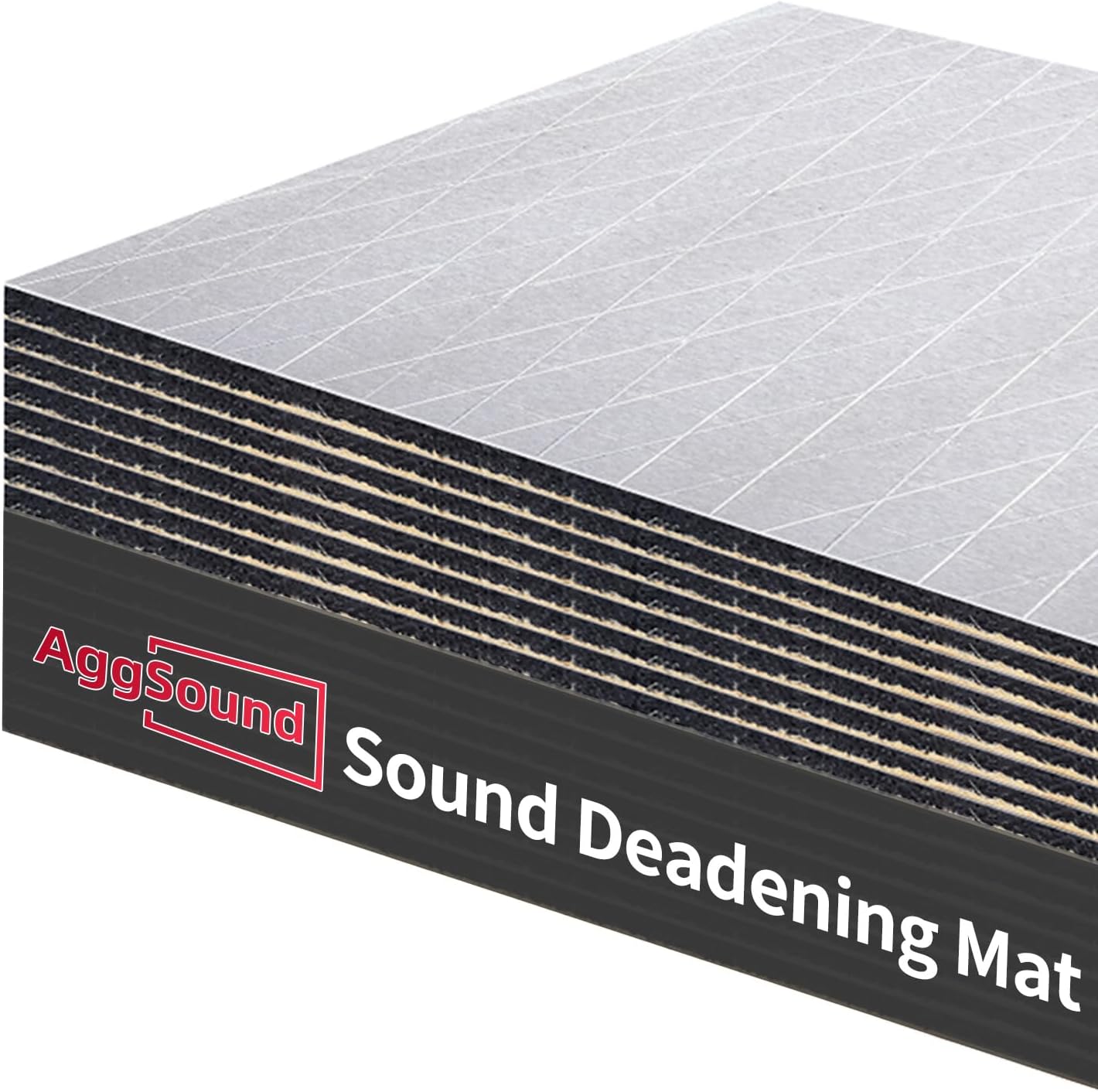
AggSound 394 mil 10mm Automotive Sound Deadening Mat Overview
Head-to-Head Comparison: What the Evidence Shows
Both mats offer closed-cell foam with aluminum facing and peel-and-stick backing, suitable for noise and heat management. However, AggSound provides additional detail about its three-layer construction and emphasizes compression resistance as a performance attribute. GOSCHE focuses more on DIY-friendly flexibility, with confirmed stability on curved or uneven surfaces. Adhesion is another point of difference—GOSCHE adhesive is single-use, while AggSound may require supplemental bonding in select applications. AggSound highlights specific use cases involving thermal exposure and roof panel installs, while GOSCHE emphasizes cabin comfort and panel resonance reduction. Clearance issues in tighter spaces are mentioned only in the AggSound documentation.At-a-Glance Comparison Table
| Feature | GOSCHE | AggSound |
|---|---|---|
| Foam Thickness | 10mm | 10mm |
| Construction Layers | Aluminum + Foam (implied 2-layer) | Aluminum + Foam + Adhesive (3-layer) |
| Adhesive Type | Single-use peel-and-stick | Peel-and-stick, reinforcement may be needed |
| Compression Resistance | Not specified | Explicitly stated |
| Panel Clearance Advisory | Not mentioned | Advised for tight assemblies |
| Thermal Use Zones | Firewall, engine bay | UTV roof, engine-adjacent areas |
| Coverage Area | 16 sq ft (15 sheets) | Not specified |
Which One May Be the Better Fit for Different Situations
For projects prioritizing sheet count, ease of application, and flexible shaping in general cabin zones, the GOSCHE mat may be more aligned with those requirements. In contrast, AggSound may be more suitable when compression durability or installation in thermally intensive or structurally constrained areas is a consideration. Each product emphasizes a distinct usage context that may guide selection depending on project specifics.Frequently Asked Questions
Do both products provide thermal insulation as well as noise control?
Yes. Both products feature closed-cell foam and aluminum foil construction intended to reduce heat transfer and block noise.
Are the materials suitable for curved or vertical surfaces?
GOSCHE reports successful installs on curved areas without delamination. AggSound allows similar applications but notes that adhesive reinforcement may be needed.
Do either products include performance ratings or certifications?
No formal decibel reduction or thermal resistance values (e.g., R-value) are listed in the source documentation for either product.