
Table of Contents
1. Introduction
If you’re comparing two-part expanding pour foams in the 2 lb density range, Lifeboat 2lb Pour Foam Kit and Fiberglass Supply Depot 2 lb Pour Foam both position as closed-cell polyurethane options for flotation-focused filling and insulation-related use. The decision in the review details largely comes down to stated expansion yield, stated working time, and how each write-up frames application constraints.
2. Key Decision Factors Identified From the Review Content
The review details highlight a few practical comparison points: stated expansion volume per kit, stated working time/window, temperature guidance during use, and which attributes are explicitly specified (such as closed-cell percentage, measurement method, and resin compatibility).
3. Lifeboat Polyurethane Pour Foam 2lb 1-Gallon Kit for Flotation, Filling, Soundproofing, and Insulation Overview
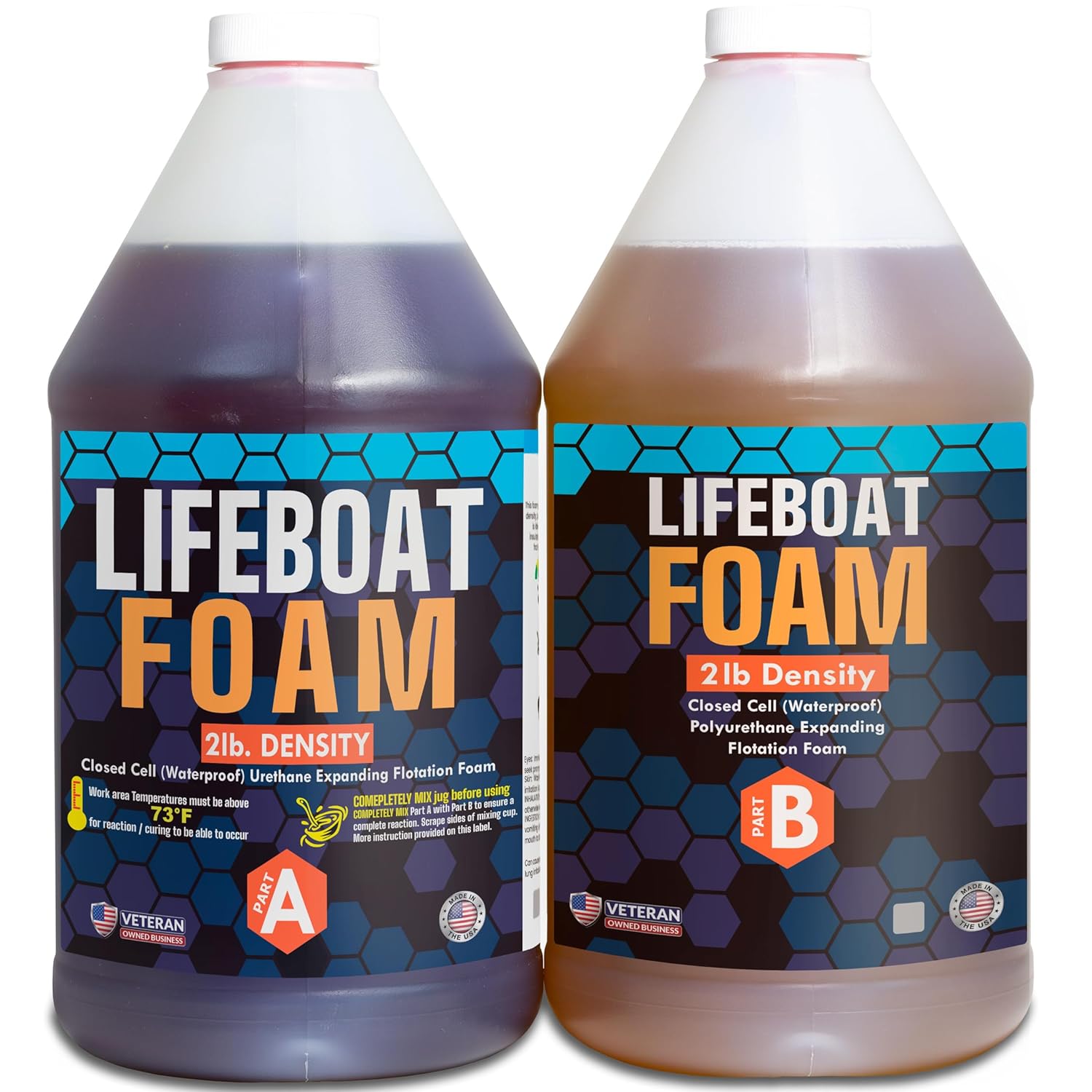
The Lifeboat product is described as a two-part, closed-cell polyurethane expanding foam in a 2 lb density formulation, presented as a 1-gallon kit. The write-up positions it for boat buoyancy, cavity filling, insulation, deep pour usage, and soundproofing, with a focus on an “extended time” formula during mixing and application.
- Stated expansion: up to four cubic feet per kit after mixing equal parts A and B.
- Stated working time: up to 20 seconds for mixing and pouring.
- Stated closed-cell rate after curing: 95% to 98%.
- Temperature guidance: ideal ambient temperature stated as 75°F or above.
For readers who want to explore the product page directly, the review includes the Lifeboat listing link.
4. Fiberglass Supply Depot 2 Lb Density Expanding Pour Foam for Flotation and Insulation Applications Overview
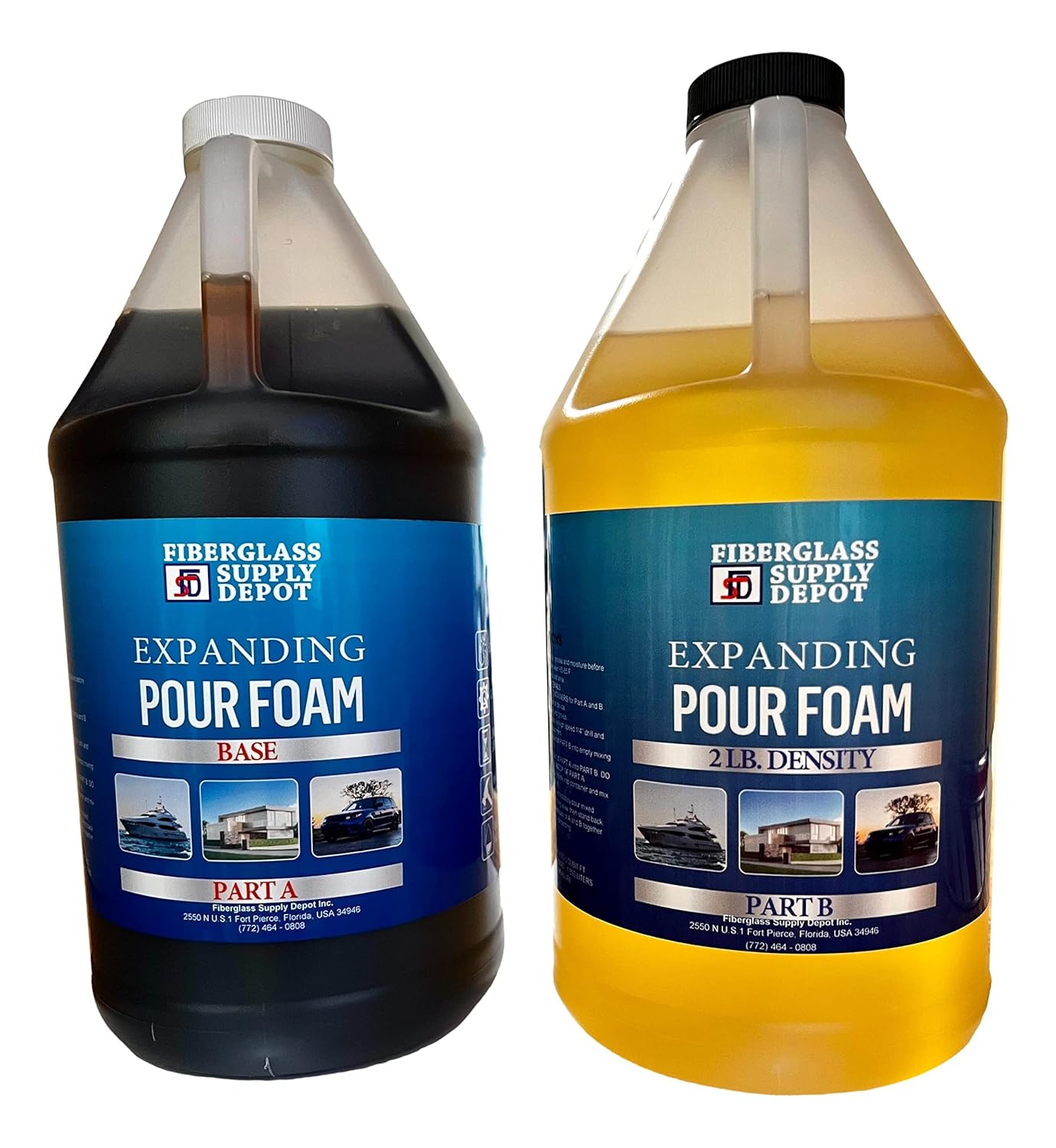
The Fiberglass Supply Depot product is described as a closed-cell, two-part polyurethane expanding pour foam at 2 lb density, discussed in the context of flotation and insulation applications. The review content emphasizes rapid expansion after mixing and provides specific notes on working time, temperature range, and how to measure parts during mixing.
- Stated expansion: up to five cubic feet of foam per one-gallon kit.
- Stated working time: approximately 45 seconds, with a full expansion window of about five minutes at optimal temperatures.
- Temperature guidance: mix and pour at or above 75°F; optimal temperatures stated between 75°F and 80°F.
- Measuring guidance: measure parts by volume rather than weight due to differing material densities.
For readers who want to reference the product link included in the review, here is the Fiberglass Supply Depot listing.
5. Head-to-Head Comparison: What the Evidence Shows
Both write-ups describe a two-part, closed-cell polyurethane expanding pour foam at 2 lb density in a one-gallon kit format, with flotation and insulation-related applications mentioned. The most explicit differences in the review details are the stated foam yield per kit and the stated working time. Lifeboat is described with an “extended time” formula and a stated “up to 20 seconds” working time, while Fiberglass Supply Depot is described as expanding rapidly with a stated “approximately 45 seconds” working time and an expansion window noted at optimal temperatures.
On stated yield, the Lifeboat kit is described as expanding to up to four cubic feet, while the Fiberglass Supply Depot kit is described as producing up to five cubic feet per one-gallon kit. On what’s explicitly specified, Lifeboat includes a closed-cell percentage range after curing (95% to 98%), while the Fiberglass Supply Depot write-up focuses more on installation considerations such as mixing by volume and avoiding sealing in airtight enclosures due to heat generation.
For quick reference to the product pages discussed in the review content, you can revisit Lifeboat and Fiberglass Supply Depot directly.
6. At-a-Glance Comparison Table
| Comparison point | Lifeboat | Fiberglass Supply Depot |
|---|---|---|
| Foam type | Two-part closed-cell polyurethane expanding foam | Closed cell, two-part polyurethane formulation |
| Density stated | 2 lb density formulation | 2 lb density |
| Kit size stated | 1-gallon kit | One-gallon kit (½ gallon each of parts A and B) |
| Stated expansion yield per kit | Up to four cubic feet | Up to five cubic feet |
| Stated working time | Up to 20 seconds | Approximately 45 seconds |
| Temperature guidance stated | Ideal ambient temperature 75°F or above | Mix and pour at or above 75°F; optimal 75°F to 80°F |
| Closed-cell percentage stated | 95% to 98% after full curing | Not specified in the available review details. |
| Chemical resistance mentioned | Resistance noted against gasoline and oil | Not stated in the researched material. |
| Resin compatibility after curing | Compatible with polyester, epoxy, and vinyl ester resins | Can be laminated with polyester, epoxy, or vinyl ester resins |
| Measuring method guidance | Not provided in the product write-up. | Measure by volume rather than weight |
7. Which One May Be the Better Fit for Different Situations
If you’re prioritizing the stated expansion yield per one-gallon kit, the review details list Fiberglass Supply Depot at “up to five cubic feet,” while Lifeboat is described as “up to four cubic feet.” If your decision hinges on the stated working time language, Lifeboat is framed around an “extended time” formula with “up to 20 seconds” for mixing and pouring, while Fiberglass Supply Depot is described as expanding rapidly with “approximately 45 seconds” of working time and an expansion window noted at optimal temperatures.
If you want a write-up that explicitly states a closed-cell percentage after curing, the Lifeboat description includes a 95% to 98% range. If you want mixing guidance that explicitly addresses measurement method, the Fiberglass Supply Depot write-up states that parts should be measured by volume rather than weight. For those comparing how the products are positioned beyond flotation and insulation, Lifeboat is also described for deep pour usage and soundproofing, while Fiberglass Supply Depot is discussed in terms of structural and acoustic applications and includes cautions about heat generation during curing.
8. Frequently Asked Questions
Are both products described as closed-cell, two-part polyurethane foams?
Yes. Both write-ups describe a two-part polyurethane expanding foam with a closed-cell structure.
How much foam does each one-gallon kit claim to produce?
The Lifeboat kit is described as expanding up to four cubic feet, while the Fiberglass Supply Depot kit is described as producing up to five cubic feet.
What working time is stated for each product?
Lifeboat is described with up to 20 seconds for mixing and pouring. Fiberglass Supply Depot is described with approximately 45 seconds of working time and an expansion window of about five minutes at optimal temperatures.
What temperature guidance is mentioned for use?
The Lifeboat write-up states an ideal ambient temperature of 75°F or above. The Fiberglass Supply Depot write-up advises mixing and pouring at or above 75°F and notes optimal temperatures between 75°F and 80°F.
Do the reviews mention compatibility with resins after curing?
Yes. Both write-ups state compatibility with polyester, epoxy, and vinyl ester resins after curing/once hardened.
9. Closing Guidance
If you’re choosing mainly on the most explicitly stated yield and the mix/measure guidance, the Fiberglass Supply Depot write-up provides “up to five cubic feet” per kit, “approximately 45 seconds” of working time, and a specific note to measure by volume rather than weight. If you’re choosing based on the inclusion of a stated closed-cell percentage and the way the product is positioned for deep pour usage alongside flotation, filling, insulation, and soundproofing, the Lifeboat write-up includes a 95% to 98% closed-cell range and describes an “extended time” formula.
For deeper product-specific detail beyond this side-by-side, revisit the standalone write-ups for Lifeboat Polyurethane Pour Foam 2lb 1-Gallon Kit for Flotation, Filling, Soundproofing, and Insulation and Fiberglass Supply Depot 2 Lb Density Expanding Pour Foam for Flotation and Insulation Applications, or compare the product pages for Lifeboat and Fiberglass Supply Depot as referenced in the review content.