
Acoustic plaster is designed for rooms where you want to control reflected sound without covering the ceiling or walls with obvious acoustic panels, baffles, or tiles. It can look much like a conventional continuous plaster finish, but the finished system remains acoustically active so sound can enter the absorptive material rather than simply reflecting back into the room.
That makes acoustic plaster useful for reducing reverberation, improving speech clarity, and making hard-surfaced rooms feel less acoustically harsh. It is important, however, to separate sound absorption from sound blocking. Acoustic plaster is primarily a room-acoustics treatment. It should not automatically be treated as a substitute for a properly designed wall, floor, or ceiling assembly intended to stop sound travelling from one space to another.
This guide explains what acoustic plaster is, how the different systems work, what NRC ratings mean, where it can be used, how it differs from acoustic plasterboard, and what to check before choosing a system.
What Is Acoustic Plaster?
Acoustic plaster, also called acoustical plaster or sound-absorbing plaster, is a specialist wall or ceiling finish used to add sound absorption while maintaining a seamless architectural appearance. Instead of exposing a grid of ceiling tiles or individual wall panels, the completed surface can appear continuous and monolithic.
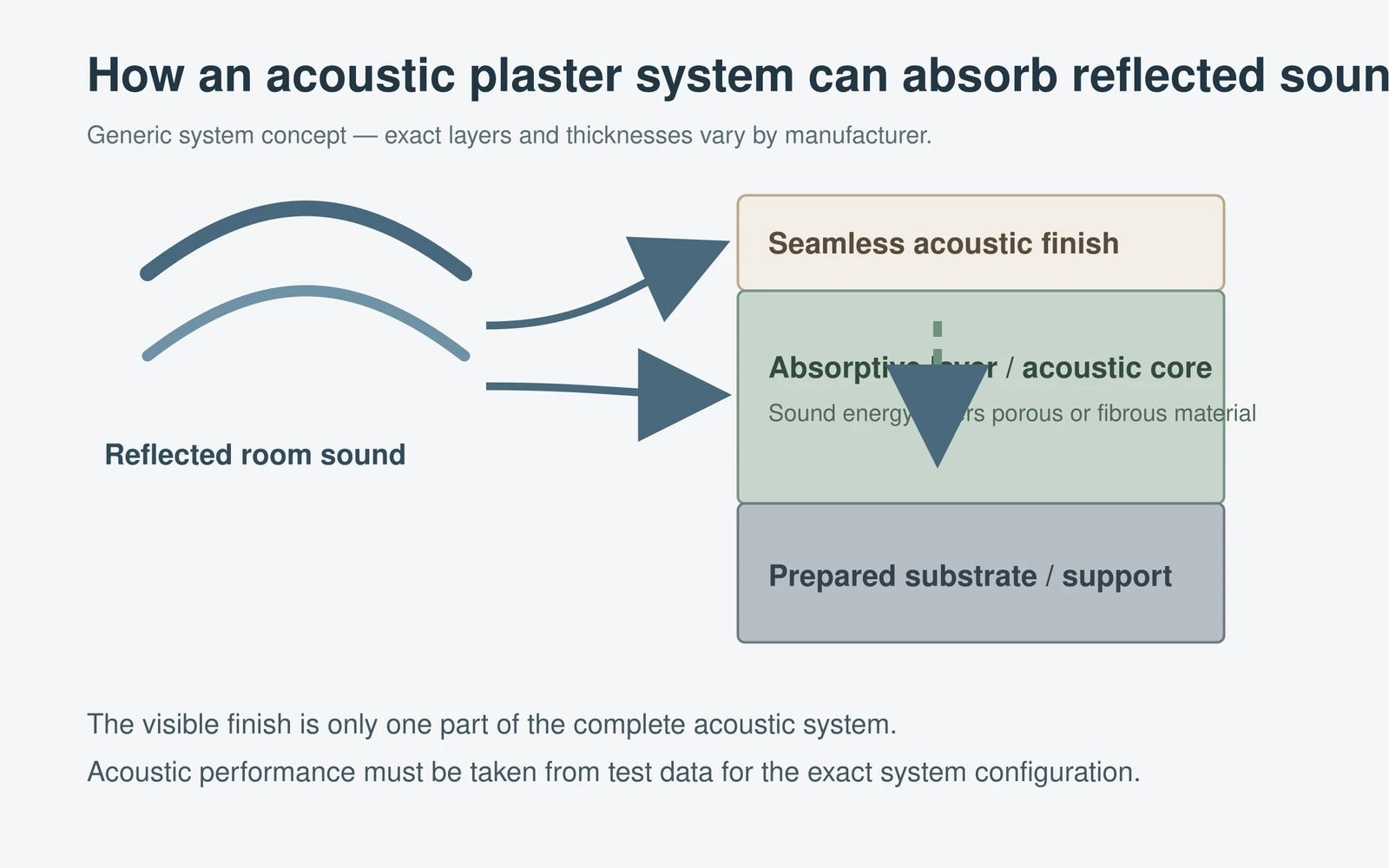
The important word is system. In many modern products, the visible plaster-like finish is only the outer layer. Behind it may be an absorptive panel, acoustic coreboard, mineral-wool layer, or another sound-absorbing substrate. The finish must remain sufficiently porous or acoustically transparent for sound energy to reach those absorptive layers.
This is why acoustic plaster should not be judged simply by how smooth or solid it looks. Two products that appear similar after installation can use very different backing materials, thicknesses, mounting methods, and test configurations. Their acoustic performance can therefore differ significantly.
How Acoustic Plaster Works
Hard surfaces such as conventional plaster, glass, concrete, and untreated drywall can reflect a large proportion of the sound that reaches them. In a room with many hard surfaces, those reflections continue after the original sound is produced. The result is reverberation: voices become less distinct, music can lose clarity, and general activity can create a tiring buildup of reflected noise.
An acoustic plaster system is intended to absorb part of that reflected energy. In panel-backed systems, sound passes through the acoustically open finish and reaches the porous or fibrous material beneath. The system dissipates part of that energy instead of sending it straight back into the room.
The practical goal is therefore not silence. It is better control of the room’s acoustic response. Reducing excessive reverberation can make speech easier to understand and can make restaurants, living rooms, offices, classrooms, auditoriums, and other hard-finished spaces feel more comfortable.
Performance is normally established through laboratory testing of a complete system, not by the word “plaster” alone. The backing material, thickness, mounting condition, finish, substrate, and installation details can all influence the result.
Acoustic Plaster Systems Are Not All Built the Same Way
There is no single construction method that defines every acoustic plaster product. BASWA describes systems built around absorptive panels with seamless plaster coats. Armourcoat publishes a mineral-wool-panel system with basecoat, undercoat, and topcoat layers. CertainTeed’s FADE system uses an acoustic coreboard with spray-applied plaster, while Ecophon also describes FADE as a spray-applied acoustic plaster solution. Sto offers a directly applied acoustic plaster system for ceilings and selected wall areas.
That variety matters because a detail that is correct for one product may be wrong for another. For example, one system may bond panels to a solid substrate, while another may use a suspended support system. One product may be appropriate for direct mounting to concrete or gypsum, while another may require a specific board, adhesive, washer, or approved preparation sequence.
The same caution applies to finish thickness, minimum curve radius, wall placement, repair methods, moisture suitability, fire ratings, and sustainability claims. These should be checked against the technical data for the product actually being specified.
For homeowners, the useful takeaway is simple: choose the system based on the room’s acoustic target and installation conditions rather than assuming that every “acoustic plaster” product is interchangeable.
Acoustic Plaster vs Regular Plaster
Conventional plaster is mainly selected to create a durable finished surface. Once painted or otherwise sealed, it is generally a hard surface that reflects sound rather than providing substantial room-acoustic absorption.
Acoustic plaster is deliberately engineered so the finished surface remains part of an absorptive system. In a typical panel-backed design, sound must be able to pass through the finish to the absorptive material behind it. Applying an unsuitable sealing coating over that surface could interfere with this function, which is why refinishing instructions matter.
The visible difference can be surprisingly small. Both finishes may look smooth and continuous. The functional difference lies in what is behind the surface, how the finish is formulated, and how the complete assembly has been acoustically tested.
Acoustic Plaster vs Acoustic Plasterboard or Drywall
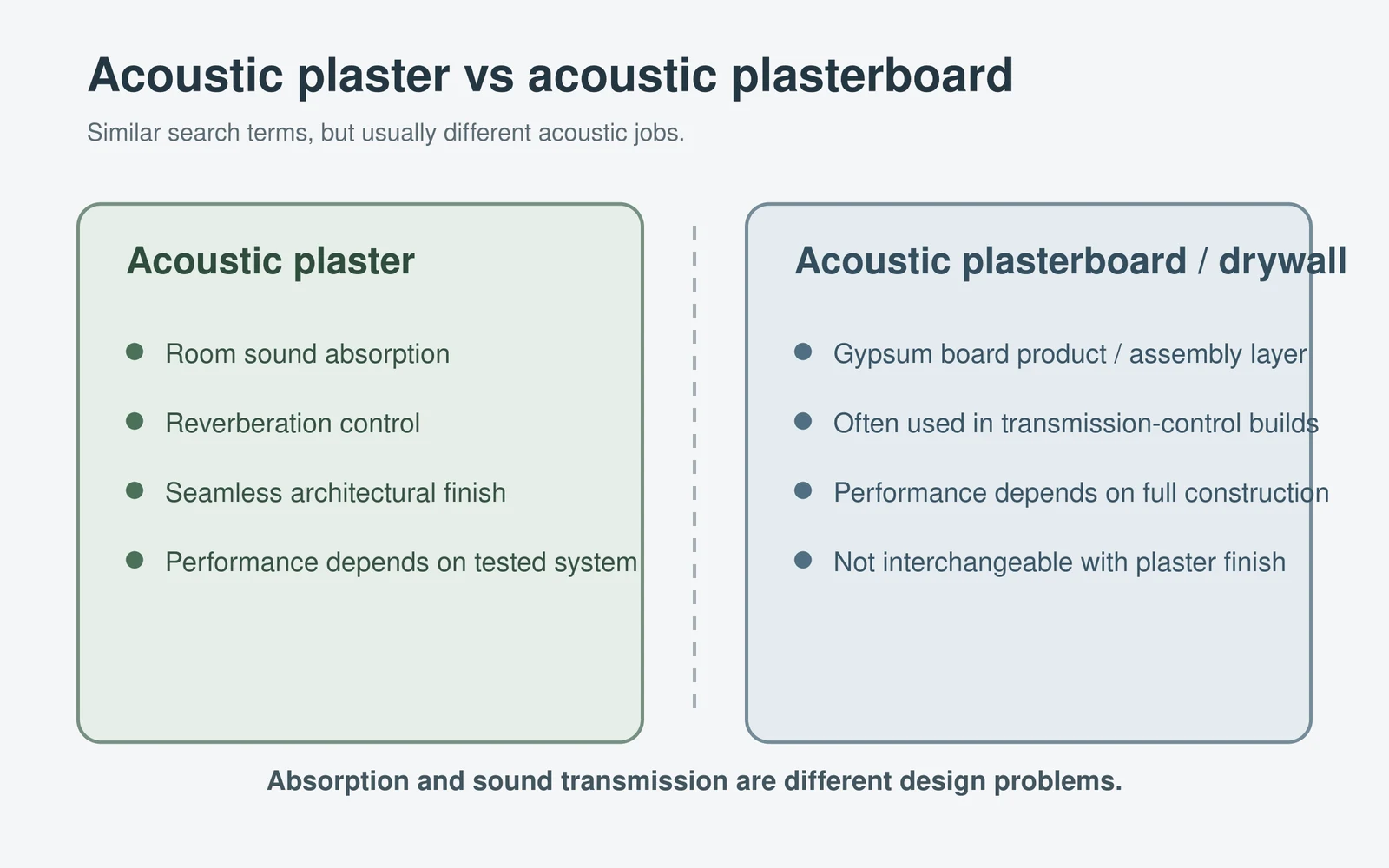
These terms are easy to confuse, especially because search results sometimes mix them together. Acoustic plaster and acoustic plasterboard are not the same product class.
Acoustic plaster is generally used to add sound absorption to a room and reduce reflected sound or reverberation while preserving a seamless finish. Acoustic plasterboard is a gypsum board product used within wall, lining, or ceiling assemblies. Products such as British Gypsum SoundBloc are marketed specifically as plasterboard for reducing noise transmission when used as part of an appropriate system.
There can also be hybrid or adjacent products. Armstrong, for example, publishes an acoustic drywall alternative that reports both NRC for sound absorption and CAC for sound blocking. That illustrates why acoustic specifications need the right metric for the right problem.
If the problem is an echoing room, absorption may be the priority. If the problem is a neighbour, television, machinery, or conversation being heard through a partition, the solution usually needs to address transmission through the full construction. A product having the word “acoustic” in its name does not by itself tell you which problem it solves.
How Much Sound Can Acoustic Plaster Absorb?
There is no single NRC rating for acoustic plaster. NRC, or Noise Reduction Coefficient, is a single-number measure used to summarize sound absorption over a defined frequency range. The relevant number is the rating for the tested system configuration, not a generic value for the material category.
Published manufacturer data shows why this distinction matters. Armourcoat reports NRC values of 0.80–0.85 for its 28 mm system and 0.90–1.00 for its 48 mm system, depending on finish. CertainTeed lists an NRC range of 0.80–0.90 for specified FADE coreboard configurations. BASWA publishes different results according to panel thickness, finish, and mounting condition, with some of its tested configurations reaching NRC 1.00.
Those figures are useful examples, not a universal performance range. A thinner assembly, different finish, different mounting method, or completely different acoustic-plaster technology may test differently.
When comparing products, ask for test data that matches the exact system being proposed. Look at the system thickness and mounting condition alongside the headline NRC figure rather than choosing from the rating alone.
Where Acoustic Plaster Is Used
Acoustic plaster is most attractive where a room needs sound absorption but the design calls for a visually continuous ceiling or wall. Manufacturer project portfolios show it being used in homes, restaurants, offices, museums, educational buildings, auditoriums, civic spaces, retail interiors, historic renovations, and other rooms dominated by reflective finishes.
Ceilings are a common location because they provide a large treatment area without competing with furniture or wall decoration. Some systems can also be used on walls, although manufacturers may restrict them to upper or non-contact areas where accidental impact is less likely.
Curved and shaped surfaces are another reason designers consider acoustic plaster. BASWA, Armourcoat, and Sto all describe systems that can follow curved, vaulted, or otherwise shaped surfaces. Minimum radii and installation requirements remain product-specific, so complex geometry should be coordinated before work begins.
Installation and Substrate Considerations
Acoustic plaster is generally more specialized than ordinary decorating plaster. A typical system may require substrate preparation, installation of an absorptive panel or coreboard, treatment of joints and penetrations, one or more acoustic base layers, and a carefully applied finish coat.
Manufacturers list substrates such as gypsum board, concrete, timber, existing plaster, and other prepared surfaces for particular systems, but that does not mean every product is approved for every substrate. Attachment methods also vary. Some systems are adhered directly; some use washers or other proprietary fixings; others can be integrated with suspended framing.
Specialist workmanship matters because poor application can affect both appearance and acoustic performance. Armourcoat describes trained application partners for its system, while CertainTeed states that FADE installation is by approved installers. BASWA similarly describes trained plasterers or specialty applicators.
Before buying material, confirm the substrate, total build-up depth, service penetrations, lighting details, edges, movement joints, expected site conditions, and who is qualified to install the selected system.
Benefits of Acoustic Plaster
The main advantage is the combination of sound absorption and a discreet architectural finish. Instead of adding visible acoustic panels after the room is designed, the treatment can become part of the ceiling or wall surface itself.
That can be especially useful in interiors where exposed absorbers would conflict with the design. Depending on the product, acoustic plaster can accommodate curves, vaulted forms, lighting details, mechanical services, and a range of textures or colours.
Another benefit is treatment area. A large ceiling can provide substantial absorptive surface without using floor space or filling the walls with separate products. This can make the approach valuable in spaces with glass, stone, concrete, or other reflective finishes.
Some manufacturers also describe repair, recolouring, or local refinishing procedures for their systems. These capabilities are not universal, so future maintenance should follow the instructions for the installed product rather than ordinary plaster or paint practices.
Limitations and Trade-Offs
Acoustic plaster is not automatically the best acoustic treatment for every room. It normally requires specialist materials and installation, and the finished system may cost more than simpler exposed panels or commodity ceiling treatments.
It also solves a specific class of acoustic problem. A highly absorptive ceiling can reduce room reverberation without fixing a weak partition that allows sound to pass from the next room. Where both absorption and isolation are required, the construction may need separate design measures for each.
Performance is configuration-dependent. An impressive NRC figure from one tested thickness should not be applied to a thinner or differently mounted assembly. Likewise, claims about fire performance, mould resistance, recycled content, emissions, humidity resistance, or durability should be tied to the particular product for which they were tested.
Finally, a seamless finish can make installation defects highly visible. Large uninterrupted surfaces, difficult lighting conditions, curves, penetrations, and transitions can all increase the level of workmanship required.
What Does Acoustic Plaster Cost?
There is no reliable universal price that can be applied to every acoustic plaster project. Published systems differ too much in construction, thickness, finish, installation method, and regional labour requirements for a single per-square-foot figure to be useful across the market.
The main cost drivers include the selected system, required acoustic performance, total treatment area, substrate condition, preparation work, ceiling height, access, curves or complex geometry, edge details, lighting and service penetrations, finish specification, and the availability of trained installers.
A straightforward flat ceiling over a suitable substrate is a different project from a high vaulted ceiling with extensive lighting details and damaged existing finishes. The sensible comparison is therefore a project-specific installed quotation based on the same acoustic and aesthetic brief.
When comparing quotes, confirm that each proposal includes the complete tested system rather than only the visible plaster finish.
How to Choose an Acoustic Plaster System
Start with the problem rather than the brand. If the room suffers from long reverberation, poor speech clarity, or excessive reflected sound, establish the acoustic target first. For larger or more demanding rooms, this may require an acoustician to calculate the treatment area and performance needed.
Then compare systems on like-for-like technical factors:
- Tested acoustic performance: check NRC or other absorption data for the exact thickness, finish, and mounting arrangement.
- Total build-up: thicker systems may provide different acoustic performance but also affect ceiling levels and details.
- Substrate compatibility: confirm whether the product can be bonded, fixed, or suspended on the existing construction.
- Surface geometry: verify minimum radii and details if the design includes curves, vaults, soffits, or complex forms.
- Installation network: check whether the manufacturer requires trained or approved installers.
- Finish options: compare texture, colour, joint appearance, and compatibility with lighting or service penetrations.
- Technical approvals: assess fire, emissions, moisture, sustainability, and other project requirements using product-specific documentation.
- Maintenance: understand how the finished surface can be cleaned, repaired, or recoloured without compromising absorption.
These checks make it easier to compare products on the complete installed system rather than relying on a single headline performance figure.
Acoustic Plaster Brand Comparisons
Once you understand the generic system requirements, brand comparisons become more useful. The right comparison is not simply which brand has the highest published NRC. Thickness, mounting, finish, geometry, installer availability, appearance, and project requirements all influence the choice.
Soundproofing Dude already has a separate comparison focused on BASWA/BaswaPhon and Pyrok StarSilent. That child article remains intentionally separate from this generic guide so brand-versus-brand questions do not take over the broader acoustic-plaster topic.
For that narrower decision, see the BaswaPhon vs Pyrok StarSilent acoustic plaster comparison.
Frequently Asked Questions
Does acoustic plaster soundproof a room?
Not by itself in the usual sense of soundproofing between rooms. Acoustic plaster is primarily used to absorb reflected sound and control reverberation inside a space. Reducing sound transmission through a wall, ceiling, or floor normally requires the complete separating construction to be designed for that purpose.
Is acoustic plaster the same as acoustic plasterboard?
No. Acoustic plaster is a seamless acoustic finish or system used mainly for absorption and reverberation control. Acoustic plasterboard is a gypsum board product used within wall or ceiling constructions and may be specified as part of a system intended to reduce noise transmission.
What NRC does acoustic plaster have?
There is no universal NRC for acoustic plaster. Published values vary with the product, thickness, finish, mounting method, and complete tested assembly. Compare technical data for the exact configuration being proposed.
Can acoustic plaster go over drywall or concrete?
Some systems are specifically designed for installation over substrates such as gypsum board or concrete, while others use proprietary panels, boards, adhesives, fixings, or suspended framing. Follow the requirements of the selected manufacturer rather than assuming every system can be applied directly.
Can acoustic plaster be used on curved ceilings?
Yes, some systems are designed to follow curved, vaulted, or shaped surfaces. Minimum radius and construction details vary, so confirm that the proposed geometry is within the selected system’s limits.
Can acoustic plaster be used on walls?
Some systems support wall applications as well as ceilings, but manufacturers may specify height or contact restrictions. Confirm the intended wall location and impact risk before choosing the product.