
Table of Contents
Introduction
Automotive sound deadening materials can differ in thickness, coverage, and how they are positioned for use inside a vehicle. This comparison focuses on two specific options: the Dynamat 10612 18 x 32 Self Adhesive Sound Deadener Superlite Tri Pack Set of 3 Made in USA and the SGM Black 80 mil Butyl Automotive Sound Deadening Mat for Noise Insulation and Vibration Dampening. The goal is to outline their documented characteristics side by side so readers can understand how they vary in format, construction, and stated use cases without replacing the more detailed individual product reviews.
How This Comparison Was Built
The information in this article is drawn only from the source content for each product. For Dynamat 10612 18 x 32 Self Adhesive Sound Deadener Superlite Tri Pack Set of 3 Made in USA, the reference is the dedicated review and specification breakdown available at this Dynamat Superlite tri pack overview. For SGM Black 80 mil Butyl Automotive Sound Deadening Mat for Noise Insulation and Vibration Dampening, the source is the corresponding product-focused article at this SGM Black 80 mil mat overview. No external testing or user reviews beyond what is summarized in those materials are added here.
Where the source material provides specific measurements, operating conditions, or installation notes, those are included in this comparison. Where information is not provided for one product, that gap is left as-is rather than filled with assumptions. For full feature lists, installation details, and contextual discussion, readers are directed to the original product reviews rather than this comparison.
Key Decision Factors Identified From the Source Content
Based on the two source documents, several decision factors stand out for someone choosing between these products:
- Material structure and thickness – One product is described as a thinner, lightweight sound deadener, while the other is described as an 80 mil butyl mat with a foil layer and a thicker profile.
- Coverage per package – The Dynamat Superlite option is supplied as a three-sheet tri pack, while the SGM Black mat is supplied as multiple smaller sheets covering a larger total area.
- Stated focus on thermal behavior – The SGM Black mat’s documentation emphasizes both noise and thermal aspects, including a specific temperature range, while the Dynamat Superlite tri pack is framed primarily around vibration damping and noise reduction.
- Installation and handling notes – Both are described as self-adhesive materials, but the SGM Black mat source document calls out a grid pattern for cutting and mentions that warming the material may help with adhesion in some situations.
- Intended application areas – Each product is associated with slightly different emphasis on where in the vehicle it is used, including doors, floors, trunks, firewalls, and other panels, with some additional non-automotive uses mentioned for the SGM Black mat.
The sections below summarize how each product is described in its respective source and then compare those descriptions directly.
Dynamat 10612 18 x 32 Self Adhesive Sound Deadener Superlite Tri Pack Set of 3 Made in USA Overview
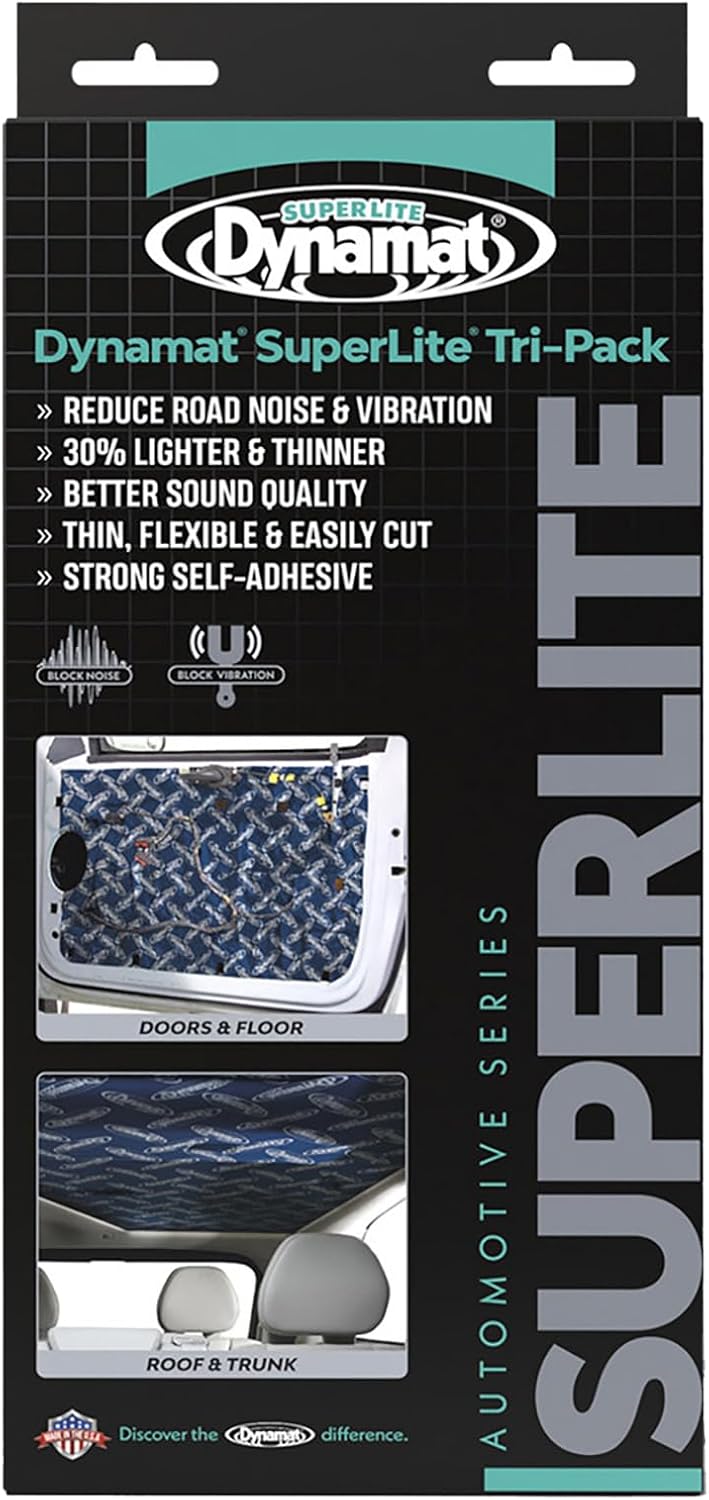
According to its source material, the Dynamat 10612 18 x 32 Self Adhesive Sound Deadener Superlite Tri Pack Set of 3 Made in USA is presented as a lightweight, self-adhesive sound deadening material intended for use on metal panels inside vehicles. More context about its positioning is available in the full review at this Dynamat 10612 Superlite tri pack article. It is supplied as a tri pack of three pre-cut sheets, with total coverage described as suitable for targeted areas rather than full-vehicle treatment. The product combines an aluminum constraining layer with a butyl-based adhesive, and its relatively thin profile is highlighted as helping it fit behind interior trim panels without interfering with reassembly.
The source describes the material as being pressed into place over clean metal surfaces to help reduce vibration and associated noise. It focuses on doors, floors, roofs, trunks, and quarter panels where vehicle sheet metal can resonate. The documentation does not present it as a dedicated thermal insulation product and does not quote specific decibel reduction figures, instead framing its role around vibration damping. Readers who want the full breakdown of dimensions, installation steps, and use cases are directed to the original review, and those who want to explore the product details on a marketplace can refer to the official listing for this Dynamat Superlite tri pack via this external product page.
For shoppers comparing options, the source material emphasizes that this Dynamat tri pack is relatively compact in coverage and oriented toward selective panel treatment. If you are focusing on understanding how its size, thickness, and construction are described by the source, it can be helpful to review both the dedicated article and the product listing at the same external retailer link for any additional official specification details. The comparison in this article does not replace the full review and is intended only as a structural overview of how it is positioned compared with the SGM alternative.
Because the information here is limited to the source content, readers who require more exhaustive specification tables, photos, or manufacturer notes for the Dynamat 10612 tri pack should consult the primary review and any documentation available via that product’s official listing, using this comparison as a high-level framing tool rather than a complete reference.
SGM Black 80 mil Butyl Automotive Sound Deadening Mat for Noise Insulation and Vibration Dampening Overview
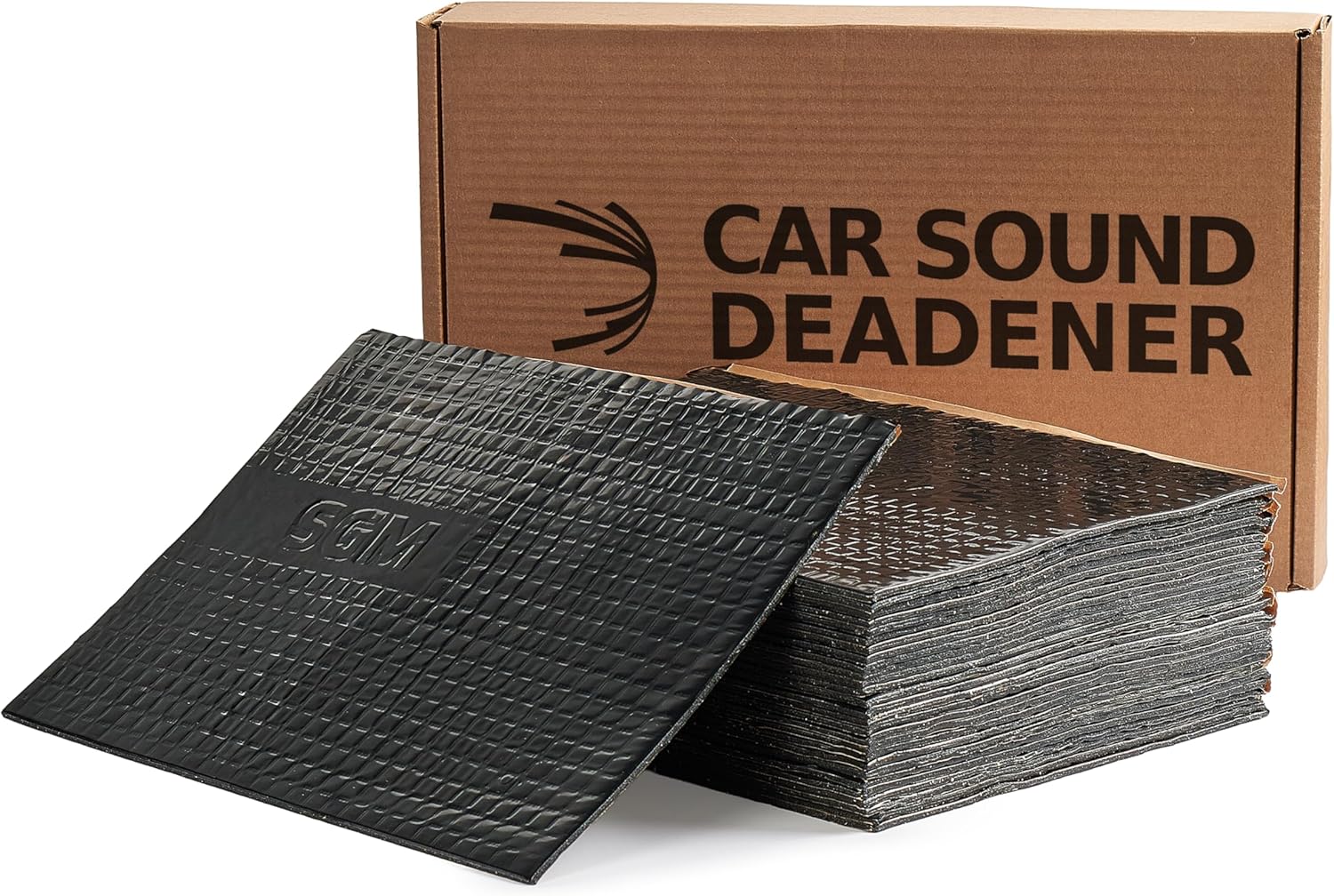
The SGM Black 80 mil Butyl Automotive Sound Deadening Mat for Noise Insulation and Vibration Dampening is described in its source as a thicker, 80 mil (approximately 2 mm) butyl mat combined with an aluminum foil layer. The documentation presents it as addressing both noise and vibration inside vehicles, while also highlighting the foil as a heat shield or radiant barrier. The product is supplied as a set of multiple sheets that together cover a larger total area than the Dynamat tri pack, and the material is stated to adhere to both metal and plastic surfaces.
The source further notes that the SGM Black mat is intended for use in areas such as floors, doors, firewalls, roofs, wheel wells, trunks, trunk lids, and hoods. It also mentions non-automotive applications like reinforcing metal cabinets or speaker enclosures. A specific operating temperature range is provided, spanning from sub-zero conditions up to elevated cabin temperatures, and the material is framed as remaining flexible rather than becoming brittle within that range. As with the Dynamat product, the documentation for this SGM mat does not provide precise decibel reduction figures.
For readers who want to see the full feature list, cutting guides, and additional usage notes, the primary product write-up offers more detail, and the external marketplace page for the SGM Black 80 mil butyl mat at this product listing can be used to review manufacturer-provided specifications. The grid pattern on the surface, the multi-sheet packaging format, and comments about warming the material to assist adhesion on complex surfaces are all described in that source material rather than developed here in depth.
Because the focus of this article is on comparison rather than repetition, anyone interested specifically in installation techniques or extended use cases of the SGM Black 80 mil mat should review the dedicated article and related documentation. For quick reference to official details, the linked listing at the same external retailer and the in-depth overview together provide a more complete picture than this high-level comparison alone.
Head-to-Head Comparison: What the Evidence Shows
When the two source documents are viewed together, several structural differences between these products become clear. The Dynamat 10612 Superlite tri pack is characterized as a thinner, lightweight aluminum-and-butyl sound deadener supplied in three relatively large sheets, with total coverage that the source describes as appropriate for targeted locations. In contrast, the SGM Black 80 mil mat is described as significantly thicker, with an 80 mil butyl layer and foil facing, and shipped as many smaller sheets covering a larger total area.
The SGM documentation includes explicit mention of both acoustic and thermal roles, citing the foil layer as a radiant barrier and providing a numeric operating temperature range. The Dynamat source, on the other hand, keeps its focus on vibration damping and noise reduction from metal panels and explicitly notes that it is not positioned as standalone thermal insulation. Both products are described as self-adhesive, but only the SGM mat source mentions that warming the material may improve adhesion around complex contours and highlights a printed grid for cutting.
In terms of application areas, both products are associated with doors, floors, and trunk regions, but the SGM source also highlights firewalls, wheel wells, trunk lids, and hoods, as well as certain non-automotive surfaces. The Dynamat tri pack description emphasizes its compact coverage and suitability for selective panel treatment. Neither source provides laboratory decibel ratings, so this comparison remains limited to structural and specification-related differences rather than measured performance.
At-a-Glance Comparison Table
| Aspect | Dynamat 10612 Superlite Tri Pack | SGM Black 80 mil Butyl Mat |
|---|---|---|
| Basic form | Tri pack of self-adhesive sound deadening sheets for automotive metal panels | Set of multiple self-adhesive butyl sheets with foil layer |
| Described thickness | Thin, lightweight profile highlighted for use behind interior trim | 80 mil butyl layer described as significantly thicker with foil facing |
| Total coverage per package | Described as covering a modest area suited to targeted applications | Described as covering a larger total area suitable for broader coverage |
| Material structure | Aluminum constraining layer bonded to butyl-based adhesive | Pliable butyl mastic base with aluminum foil layer |
| Thermal emphasis | Not positioned as standalone thermal insulation; thermal role not emphasized | Foil described as heat shield or radiant barrier with combined noise and thermal focus |
| Temperature information | Qualitative reference to typical interior temperature conditions | Numeric operating temperature range stated in the source |
| Stated application areas | Doors, floors, roofs, trunks, and quarter panels in vehicles | Floors, doors, firewalls, roofs, wheel wells, trunks, trunk lids, hoods, plus some non-automotive uses |
| Installation notes | Self-adhesive, pressed into place on clean metal panels | Self-adhesive with grid pattern; source mentions warming can help adhesion in some cases |
| Documented acoustic metrics | No lab decibel ratings provided in the source | No lab decibel ratings provided in the source |
Which One May Be the Better Fit for Different Situations
Because the available information is limited to what each product’s source document provides, this section focuses on how the documented characteristics may align with different kinds of projects rather than offering recommendations. Any decision should be cross-checked against the full reviews and official product documentation.
Based on the way it is described, the Dynamat 10612 Superlite tri pack may be more suitable when a thinner, lighter material and a compact amount of coverage are priorities. Its source highlights use behind interior panels on specific metal surfaces, where maintaining clearances and avoiding bulk are important considerations. In such scenarios, it can be useful to review both the dedicated Dynamat article and the specifications shown on the product’s external listing to confirm sheet size, coverage, and other details relevant to targeted panel treatment.
The SGM Black 80 mil butyl mat, as described in its documentation, may be a better match when a thicker butyl layer, an integral foil surface, and a larger total coverage area are important. Its stated temperature range and mention of a thermal role suggest that it may be selected in situations where both noise and heat from areas such as firewalls, floors, or roofs are being addressed. For those kinds of projects, reviewing the full write-up and cross-referencing with the SGM Black 80 mil product page can help confirm compatibility with the surfaces and temperature conditions involved.
In practice, many projects involve trade-offs: the thinner material may be easier to fit behind tight trim in limited areas, while the thicker, foil-faced option may be configured to cover more surfaces within the same vehicle. This comparison is intended to highlight such differences so readers can identify which documented characteristics align most closely with their situation before diving into the full reviews or exploring marketplace listings like the Dynamat Superlite tri pack page and the SGM Black 80 mil listing.
Frequently Asked Questions
Do these products list specific decibel reduction numbers?
No. According to the source documents, neither the Dynamat 10612 Superlite tri pack nor the SGM Black 80 mil butyl mat includes laboratory-certified decibel reduction figures. Both are described in terms of structure, thickness, and intended applications rather than measured sound level changes.
Which option covers more area per package according to the sources?
The Dynamat 10612 tri pack description emphasizes targeted coverage with three sheets forming a relatively modest total area. The SGM Black 80 mil mat source, by contrast, states that its multiple-sheet package covers a larger total area and is often referenced in the context of treating floors, doors, and trunk spaces more broadly. For exact coverage numbers and layout diagrams, readers should consult the individual reviews and can also verify details via the Dynamat listing and the SGM Black listing.
Do the sources say anything about using heat during installation?
The Dynamat 10612 Superlite tri pack is simply described as a self-adhesive product that is pressed onto clean metal panels, with no explicit mention of heating in the provided material. The SGM Black 80 mil mat’s source, on the other hand, reports that some users warm the material before application and notes that warming can help with adhesion around complex curves and surfaces. These statements come directly from the respective product write-ups.
Are there differences in how thermal behavior is presented?
Yes. The Dynamat source stresses its role as a sound deadener and notes that it is not positioned as a standalone thermal insulation product. The SGM Black mat’s documentation emphasizes a dual role, highlighting its foil layer as a heat shield or radiant barrier and providing a specific operating temperature range. Anyone for whom thermal considerations are critical should cross-reference these descriptions with the manufacturer information available through the detailed reviews and external product pages such as the SGM 80 mil listing.
Closing Guidance
This comparison has focused on information that is explicitly documented in the source material for the Dynamat 10612 18 x 32 Self Adhesive Sound Deadener Superlite Tri Pack Set of 3 Made in USA and the SGM Black 80 mil Butyl Automotive Sound Deadening Mat for Noise Insulation and Vibration Dampening. The main differences highlighted here involve thickness and structure, coverage per package, how thermal aspects are described, and the range of applications noted in each product’s write-up.
Because it is not intended to replace the original reviews, readers should treat this article as a starting point for understanding structural differences rather than a final decision tool. For more detail on installation steps, material composition, example projects, and any updates to specifications, it is recommended to read the full individual reviews and, where appropriate, to explore official product information via external listings such as the Dynamat Superlite tri pack page and the SGM Black 80 mil butyl mat page. Using this comparison alongside those deeper resources can help ensure that any decision is based on the documented characteristics most relevant to a given vehicle or project.