
If you’re looking for the best acoustic ceiling tiles, the first thing to decide is what you actually want the ceiling to do.
Some ceiling tiles are excellent at absorbing sound and reducing echo inside a room. Others combine absorption with better sound attenuation through a suspended ceiling system. Decorative tiles may prioritize appearance, moisture resistance, or easy maintenance instead.
That distinction matters because products marketed as soundproof ceiling tiles are not all designed to stop sound traveling through a ceiling.
For home theaters, basements, offices, studios, classrooms, gaming rooms and other finished spaces, acoustic ceiling tiles can make a noticeable difference to reverberation and speech clarity. But if your real problem is footsteps, voices, television noise or bass traveling between floors, the ceiling tile may need to be only one part of a larger sound-isolation assembly.
This guide compares the most useful types of acoustic ceiling tiles, sound absorbing ceiling tiles and acoustic drop ceiling tiles, including options from Armstrong, Soundsulate, Ceilume and USG.
Best Acoustic Ceiling Tiles: Quick Picks
| Best for | Recommended option | Main strength | Main limitation |
|---|---|---|---|
| Best overall suspended ceiling | Armstrong acoustic ceiling tiles | Large range of acoustic performance and grid options | Performance varies significantly by product line |
| Home theater or studio | Soundsulate acoustical drop ceiling tiles | Strong focus on sound absorption | Primarily controls reflections rather than structural transmission |
| Decorative or moisture-conscious room | Ceilume ceiling tiles | Lightweight, decorative and moisture-resistant options | Standard decorative tiles are not automatically high-performance acoustic absorbers |
| Traditional suspended ceiling | USG Fifth Avenue acoustic panels | Conventional appearance with documented acoustic performance | Moderate rather than very high absorption |
| Low ceiling | Approved direct-mount acoustic tiles | Preserves headroom | May reduce access to utilities above |
| Echo reduction on a budget | Ceiling-approved acoustic foam or PET panels | Lightweight absorption | Does not provide serious floor-to-floor isolation |
| Basement ceiling | Mineral fiber, fiberglass or moisture-appropriate suspended tile | Acoustics plus removable utility access | Suspended grid reduces ceiling height |
Our Top Picks
1. Armstrong Acoustic Ceiling Tiles – Best Overall
Armstrong acoustic ceiling tiles are my strongest all-around choice because Armstrong offers a particularly broad range of ceiling products designed around different acoustic requirements.
That matters because there isn’t one universal NRC or sound-blocking specification that works for every room.
Armstrong offers conventional acoustic ceiling tiles as well as higher-absorption products intended for spaces where shorter reverberation time and better speech intelligibility are priorities.
Some Armstrong systems also combine sound absorption and sound attenuation, which makes the brand useful when you’re designing an entire ceiling system rather than simply buying a decorative tile.
Best for
- Offices
- Basements
- Classrooms
- Home theaters
- Studios
- Suspended ceiling replacements
- Rooms where acoustic performance needs to be matched carefully to the application
Advantages
- Large selection of acoustic ceiling products
- Options for standard and high sound absorption
- Common suspended-grid formats
- Good availability
- Replaceable tiles
- Suitable options for both residential and commercial environments
Things to check
- Exact NRC rating
- CAC rating where sound attenuation matters
- Tile dimensions
- Edge profile
- Grid compatibility
- Humidity resistance
- Fire classification
Don’t buy Armstrong based only on the brand name. Check the specifications of the exact tile because acoustic performance varies considerably across the range.
Check Armstrong acoustic ceiling tiles on Amazon
2. Soundsulate Acoustical Drop Ceiling Tiles – Best for Sound Absorption
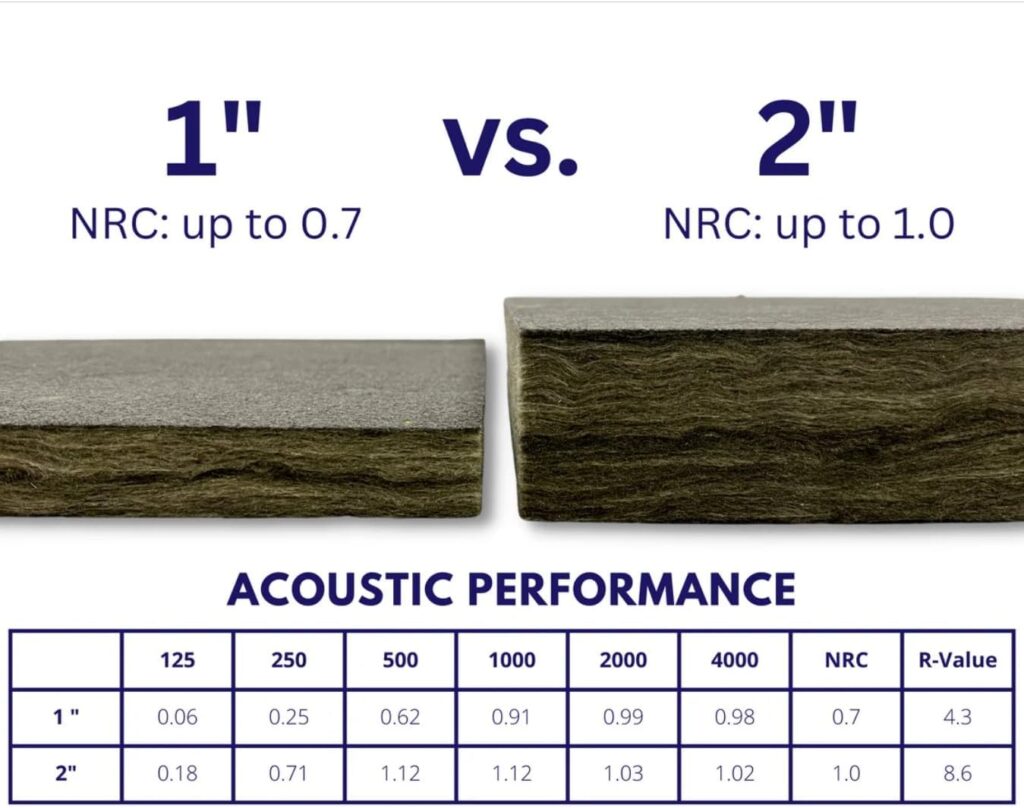
Soundsulate acoustical drop ceiling tiles are particularly interesting when reducing echo and reverberation is the main objective.
Soundsulate currently positions its fiberglass ceiling tiles specifically as sound-absorbing products for suspended ceilings.
That makes them a natural option for:
- Home theaters
- Recording rooms
- Gaming rooms
- Voice-over spaces
- Offices
- Conference rooms
- Rooms with excessive echo
Fiberglass absorbers can provide strong room-acoustic performance without needing large amounts of mass.
But that same point explains their limitation:
Soundsulate acoustic ceiling tiles are absorbers, not a replacement for a complete soundproof ceiling assembly.
Best for
- Rooms where echo is the main problem
- Home studios
- Theaters
- Gaming spaces
- Suspended-grid ceilings
Advantages
- Designed specifically for sound absorption
- Available for suspended ceiling systems
- Useful for reducing reflections and reverberation
- Appropriate for rooms where speech or music clarity matters
Main limitation
They should not be expected to stop substantial voices, bass or impact noise traveling between floors by themselves.
Check Soundsulate acoustic ceiling tiles on Amazon
3. Ceilume Ceiling Tiles – Best Decorative and Moisture-Conscious Option
Ceilume ceiling tiles take a different approach.
Many of Ceilume’s tiles are extremely lightweight thermoformed vinyl products rather than conventional porous mineral-fiber absorbers.
The popular Stratford design, for example, is available in standard suspended-grid formats and is designed to be lightweight, easy to maintain and resistant to moisture-related problems that can affect some conventional fiber tiles.
Ceilume also offers dedicated acoustic configurations that combine perforated ceiling tiles with absorptive backing material. Its current Stratford NRC.85+ system is specifically designed as an acoustic ceiling system rather than relying on the decorative vinyl tile by itself.
This distinction is important.
A standard decorative Ceilume tile should not automatically be treated as equivalent to a high-NRC fiberglass or mineral-fiber acoustic panel.
Best for
- Finished basements
- Recreation rooms
- Home offices
- Decorative suspended ceilings
- Spaces where easy cleaning matters
- Rooms where moisture resistance is a priority
Advantages
- Very lightweight
- Wide choice of decorative styles
- Easy to maintain
- Moisture-resistant material
- Dedicated acoustic systems are available
Things to check
- Whether you’re buying a standard decorative tile or an acoustic system
- Grid dimensions
- Required acoustic backing
- Ceiling-temperature limits
- Fire and installation documentation
Check Ceilume ceiling tiles on Amazon
4. USG Fifth Avenue Acoustic Panels – Best Traditional Option
USG Fifth Avenue acoustic ceiling panels are a good option for someone who wants the familiar appearance and practicality of a conventional suspended acoustic ceiling.
USG currently lists Fifth Avenue panels with an NRC of 0.55 and CAC options in the low-to-mid 30s depending on configuration.
That means they provide useful absorption while also offering measurable ceiling attenuation characteristics.
They are not the highest-absorption products available, but they represent a practical middle ground for general-purpose rooms.
Best for
- Offices
- Finished basements
- Multipurpose rooms
- Rental or commercial-style suspended ceilings
- Buyers wanting conventional replaceable tiles
Advantages
- Established ceiling manufacturer
- Published NRC and CAC specifications
- Traditional appearance
- Common 2 × 2 and related ceiling formats
- Replaceable panels
Main limitation
An NRC around 0.55 is useful, but buyers specifically trying to maximize absorption may prefer a high-NRC product.
Check USG acoustic ceiling tiles on Amazon
Acoustic Ceiling Tiles vs Soundproof Ceiling Tiles
This is the most important distinction in the entire guide.
The phrases acoustic ceiling tiles and soundproof ceiling tiles are often used interchangeably online, but they can describe different acoustic goals.
Acoustic absorption
An absorptive ceiling tile reduces sound reflections inside the room.
That can make a space:
- Less echoey
- Less harsh
- Easier to understand speech in
- Better for recording
- More comfortable for music and movies
Sound isolation
Sound isolation is about reducing sound passing through the ceiling assembly. For the broader assembly-level methods used to reduce transmission through the structure, see our floor and ceiling soundproofing guide.
That can require:
- Mass
- Insulation
- Decoupling
- Airtight sealing
- Multiple drywall layers
- Isolation clips or resilient channels
- Treatment of penetrations and flanking paths
A high-NRC tile can be excellent at absorbing sound inside the room and still be relatively poor at blocking noise traveling to another room.
Armstrong itself distinguishes these jobs: NRC relates to sound absorption, while CAC is used to describe attenuation through a ceiling/plenum system.
For a deeper explanation, see our guide to NRC, STC and CAC acoustic ratings.
What Is NRC?
NRC stands for Noise Reduction Coefficient.
It is commonly used to describe how much sound an absorptive surface absorbs across a specified range of frequencies.
In practical terms:
- A higher NRC generally means greater sound absorption.
- A lower NRC means more sound energy is reflected back into the room.
Armstrong currently classifies high-NRC ceiling tiles as products with an NRC of approximately 0.70 or greater.
If you’re treating a theater, studio or highly reverberant room, NRC is one of the specifications worth comparing.
But NRC does not tell you how well the complete ceiling blocks upstairs noise.
What Is CAC?
CAC stands for Ceiling Attenuation Class.
It is particularly relevant to suspended ceiling systems where sound could travel through the tile, into the plenum above, and then into another space.
Armstrong notes that ceilings with CAC ratings around 35 or above are used where better sound attenuation and speech privacy are required.
So when comparing acoustic drop ceiling tiles:
- NRC helps you understand absorption inside the room.
- CAC helps you understand attenuation through a ceiling system.
Neither number should be interpreted in isolation from the rest of the building assembly.
Best Acoustic Drop Ceiling Tiles
If you already have a suspended grid, a drop-in acoustic tile is usually the simplest upgrade.
The main advantages are:
- Easy replacement
- Access to wiring and plumbing
- Large choice of acoustic specifications
- No need to permanently cover service equipment
- Simple integration with lighting and HVAC
Good candidates include:
- Armstrong mineral-fiber or fiberglass acoustic tiles
- Soundsulate fiberglass drop ceiling tiles
- USG acoustic panels
- Ceilume acoustic systems where a decorative appearance is preferred
Before buying, verify:
- 2 × 2 vs 2 × 4 format
- Grid width
- Edge profile
- Tile thickness
- NRC
- CAC where relevant
- Humidity rating
- Fire classification
Best Sound Absorbing Ceiling Tiles for Home Theaters
A home theater normally benefits more from good sound absorption than from simply choosing the heaviest ceiling tile.
The goal is often to reduce:
- Early reflections
- Flutter echo
- Excessive reverberation
- Harshness
- Poor dialogue clarity
For this use, high-NRC mineral fiber, fiberglass or other purpose-designed absorptive ceiling products are strong candidates.
Soundsulate’s fiberglass tiles are particularly relevant here, while Armstrong’s high-NRC ranges provide additional design and performance choices.
But if you are trying to stop movie bass reaching the bedroom upstairs, absorptive tiles alone are unlikely to be enough.
That is a structural isolation problem.
Best Acoustic Ceiling Tiles for Recording Studios
Studios present similar requirements to theaters but often demand even better control of reflections.
Ceiling absorption can help control:
- Vertical room reflections
- Flutter echo
- Speech and vocal reflections
- Reverberation
High-NRC fiberglass or mineral-fiber ceiling systems are generally more useful than decorative low-absorption tiles when room acoustics are the primary goal.
For serious studios, ceiling treatment should be considered alongside:
- Wall absorbers
- Bass trapping
- Speaker placement
- Listening position
- Structural sound isolation
Best Acoustic Ceiling Tiles for Basements
Basements remain one of the best use cases for acoustic ceiling tiles, but they deserve their own section rather than defining this entire guide.
Basement ceilings create several practical problems:
- Low headroom
- Exposed utilities
- Humidity
- Noise from upstairs
- Echo in hard-finished basement rooms
For an existing suspended basement ceiling
Armstrong, USG or another compatible acoustic drop-in tile is usually the most straightforward approach.
You maintain access to:
- Water lines
- Drain pipes
- Electrical wiring
- Network cabling
- HVAC systems
- Shutoff valves
For a basement theater
Prioritize absorption. Soundsulate or a high-NRC Armstrong-style tile can help reduce room reflections.
For a damp basement
Fix the moisture problem first.
Then consider tiles with documented humidity resistance. Ceilume’s vinyl construction can be useful in moisture-conscious designs because the tile material itself does not behave like conventional porous fiberboard.
For noise from upstairs
Do not expect swapping ceiling tiles alone to eliminate footsteps or voices.
You may need a complete isolation strategy involving the joist cavities and ceiling structure.
Best Ceiling Tiles for Offices
Offices often need a balance between absorption and speech privacy.
A highly reflective ceiling increases reverberation and can make conversations spread further through a space.
For an individual home office, standard acoustic absorption may be enough.
For commercial offices or rooms sharing a common ceiling plenum, CAC can become much more important.
This is where Armstrong and USG’s documented ceiling-system specifications become particularly useful.
Best Ceiling Tiles for Classrooms
Good speech intelligibility is especially important in classrooms.
Too much reverberation can make a teacher harder to understand, particularly for students sitting farther away.
High-NRC ceiling products can help reduce reverberation when used as part of an appropriate room-acoustic design.
Armstrong specifically identifies classrooms and other speech-sensitive environments among the kinds of spaces where acoustic ceiling performance matters.
What About Direct-Mount Acoustic Ceiling Tiles?
A suspended ceiling is not always practical.
If headroom is limited, direct-mount acoustic tiles or panels can preserve more ceiling height.
Potential advantages include:
- Less lost headroom
- No full suspended grid
- Cleaner appearance in some rooms
- Useful option over existing ceilings
Potential disadvantages include:
- Reduced access to utilities
- More difficult replacement
- Dependence on the mounting substrate
- Possible adhesive or fastener requirements
Do not assume a wall-mounted acoustic panel can simply be glued overhead.
For ceiling installation, verify that the manufacturer specifically supports overhead use and follow its mounting instructions.
For an example of the differences between these product types, see our Art3d ceiling tile vs Quieture acoustic panel comparison.
What About PET Felt Ceiling Tiles?
PET felt products have become increasingly popular because they combine acoustic absorption with decorative design.
They may be useful in:
- Offices
- Gaming rooms
- Studios
- Creative spaces
- Home gyms
- Modern finished basements
However, many PET products sold online are actually wall panels.
For ceiling use, verify:
- Overhead-installation approval
- Mounting method
- Product weight
- Fire documentation
- Adhesive or fastener suitability
Our Art3d drop ceiling tile vs PINWELIFE wall panel comparison explains why the two product categories should not automatically be treated as interchangeable.
What About Wood-Fiber Acoustic Ceiling Tiles?
Wood-fiber ceiling products can provide a warmer architectural appearance while also offering acoustic absorption.
They can make sense in:
- Restaurants
- Creative studios
- Offices
- Finished basements
- Recreation rooms
Before buying, check:
- NRC
- Panel weight
- Mounting requirements
- Fire classification
- Humidity limitations
- Cutting instructions
If material sustainability is important, see our guide to eco-friendly soundproofing materials.
Are Acoustic Foam Ceiling Tiles Worth It?
Acoustic foam can be useful for controlling reflections, but it is one of the most misunderstood products in soundproofing.
Foam can help reduce:
- Flutter echo
- Harsh reflections
- Some reverberation
It does not provide the kind of mass required for serious sound isolation between rooms.
Foam therefore makes sense primarily where:
- Echo is the problem
- The room is already structurally isolated enough
- A lightweight absorptive treatment is wanted
For overhead use, also verify the product’s fire classification and approved mounting method.
Can Ceiling Tiles Actually Soundproof a Room?
Usually not by themselves.
This is why I’m cautious about the phrase “soundproof ceiling tiles.”
Some ceiling systems provide both absorption and measurable attenuation, but serious room-to-room isolation depends on the entire construction.
For example, a ceiling designed to reduce significant upstairs/downstairs transmission may involve:
- Insulation between joists
- Isolation clips
- Hat channel or resilient channel
- Multiple layers of drywall
- Damping compound
- Acoustic sealant
- Treatment of penetrations
- Flanking-path control
The visible acoustic tile may then be used beneath that assembly for room-acoustic control and appearance.
Can Acoustic Ceiling Tiles Reduce Footstep Noise?
Not very effectively on their own.
Footsteps create impact vibration in the floor structure.
That energy can travel through:
- Floorboards
- Joists
- Walls
- Ceiling framing
Absorptive ceiling tiles primarily deal with acoustic energy in the room below, not the original structural vibration.
Better impact-noise solutions often involve treating the floor above or structurally decoupling the ceiling below. For the ceiling-side approach, see our guide to ceiling sound-isolation clips and decoupled drywall systems; clips are one component of an assembly, not a standalone fix.
Mineral Fiber vs Fiberglass Ceiling Tiles
Both materials are widely used for acoustic ceilings.
Mineral fiber
Typical advantages:
- Familiar suspended-ceiling appearance
- Good availability
- Different NRC and CAC combinations available
- Often relatively economical
Fiberglass
Typical advantages:
- Can achieve very high absorption
- Often lightweight
- Good choice for studios and other reflection-sensitive spaces
Neither material is automatically superior. Compare the specifications of the exact product.
Ceiling Tile Thickness: Does Thicker Mean Better?
Not necessarily.
A thicker porous absorber may provide benefits in some frequency ranges, but thickness alone does not determine overall ceiling performance.
You also need to consider:
- Material composition
- Density
- Air space above the tile
- NRC
- CAC
- Grid design
- The rest of the ceiling assembly
Just as with automotive damping materials, “thicker equals better” is too simplistic.
Moisture and Basement Ceiling Tiles
Moisture is a particularly important issue in basements.
Before installing a ceiling, deal with:
- Roof or plumbing leaks
- Condensation
- High humidity
- Mold
- Groundwater intrusion
A moisture-resistant ceiling tile is not a substitute for fixing the source of moisture.
Once the environment is controlled, choose tiles with documented suitability for the expected humidity conditions.
Ceilume’s thermoformed vinyl products are unusual in this respect because the manufacturer describes the material as waterproof and resistant to mold/mildew issues, although installation conditions and temperature limits still need to be followed.
Fire Safety and Ceiling Tiles
Ceiling products form part of the interior finish of a building, so fire performance matters.
Always check:
- Manufacturer fire classification
- Local building requirements
- Approved installation method
- Required clearances around lights
- Sprinkler requirements
- Compatibility with heat-producing fixtures
This is especially important with decorative foam and felt products bought online.
How to Calculate How Many Ceiling Tiles You Need
Start by calculating the ceiling area:
Room length × room width = ceiling area
Then compare that figure with the coverage of the tile pack you’re buying.
For example:
- A 2 × 2 tile covers approximately 4 sq ft.
- A 2 × 4 tile covers approximately 8 sq ft.
Add an allowance for:
- Border cuts
- Damaged pieces
- Irregular room shapes
- Future replacements
If you already have a suspended grid, count the existing openings as well as measuring the room.
How to Choose the Best Acoustic Ceiling Tile
1. Decide whether you need absorption or isolation
If the room sounds echoey, prioritize absorption.
If noise is traveling between rooms or floors, investigate the complete structural assembly.
2. Check NRC
For rooms where echo control matters, compare the product’s verified NRC.
3. Check CAC where relevant
If sound can travel through a shared ceiling plenum, CAC may be important.
4. Match the grid
Check:
- 2 × 2 or 2 × 4 format
- Grid width
- Square or tegular edge
- Tile thickness
5. Consider moisture
Choose a product that suits the actual humidity conditions.
6. Check fire documentation
Especially for overhead decorative products.
7. Consider future access
If plumbing, electrical systems or HVAC are above the ceiling, removable drop tiles have a major practical advantage.
8. Calculate total project cost
Include:
- Tiles
- Grid components
- Hangers
- Fasteners
- Acoustic backing
- Border tiles
- Delivery
- Installation
Acoustic Ceiling Tiles FAQ
What are the best acoustic ceiling tiles?
The best tile depends on the room. Armstrong offers one of the broadest ranges for general acoustic ceiling applications. Soundsulate is particularly relevant where absorption is the priority. USG offers conventional acoustic suspended-ceiling panels, while Ceilume is attractive where decorative appearance and moisture-resistant construction matter.
What are the best soundproof ceiling tiles?
If by “soundproof” you mean reducing echo, look for high-NRC acoustic ceiling tiles. If you mean blocking sound from passing through the ceiling, compare CAC and the performance of the complete ceiling assembly rather than relying only on the tile.
Do acoustic ceiling tiles work?
Yes, when used for the job they are designed to perform. Absorptive acoustic ceiling tiles can reduce reverberation and reflected sound very effectively.
Do drop ceiling tiles block sound?
Some suspended ceiling systems provide measurable sound attenuation, but typical absorptive drop tiles should not be expected to provide complete sound isolation between rooms or floors.
What NRC should acoustic ceiling tiles have?
It depends on the application. Armstrong currently categorizes products with NRC ratings of approximately 0.70 or above as high-NRC ceiling tiles. Rooms requiring strong reflection control may benefit from higher values.
Are fiberglass ceiling tiles better than mineral fiber?
Not universally. Fiberglass can provide very high absorption, while mineral-fiber products offer a wide range of absorption, attenuation, appearance and price combinations.
Can acoustic ceiling tiles help with upstairs noise?
They may improve the acoustics of the room below, but footsteps and substantial airborne noise normally require treatment of the complete floor/ceiling assembly.
What ceiling tiles are best for a home theater?
High-absorption mineral fiber or fiberglass tiles are strong choices because reducing reflections and reverberation improves dialogue and overall room acoustics.
What ceiling tiles are best for a basement?
For an existing grid, mineral fiber, fiberglass or another compatible suspended acoustic tile is normally practical. In humidity-conscious spaces, choose a product with suitable moisture documentation after fixing any underlying moisture problems.
Can I use acoustic wall panels on the ceiling?
Only when the manufacturer approves them for overhead mounting and provides an appropriate installation method. A wall panel is not automatically a ceiling panel.
Are Ceilume tiles acoustic?
Ceilume makes both standard decorative ceiling tiles and dedicated acoustic systems. Its acoustic Stratford systems combine specially configured tiles with absorptive material. Check the exact product rather than assuming every Ceilume tile has the same acoustic performance.
Are Armstrong ceiling tiles soundproof?
Armstrong offers products with different combinations of absorption and attenuation. Some systems are designed to improve both, but even high-performing ceiling panels should be evaluated as part of the entire ceiling system rather than as standalone “soundproof” barriers.
What is the difference between NRC and CAC?
NRC describes sound absorption within the room. CAC describes how well a ceiling system attenuates sound traveling through the ceiling/plenum pathway.
For more detail, read our NRC, STC and CAC guide.
Best Acoustic Ceiling Tiles: Final Recommendation
There is no single ceiling tile that wins every category.
My recommendations are:
- Best overall: Armstrong acoustic ceiling tiles
- Best for high sound absorption: Soundsulate acoustical drop ceiling tiles
- Best decorative/moisture-conscious option: Ceilume
- Best conventional acoustic panel: USG Fifth Avenue
- Best for home theaters and studios: high-NRC fiberglass or mineral-fiber tiles
- Best for basements: a compatible suspended acoustic tile chosen for the room’s humidity, headroom and acoustic goal
The most important buying decision is not the brand. It is deciding whether your problem is echo inside the room or sound transmission through the ceiling.
If it’s echo, acoustic ceiling tiles can be an excellent solution.
If it’s voices, bass, television noise or footsteps traveling between floors, use the ceiling tile as one component of a properly designed isolation system rather than expecting the tile to do everything by itself.
View Armstrong acoustic ceiling tiles on Amazon
View Soundsulate acoustic ceiling tiles on Amazon
View Ceilume ceiling tiles on Amazon
View USG acoustic ceiling tiles on Amazon
Good luck and happy soundproofing!
Comments are closed.