
Acoustic foam is useful when the goal is to control reflections, reduce noticeable echo, and improve the acoustic character of a room. It is commonly considered for home studios, offices, gaming rooms, streaming spaces, vocal areas, and other rooms where hard surfaces create distracting reflections.
The important limitation is that acoustic foam is not the same thing as a sound-blocking construction material. Ordinary foam panels are primarily acoustic-treatment products. They should not be relied on by themselves to stop substantial sound transmission through walls, floors, ceilings, doors, or other building elements.
Choosing acoustic foam therefore starts with the problem you are trying to solve. Panel thickness, shape, dimensions, coverage, mounting method, placement, surface compatibility, and room use can all matter. This guide explains how to compare those factors without assuming that one panel style is automatically best for every room.
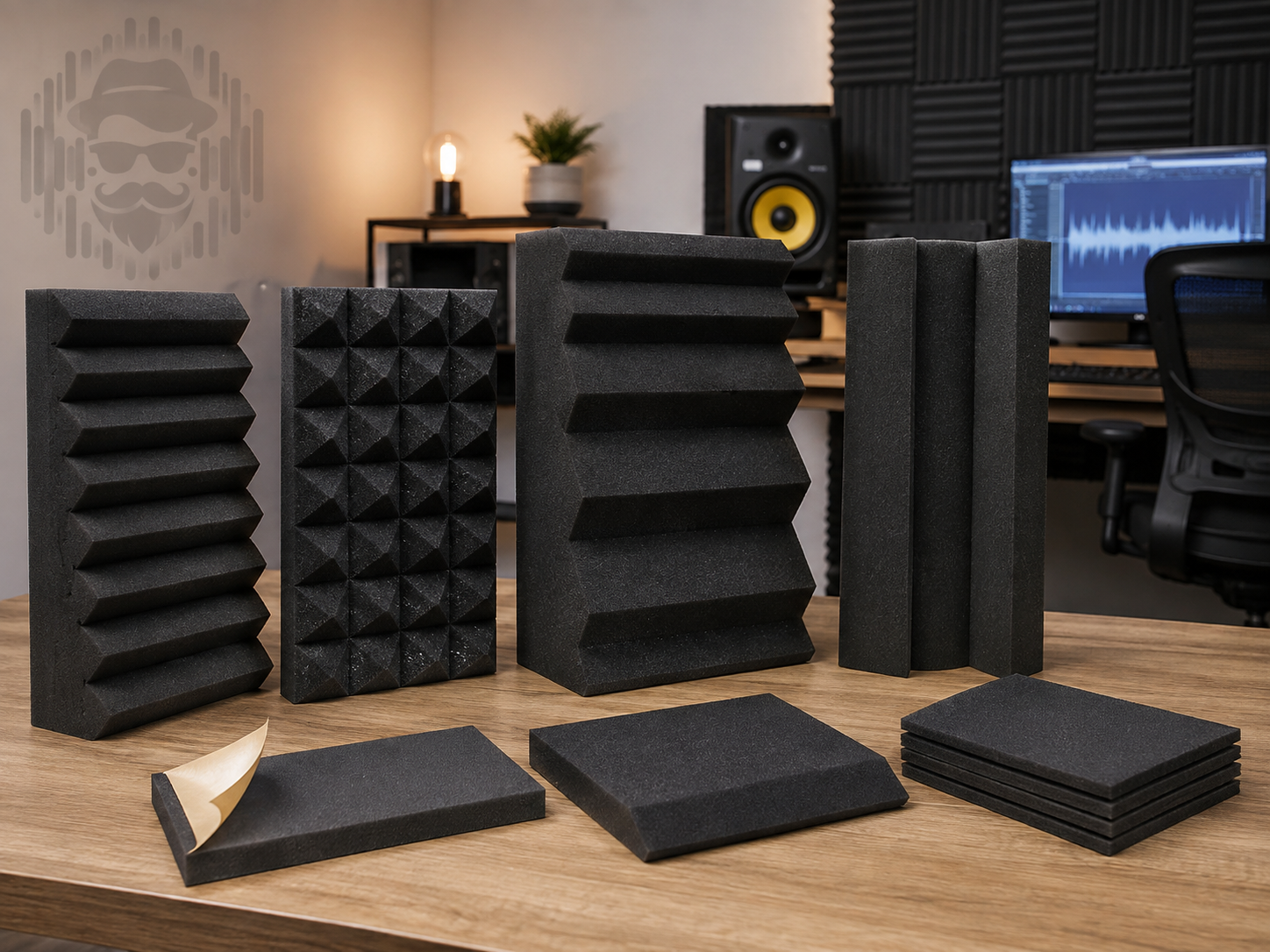
Quick Guide: Which Acoustic Foam Type Fits Your Use Case?
Different foam formats solve different practical buying problems. Before comparing individual products, decide which general format makes sense for your installation.
| Acoustic Foam Type | Best Starting Point For | Main Factors to Compare |
|---|---|---|
| 2-inch wedge foam | General-purpose wall or ceiling treatment | Thickness, panel size, coverage, mounting method |
| Pyramid foam | Buyers comparing common panel profiles | Thickness, dimensions, layout, installation |
| Thicker foam | Rooms where greater panel depth is acceptable | Depth, placement, usable space, documented performance |
| Corner foam | Corner-specific treatment | Dimensions, corner fit, quantity, mounting |
| Self-adhesive foam | Installation convenience | Adhesive design, surface compatibility, removability |
| Large-format foam | Covering larger areas with fewer pieces | Panel dimensions, handling, seams, mounting |
| 1-inch foam | Space-constrained installations | Thickness, coverage, placement, limitations |
Best Overall Format: 2-Inch Wedge Acoustic Foam
Two-inch wedge panels are a useful starting category for buyers because they combine a familiar acoustic-foam profile with enough depth to create meaningful differences from very thin tiles. They are commonly considered for walls and ceilings in studios, offices, gaming setups, and other rooms where reflections need to be managed.
Do not choose a wedge panel only because a product page describes it as “high density” or uses aggressive soundproofing language. Compare the specifications that affect the real installation: panel dimensions, thickness, number of panels, total coverage, mounting method, material description, and intended use.
SoundproofingDude has individual product coverage that can help readers explore this category further, including a page on Siless acoustic foam. Product-specific dimensions and other commercial details should always be checked against the current product information before purchase.
Best Pyramid-Profile Acoustic Foam
Pyramid foam is another common panel format. The visible difference is the surface geometry, which creates a different appearance and layout from wedge foam.
When comparing pyramid and wedge panels, focus first on thickness, panel dimensions, coverage, installation method, room placement, and any reliable performance information available for the exact products. Shape alone does not establish that one panel will outperform another.
Readers researching this format can explore the site’s pyramid acoustic foam panel overview for a product-specific example.
Best Thick Acoustic Foam
Thicker acoustic foam can be worth considering when the room and installation allow more panel depth. Extra depth changes the physical treatment and may be relevant to the way a particular product performs, but thickness should not be treated as a universal performance guarantee.
Compare thicker panels by looking at the complete product rather than just the depth measurement. Important factors include material construction, dimensions, coverage, mounting requirements, placement, and any documented acoustic information available for that specific panel.
Large, deeper wedge panels are covered in the site’s large wedge acoustic foam panel overview.
Best Acoustic Foam for Corner Treatment
Corner foam is designed around a different placement problem than flat wall tiles. Instead of covering a broad flat surface, these products are intended to fit into room corners as part of a wider acoustic-treatment layout.
Compare corner products by checking their dimensions, shape, number of pieces, mounting method, and how they integrate with the rest of the room treatment. Be cautious with broad promises about bass control. Foam corner products should not automatically be treated as equivalent to every type of low-frequency absorber.
The site’s Mybecca acoustic foam guide covers wedges, tiles, and corner-oriented foam formats that can help illustrate these differences.
Best Self-Adhesive Acoustic Foam
Self-adhesive foam is attractive to buyers who want a simpler installation process. The main benefit is convenience, but the adhesive itself becomes an important part of the buying decision.
Check whether adhesive is factory-applied, included separately, or not supplied at all. Also verify what surfaces the adhesive is intended for and whether removal can leave residue or damage finishes.
Do not assume that self-adhesive foam is automatically suitable for renters. Painted drywall, wallpaper, textured surfaces, wood finishes, and other materials can respond differently to adhesives.
A product-specific example can be found in the site’s Focusound acoustic foam overview.
Best Large-Format Acoustic Foam
Large-format foam panels appeal to buyers who would rather install fewer individual pieces across a treatment area. They can reduce the number of seams in a layout and change the visual appearance compared with grids of small tiles.
The trade-off is handling. Larger panels can be more awkward to position, align, and mount, particularly on ceilings. Compare dimensions, thickness, total coverage, mounting requirements, packaging, and any product-specific instructions before deciding that a larger panel is easier overall.
Best Thin-Profile Acoustic Foam
One-inch acoustic foam can make sense where available depth is limited or where a buyer wants a lower-profile treatment. It should be viewed as a space-conscious category rather than automatically as the cheapest or most efficient option.
Thin panels can differ considerably in dimensions, material, mounting system, and documented acoustic behavior. Buyers should understand those limitations instead of assuming that equal wall coverage means equal acoustic performance across different thicknesses.
Wedge vs Pyramid Acoustic Foam
Wedge and pyramid foam are often compared because both are familiar acoustic-treatment shapes. The most obvious distinction is surface geometry, but that should not become a shortcut for predicting performance.
A useful comparison looks at:
- panel thickness
- panel dimensions
- total treatment coverage
- material construction
- mounting method
- room placement
- appearance and layout
- documented performance information where available
If two panels differ in several of those areas, the surface profile alone cannot explain every performance difference.
How Thick Should Acoustic Foam Be?
There is no single foam thickness that is ideal for every room. Thickness is one part of the selection process and should be considered alongside the room, treatment goal, placement, available wall or ceiling depth, product construction, and supporting acoustic information.
Thinner panels may fit spaces where a low-profile installation is important. Deeper panels use more physical space and should be compared carefully rather than being assumed to provide a universally better result.
When a manufacturer provides useful acoustic data, make sure the data applies to the exact product and thickness being considered. Avoid applying the performance of one foam panel to an entire thickness category.
How Much Acoustic Foam Do You Need?
Buying enough foam is not simply a matter of covering every wall. Room acoustics depend on the room geometry, reflective surfaces, listening or recording position, treatment goal, and placement of the panels.
Start by calculating the actual coverage provided by the product you are considering. Panel count alone can be misleading because panel dimensions differ.
For example, a package containing many small tiles can cover less area than a package with fewer large panels. Compare total usable coverage instead of relying on pack size as the primary value measure.
Wall, Ceiling, and Corner Placement
Where you place acoustic foam can matter as much as how much you buy. Panels are commonly considered for walls, ceilings, and corners, but the right layout depends on the room and its purpose.
In a recording or monitoring space, placement decisions may focus on important reflection areas around the listening or recording position. In an office or general room, the goal may instead be reducing noticeable speech reflections or excessive room liveliness.
Avoid treating one installation diagram as a universal plan. The best treatment layout depends on the surfaces and acoustic behavior of the actual room.
Adhesive and Surface Compatibility
Mounting is one of the easiest parts of an acoustic-foam project to overlook. Before ordering panels, decide how they will be attached and whether that method is suitable for the surface.
Possible installation systems vary between products and can involve built-in adhesive, separate adhesive products, mounting strips, hooks, or other methods. Follow the instructions supplied for the exact panel and mounting system.
Pay particular attention to painted walls, ceilings, delicate finishes, wallpaper, and rental properties. A mounting method that holds securely may still leave residue or damage a surface during removal.
Acoustic Foam for Home Studios
Home studios are one of the most natural applications for acoustic foam because recordings and monitoring can be affected by strong room reflections. Foam may be considered around vocal areas, monitoring positions, streaming setups, gaming stations, and other reflection-sensitive areas.
Choose panels based on the actual treatment goal rather than how “soundproof” the packaging appears. If the problem is sound escaping through a wall or entering from another room, acoustic foam alone is unlikely to address the underlying transmission path.
Readers comparing individual studio-oriented products can also explore the site’s 2-inch wedge acoustic foam overview.
Acoustic Foam for Home Offices and General Rooms
In a home office, acoustic foam may help when hard surfaces make speech sound overly reflective during calls, recordings, or streaming. In general-purpose rooms, the motivation may simply be reducing obvious echo or controlling reflections around a particular activity area.
For these spaces, appearance and installation can become especially important. Consider panel dimensions, layout, color, surface compatibility, mounting method, and whether the installation needs to be temporary or permanent.
Acoustic Foam vs Broader Acoustic Panels
Foam is only one acoustic-treatment category. Other acoustic panels can use different constructions and materials, which means a buyer should not assume that every room-treatment product behaves like conventional foam.
If you are still deciding whether foam is the right treatment category, see the guide to acoustic panels for home studios, offices, and living spaces. That broader comparison is a better next step for readers who want to consider alternatives beyond foam.
The site also compares foam rubber and fiberboard panels for readers interested in different acoustic-treatment constructions.
Acoustic Absorption vs Soundproofing
This distinction is essential when buying acoustic foam.
Acoustic absorption deals with sound energy reflecting inside a room. Treating those reflections can reduce echo and change how the room sounds internally.
Sound isolation deals with reducing transmission from one space to another. That usually depends on the complete construction, including factors such as mass, sealing, structural connections, doors, windows, penetrations, and other transmission paths.
Foam designed for room treatment should therefore not be evaluated as though it were a substitute for a complete sound-isolation assembly.
For a narrower wall-focused treatment discussion, readers can continue to the site’s guide to sound-absorbing foam for walls.
What to Verify Before Buying Acoustic Foam
Product listings can make different foam panels look interchangeable. Before buying, check the details that affect your actual installation.
- Thickness: Confirm the actual panel depth rather than relying on photographs.
- Dimensions: Check the width and height of each panel.
- Panel count: Make sure the package quantity matches the exact size you are comparing.
- Total coverage: Calculate how much surface area the complete package covers.
- Material: Confirm what the manufacturer says the panel is made from.
- Mounting method: Determine whether adhesive or mounting hardware is included and what surfaces it suits.
- Surface compatibility: Check whether removal could affect paint, wallpaper, or other finishes.
- Intended application: Confirm whether the panel is intended for walls, ceilings, corners, studios, offices, or another use.
- Safety information: Review current manufacturer documentation for any fire, material, odor, or indoor-use claims that matter to your project.
- Performance information: Use documented acoustic data where available rather than relying on broad marketing phrases.
- Package configuration: Confirm that the dimensions and quantity apply to the exact product variant you are buying.
- Current availability: Verify that the exact model or package is still available before planning the room around it.
Common Acoustic Foam Buying Mistakes
- Buying foam to solve a room-to-room noise problem without first identifying the transmission path.
- Assuming that a thicker panel is automatically the best choice.
- Assuming wedge and pyramid shapes have predictable performance differences based only on appearance.
- Comparing packages by panel count without calculating total coverage.
- Ignoring mounting requirements until after the panels arrive.
- Assuming self-adhesive foam can be removed without affecting the underlying surface.
- Choosing products primarily from terms such as “soundproof” or “noise cancelling” in a listing.
- Covering large areas without considering whether the placement matches the room’s actual treatment needs.
How to Choose Acoustic Foam Step by Step
- Identify the problem. Decide whether you are trying to reduce reflections and echo inside the room or stop sound transmission between spaces.
- Confirm acoustic foam is appropriate. Use it for room treatment rather than expecting it to replace sound-isolation construction.
- Choose the treatment location. Decide whether the project involves walls, ceilings, corners, or a combination.
- Select a practical thickness. Balance available space with the intended treatment and any useful product-specific performance information.
- Compare panel formats. Evaluate wedge, pyramid, corner, large-format, self-adhesive, or thin-profile products according to the installation.
- Calculate coverage. Use actual dimensions rather than package count alone.
- Check mounting requirements. Confirm compatibility with the wall, ceiling, or other surface.
- Review product documentation. Verify specifications and any safety or performance information important to the project.
- Compare value. Consider coverage, installation requirements, panel format, and suitability rather than price alone.
Final Buyer Selection Guide
For a general-purpose treatment project, 2-inch wedge foam is a sensible category to investigate first because it gives buyers a straightforward combination of familiar panel geometry, practical placement options, and meaningful variation in size and coverage.
Pyramid panels are worth considering when you prefer that profile or need to compare alternative layouts. Thicker foam may suit projects where additional depth is acceptable, while corner products belong in a different placement category from flat wall panels.
Self-adhesive foam is primarily an installation-convenience choice, but surface compatibility matters. Large-format panels can simplify broad coverage, while thin-profile foam can make more sense where available depth is limited.
The right acoustic foam is ultimately the one that fits the room, the intended treatment location, the mounting surface, the required coverage, and the acoustic problem you are actually trying to solve.
Conclusion
Acoustic foam can be a practical part of a room-treatment plan when the goal is to manage reflections, reduce noticeable echo, or improve the acoustic character of studios, offices, gaming rooms, streaming spaces, and other interiors.
Choose panels by looking beyond marketing labels. Compare thickness, dimensions, coverage, panel profile, mounting method, placement, surface compatibility, intended use, and reliable product information.
Most importantly, keep acoustic treatment separate from sound isolation. Foam can help control what happens to sound inside a room, but reducing sound transmission between rooms usually requires a broader approach than foam panels alone.
SPD’s approach: choose foam for the reflection problem you actually have rather than buying the largest pack or most dramatic shape. Start with useful thickness, sensible placement and enough coverage to treat the problem areas. If the real issue is noise travelling through walls, ceilings, doors or floors, move to sound-isolation methods instead of adding more foam.
Good luck and happy soundproofing!
Comments are closed.