
Hard walls reflect speech, music, and other sounds back into a room. Those reflections can make recordings, calls, and listening spaces sound harsh, hollow, or uncontrolled.
Acoustic foam helps by absorbing part of that reflected energy. It can reduce flutter echo, excessive reverberation, and strong early reflections when placed correctly.
It does not fully soundproof a wall. Foam lacks the mass and structural isolation needed to stop substantial room-to-room noise. Blocking voices, traffic, or neighbor noise usually requires sealing gaps, adding mass, damping surfaces, or decoupling the wall assembly.
This guide compares the most useful foam formats by thickness, coverage, mounting method, appearance, room use, and available safety documentation.
Quick Picks by Buyer Need
| Buyer Need | Best Foam Format | Main Advantage | Main Limitation |
|---|---|---|---|
| General home-studio treatment | Thick wedge foam | Conventional format with useful depth | Usually needs separate mounting hardware or adhesive |
| Simple installation | Self-adhesive foam | Reduces installation steps | Adhesive may affect paint or fail on textured walls |
| Broad wall coverage | Large-format foam | Fewer seams and faster coverage | Can be harder to align and support |
| Appearance-focused treatment | Pyramid or beveled foam | More visually intentional surface design | Shape alone does not prove better absorption |
| Documented safety information | Foam with verifiable fire-test records | Clearer evidence for occupied-room use | Seller wording alone is not reliable documentation |
| Wall and corner treatment | Combined panel and corner kits | Simplifies broader room treatment | Coverage can be difficult to compare |
What Acoustic Foam Can Realistically Improve
Acoustic absorption controls sound energy after it enters a room. Foam reduces some reflections from hard surfaces such as drywall, glass, and bare ceilings.
This can improve speech clarity, reduce ringing between parallel walls, and make recordings easier to monitor. It may also make calls and media playback sound more controlled.
Results depend on the foam material, panel depth, total coverage, placement, room dimensions, and frequencies involved. No foam panel should be expected to create complete silence.
For a deeper explanation, see how acoustic foam affects room sound.
Best Overall Format: Thick Wedge Acoustic Foam
Thick wedge panels are a practical starting point for many home studios, vocal spaces, and media rooms. Their familiar format makes placement and coverage easier to plan.
Focus on verified panel depth, face dimensions, total covered area, and mounting requirements. Package quantity matters less than the usable wall area each package treats.
Wedge geometry increases the exposed surface profile, but it should not be treated as proof of superior performance. Material, thickness, placement, and coverage remain more important.
The Mybecca acoustic foam panel review covers wedges, tiles, and related treatment formats. The wedge acoustic foam panel overview also highlights small-pack buying considerations.
Best for
- Home studios and vocal recording spaces
- Reducing reflections near microphones or speakers
- Buyers who want a conventional treatment layout
Check before buying
- Verified thickness and panel dimensions
- Total square-foot coverage
- Whether mounting supplies are included
- Recovery instructions for compressed foam
Best for Easy Installation: Self-Adhesive Acoustic Foam
Self-adhesive panels remove the need to source a separate glue or tape system. This can reduce installation time and help maintain consistent placement.
Convenience comes with surface risks. Adhesive performance can vary across painted drywall, textured walls, wood, glass, and other finishes.
Dust, humidity, fresh paint, panel weight, and installation duration can also affect adhesion. Damage-free removal should never be assumed.
Read more about self-adhesive acoustic panels for walls. Another useful reference covers acoustic foam with included adhesive.
Best for
- Buyers who want fewer installation steps
- Small treatment areas
- Permanent or semi-permanent layouts on compatible surfaces
Check before buying
- Supported wall surfaces
- Adhesive coverage across the panel back
- Paint and finish compatibility
- Removal method and residue risk
Best for Home Studios: Thicker Studio-Oriented Foam
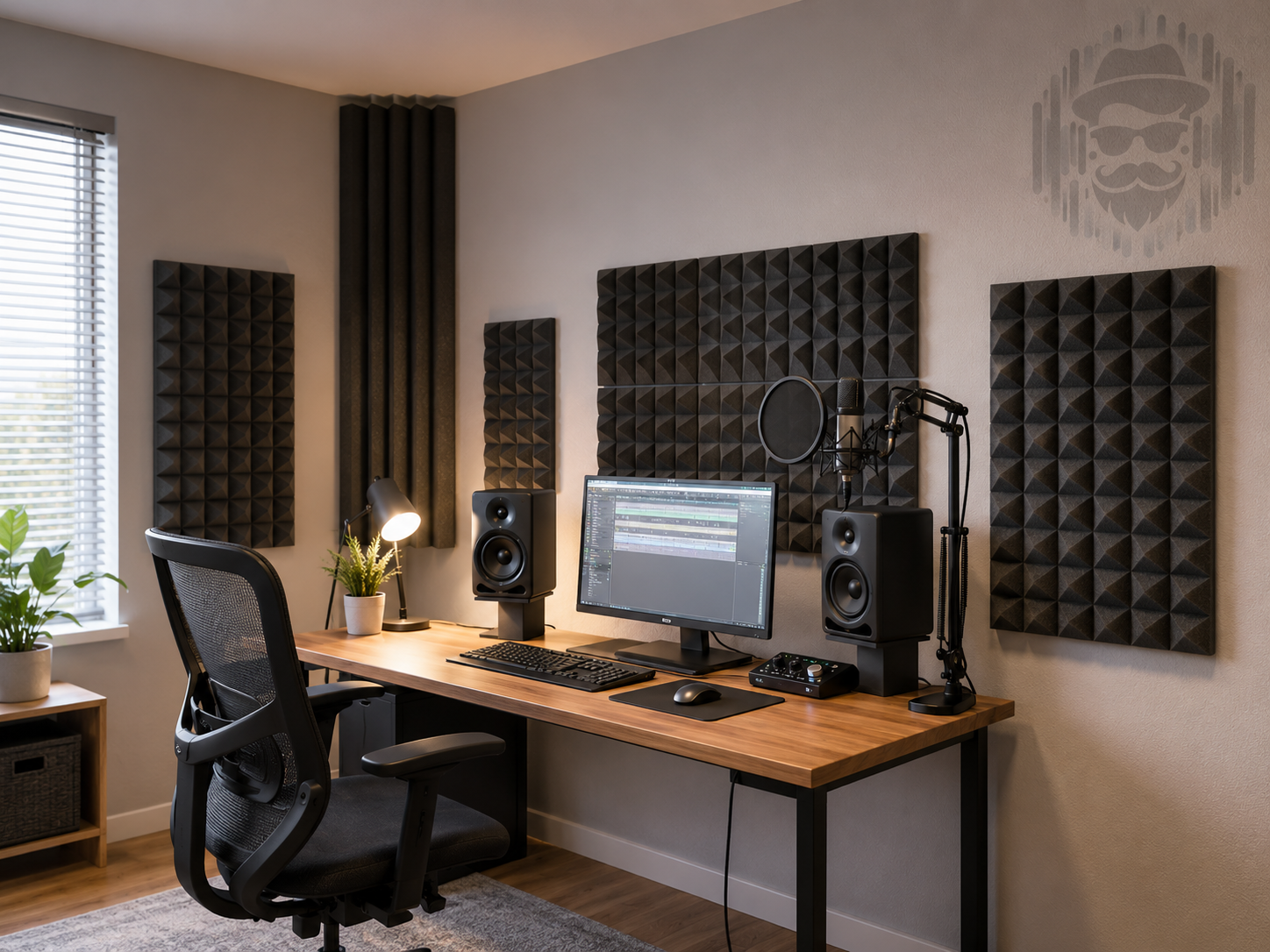
Home-studio treatment works best when panels address specific reflection problems. Randomly covering every wall often wastes material.
Start near first-reflection points, nearby side walls, and hard surfaces close to the microphone or listening position. Add coverage gradually while listening for changes.
Compare panel depth, consistency, usable area, and mounting method. The panel format should also fit the room layout without blocking outlets, ventilation, or equipment.
The Focusound versus Dmsky foam comparison provides additional context for wedge-style studio options.
Wall foam alone should not be expected to solve strong low-frequency buildup. Bass management often requires thicker or differently positioned treatment.
Best for Large-Wall Coverage: Large-Format Acoustic Foam
Large panels can cover broad wall areas with fewer seams. This may reduce installation time and create a cleaner visual layout.
Fewer pieces do not automatically mean better value. Compare total usable area, thickness, panel weight, sag risk, and mounting needs.
Large panels may also be harder to align. A slight installation error becomes more visible across a wider surface.
Shipping compression deserves attention. Follow the exact recovery instructions before mounting any compressed panel.
One large-format example is the Geynnple 48 × 24 × 2-inch acoustic foam panel. The product information identifies a polyester-foam, egg-crate panel supplied in compressed quick-recovery packaging. Adhesive is not included, and no published NRC or STC rating is provided, so it should be evaluated as an acoustic-treatment product for reflections and echo rather than as a proven sound-blocking wall system.
Best Decorative Option: Pyramid, Beveled, or Geometric Panels
Decorative panels suit offices, media rooms, and visible recording spaces where appearance matters. Pyramid, beveled, and geometric patterns can create a more deliberate wall design.
Surface shape should be treated mainly as a design distinction unless comparable acoustic testing proves otherwise. A pyramid profile is not automatically better than a wedge profile.
Material differences also matter. Polyester-fiber hexagons, fiberboard, rubber foam, and polyurethane foam should not be ranked as identical products.
The foam versus hexagonal acoustic panels comparison explains several of these distinctions. Buyers focused on appearance can also review decorative self-adhesive wall panels.
Best Safety-Documented Option
Safety documentation deserves careful review when foam will cover occupied-room walls. Product titles and seller descriptions are not enough.
Look for documentation tied to the exact product. Check the test method, issuing source, product identity, and applicable installation conditions.
Do not treat words such as “fire-resistant” or “flame-retardant” as verified evidence. No acoustic foam should be described as fireproof.
The Dmsky versus TOUO acoustic panels comparison identifies useful safety and specification questions to investigate.
Alternative Option: Wall and Corner Treatment Kits
Combined kits package wall panels with corner pieces. They may suit buyers planning broader room treatment from the start.
These kits can simplify product selection, but they complicate coverage comparisons. Corner pieces and wall panels serve different placement needs.
Calculate the wall-panel area separately. Confirm the number and type of corner components before comparing one kit with another.
How to Choose Acoustic Foam for Walls
Thickness
Panel depth affects how a product interacts with different frequencies. However, thicker foam is not automatically the best choice for every room.
Panel Dimensions
Large panels reduce seams. Smaller panels provide more flexibility around doors, outlets, shelves, and equipment.
Total Coverage
Compare square footage rather than package count. A box containing many small tiles may cover less area than a smaller number of large panels.
Material
Confirm whether the product is acoustic foam, polyester fiber, fiberboard, rubber foam, or another material. These categories should not be treated as interchangeable.
Mounting Method
Options include pre-applied adhesive, separate tape, hook-and-loop strips, clips, and removable backing boards.
Wall Compatibility
Textured walls, dusty surfaces, new paint, humidity, and heavy panels can reduce adhesive reliability.
Room Type
A vocal booth, home office, media room, and large studio may require different coverage and placement strategies.
Appearance
Choose a profile and color that suit the room, but do not confuse visual complexity with proven acoustic performance.
Safety Information
Verify all fire-test, VOC, toxicity, and environmental claims for the exact item.
Thickness, Dimensions, and Coverage
Thickness and material influence which reflections a panel can address. Exact performance still depends on the complete installation.
Compare four figures whenever possible:
- Panel depth
- Face dimensions
- Number of panels
- Total covered area
Thin decorative panels may help with light reflection control. They should not automatically be compared with thicker studio foam as though both formats serve the same need.
Mounting Methods and Wall Compatibility
Pre-applied adhesive offers convenience. Separate tape provides more control over placement. Hook-and-loop systems may simplify panel replacement.
Mounting clips can suit heavier panels. Backing boards allow several foam pieces to be assembled before the treatment is attached to the wall.
Test any adhesive in a hidden area first. Surface preparation, humidity, panel weight, and removal technique can affect the finish.
Acoustic Foam Versus Soundproofing
Acoustic foam treats sound inside a room. Structural soundproofing reduces transmission through walls, floors, ceilings, doors, and gaps.
Effective isolation may require several principles:
- Mass: Heavier layers resist airborne sound transmission.
- Damping: Damping materials reduce vibration within an assembly.
- Decoupling: Clips, channels, or separated framing reduce direct vibration paths.
- Sealing: Acoustic sealant closes gaps that act as weak sound paths.
- Absorption: Insulation or foam reduces sound energy within cavities or rooms.
Buyers trying to stop neighbors, traffic, or speech through a shared wall usually need more than foam. Read more about acoustic absorption versus noise transmission.
Accessories and Mounting Add-Ons
Choose mounting accessories according to panel weight, wall material, finish, and future removal needs.
- Double-sided mounting tape
- Hook-and-loop strips
- Panel clips
- Measuring and leveling tools
- Temporary backing boards
Do not assume every adhesive works with every foam material. Some products can damage foam, fail under panel weight, or leave residue on the wall.
Readers comparing non-foam materials can review foam rubber versus fiberboard panels.
Frequently Asked Questions
Does acoustic foam soundproof a wall?
No. Acoustic foam mainly absorbs reflections inside the room. It does not provide the mass or structural isolation needed to block substantial sound transmission.
How thick should wall-mounted acoustic foam be?
The right thickness depends on the room, material, placement, and frequencies involved. Compare verified panel depth with the intended use rather than following one universal rule.
Are self-adhesive foam panels safe for painted walls?
That cannot be guaranteed across all finishes. Paint type, preparation, humidity, temperature, installation duration, and removal method can affect the result.
Are pyramid panels better than wedge panels?
Not automatically. Reliable comparison requires similar material, thickness, coverage, placement, and verified testing.
How much of the wall should be covered?
No single percentage works for every room. Start at strong reflection points, listen to the result, and add treatment gradually.
Can acoustic foam reduce outside noise?
It may change how sound behaves after entering the room. It is not designed to stop outside noise from passing through the building structure.
Final Selection Guidance
Choose thick wedge foam when conventional studio-style treatment and useful panel depth are priorities.
Choose self-adhesive foam when installation convenience matters and wall compatibility has been checked.
Choose large-format foam when broad coverage and fewer seams matter more than easy handling.
Choose decorative profiles when appearance is important alongside moderate reflection control.
Choose a safety-documented option only when the exact supporting records match the current product.
Consider a wall-and-corner kit when broader room treatment is planned and every component is clearly specified.
The best choice matches the acoustic principle to the actual problem. Use foam for echo and reflection control. Use a properly designed wall assembly when the goal is sound isolation.
SPD’s approach: start with the reflection problem and treat the areas that actually need absorption rather than covering an entire room with foam. If the problem is noise passing through the wall, stop adding foam and address the wall assembly, gaps, doors, windows, or other transmission paths instead.
Good luck and happy soundproofing!