
The Short Answer: Which Mat Fits Your Project?
For a straightforward two-door upgrade with minimal planning, the Dynamat Xtreme Door Kit 10435 is the simpler buy. It is sized and packaged for exactly that job. If you want a mat with more published specifications, smaller sheets that are easier to place around tight door internals, or material you might also use on a trunk, floor, or firewall, Second Skin Damplifier Pro is the more flexible choice.
Both are butyl-and-aluminum constrained-layer dampers. Their job is to reduce panel vibration and resonance. Neither one turns a car into a soundproof room, and neither manufacturer publishes a guaranteed decibel reduction.
What These Mats Actually Do (and Don’t Do)
Buyers often lump every “sound deadening” product into one category, so it helps to separate the three main approaches:
- Vibration damping: A dense, sticky layer bonded to sheet metal converts panel vibration into tiny amounts of heat. Rattles, buzz, and that hollow “tin can” tone get quieter. Both products here work this way.
- Absorption: Soft, porous materials such as foams and fibers soak up sound waves bouncing around inside a cavity. Butyl mats are not absorbers.
- Isolation (blocking): Heavy, decoupled barriers, such as mass-loaded vinyl over a foam decoupler, reduce airborne noise passing through a panel. A damping mat alone is not a full barrier system.
In practice, a damped door feels more solid when it closes, and door speakers usually sound cleaner because the panel is resonating less. How much road noise drops depends on the vehicle, the coverage, and whatever other treatments you add.
Second Skin Damplifier Pro at a Glance
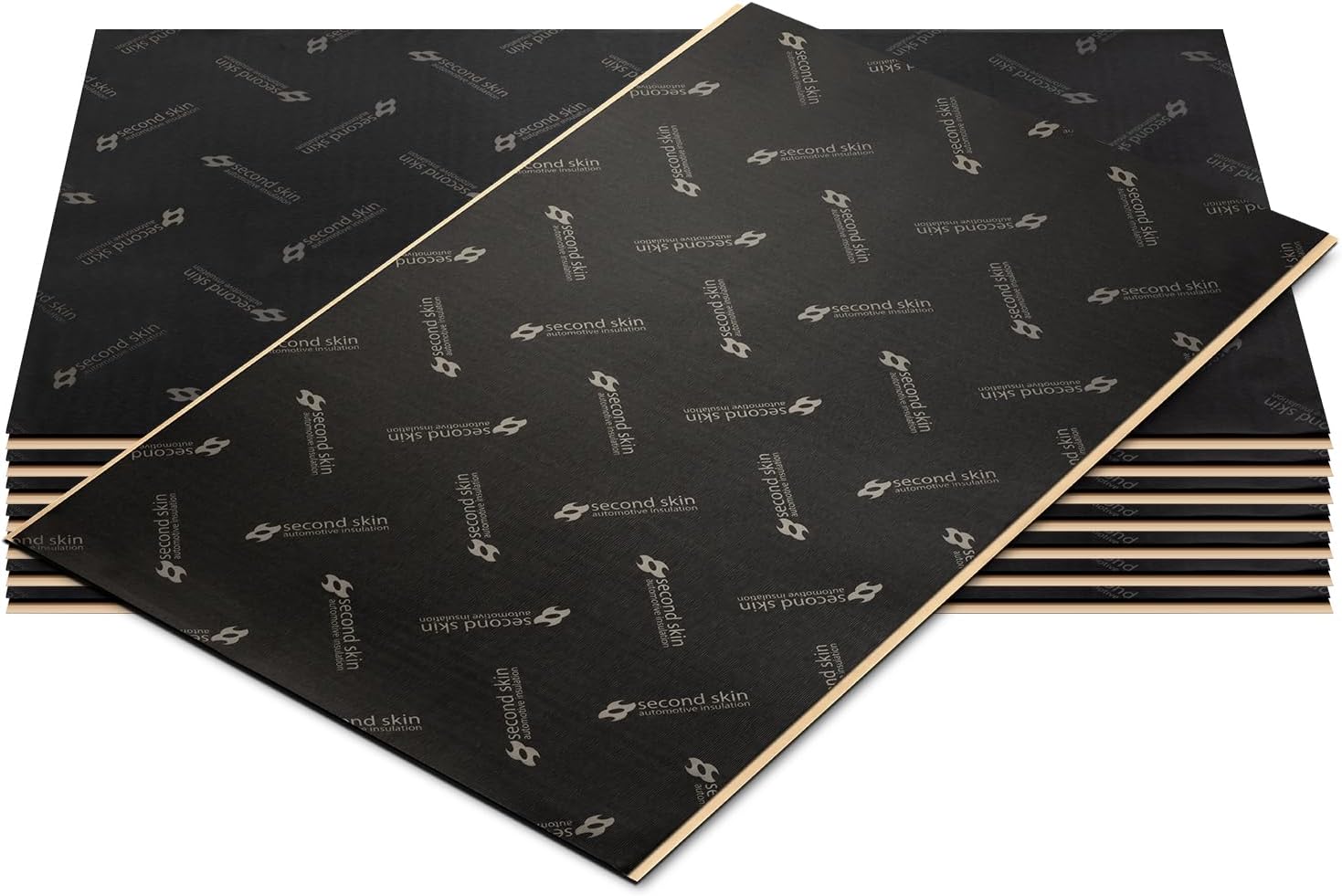
According to Second Skin’s listing, Damplifier Pro combines elastomeric butyl rubber with a 6.5 mil aluminum foil backing, for a stated total thickness of 2mm. The manufacturer also lists an operating temperature of up to 450°F and RoHS compliance. We have not independently verified those figures, so treat them as manufacturer claims.
The pack includes eight 12″ x 20″ peel-and-stick sheets, listed at 13.67 sq ft. Second Skin positions it for doors, trunks, floors, and firewalls. Our full Second Skin Damplifier Pro review has more detail, or you can check current options for Second Skin Damplifier Pro on Amazon.
Dynamat Xtreme Door Kit 10435 at a Glance
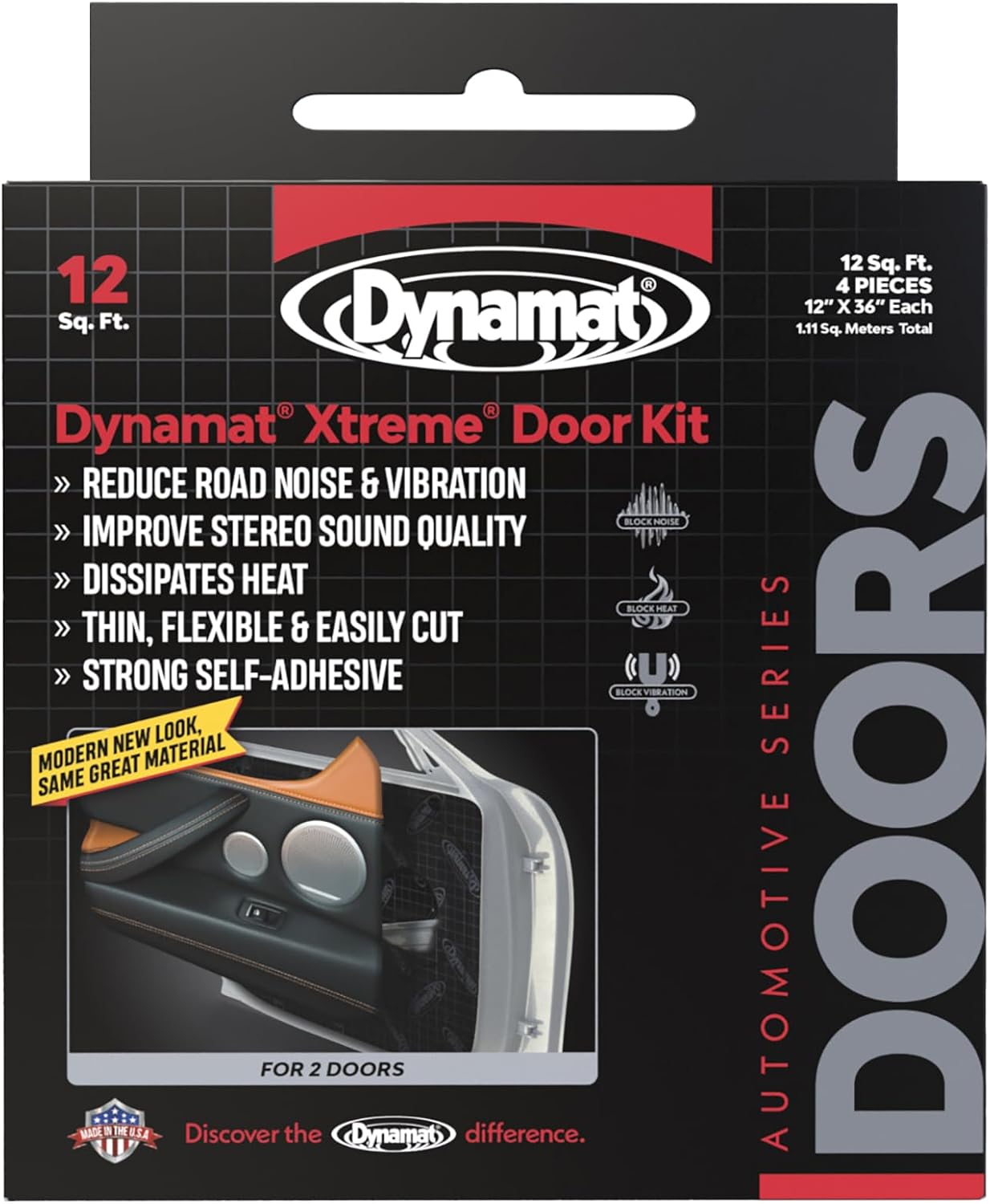
The 10435 kit contains four pre-cut 12″ x 36″ sheets, totaling 12 sq ft. Dynamat sizes it to treat two standard car doors. It uses a butyl base with an aluminum constraining layer and a self-adhesive backing, and it is listed as made in the USA.
The documentation we reviewed does not state a thickness or temperature rating. That doesn’t mean the product lacks those properties. It only means we can’t compare those numbers directly. Read the Dynamat Xtreme Door Kit review or view the Dynamat Xtreme Door Kit on Amazon.
Specs Side by Side
Coverage and Fit: Small Sheets vs Long Strips
The square footage is similar, so the real difference is format. Dynamat’s 36-inch strips can span a large outer door skin in fewer pieces, which means fewer seams and faster coverage. Second Skin’s 12″ x 20″ sheets are easier to handle inside cramped door cavities and around bracing, though you’ll make more individual placements.
For damping, full coverage usually isn’t necessary. Treating the center of large, flat panels does most of the work. Leftover material can go on the inner door skin or on rattly trim.
How to Install Either Mat in a Door
- Remove the trim and vapor barrier carefully. Photograph clip and connector positions before you disconnect anything.
- Clean and degrease the metal. Wipe with isopropyl alcohol or a panel prep cleaner, then let it dry fully. Dust and oil are the main reasons mats peel off.
- Dry-fit and trim. Cut paper templates for awkward spots, and trim the mat before removing the backing.
- Keep drain holes clear. Water is supposed to exit the bottom of the door. Never cover the drain holes or seams along the lower edge.
- Stay clear of moving parts. Roll the window down and up to confirm the regulator, glass channel, lock rods, and cables have clearance. Route around wiring harnesses rather than over them.
- Roll it firmly. Use a hard roller and press from the center outward until the foil texture flattens. Good contact is what makes damping work.
- Reassemble and test. Check the windows, locks, mirrors, and speakers before you snap the trim back on.
Real-World Scenarios
- Front-door speaker upgrade: Dynamat’s kit matches this job neatly and needs little planning.
- Doors now, trunk later: Second Skin’s smaller sheets and multi-zone positioning make leftovers more useful elsewhere.
- Firewall or floor near exhaust heat: Second Skin publishes a temperature claim and Dynamat’s door kit does not. Even so, confirm suitability for your specific location.
- Quieter highway cabin overall: Either mat alone will feel limited. Pair damping with a barrier and absorber layer.
Limitations Worth Knowing
Neither brand provides measured dB reductions or damping coefficients in the materials we reviewed. Second Skin notes that Damplifier Pro can be excessive for full-surface coverage. Dynamat’s kit is sized only for two doors, so a four-door car needs two kits. Peel-and-stick adhesion also depends heavily on surface prep and on the temperature during installation.
Final Verdict
Choose the Dynamat Xtreme Door Kit if you want a convenient, door-specific package with long sheets and fewer cuts. Choose Second Skin Damplifier Pro if you value disclosed specs such as its claimed 2mm thickness and 450°F rating, prefer smaller sheets, or plan to treat areas beyond the doors. Either one will damp panel resonance well when you prep and roll it properly.