
Acoustic door seals reduce sound leakage through the gaps around a closed door. They are one of the simplest upgrades you can make when noise is getting through the top, sides or bottom of an otherwise reasonably solid door.
The key is to seal the entire perimeter. A good soundproof door seal setup normally combines compression or perimeter seals around the jamb with a door-bottom solution such as an automatic drop seal, door shoe or suitable sweep. Garage doors use different moving geometry and bottom sealing, so see our garage door soundproofing guide before applying standard hinged-door seal advice to a garage door.
This guide explains the main types of soundproof door seals, how they work, where each type belongs, how to install them, and what they can — and cannot — do for room-to-room noise.
Best Acoustic Door Seals: Quick Guide
| Door area | Best seal type | Main advantage | Main limitation |
|---|---|---|---|
| Top and sides | Compression acoustic gasket | Seals perimeter gaps when the door closes | Must be adjusted so the door still latches properly |
| Bottom | Automatic drop-down door seal | Seals the floor gap without dragging while the door opens | More expensive and more involved to install |
| Bottom | Surface-mounted door sweep or shoe | Simple retrofit for existing doors | May drag or perform less consistently on uneven floors |
| Entire opening | Acoustic door seal kit | Coordinates perimeter and bottom sealing | More expensive than individual weatherstripping |
| Small residential gaps | Compression weatherstripping | Affordable and DIY friendly | Often lacks tested acoustic performance |
What Is an Acoustic Door Seal?
An acoustic door seal is a gasket or sealing system designed to reduce air gaps around a closed door.
Those gaps matter because airborne sound can travel through the same openings that allow:
- Air
- Light
- Drafts
- Odors
A door can be heavy and well constructed but still perform poorly acoustically if there is an open gap around its perimeter.
Typical leakage points are:
- The head, or top, of the door
- The latch side
- The hinge side
- The gap underneath the door
- The lower corners where the vertical and bottom seals meet
The objective is therefore not simply to put one strip of foam somewhere on the frame. It is to create a continuous seal around the closed door.
Do Door Seals Really Reduce Noise?
Yes, when sound is leaking through gaps around the door.
Sealing an obvious air gap can improve the acoustic performance of the opening because it removes a direct path through which airborne sound can travel.
However, a door seal cannot compensate for every weakness in a door.
If the door itself is:
- Very lightweight
- Hollow-core
- Poorly fitted
- Damaged
- Installed in a lightweight wall
then some sound will continue to pass through the door or surrounding structure even after the gaps have been sealed.
Think of door seals as one important part of the complete door assembly rather than a magic soundproofing product.
The 5 Main Types of Soundproof Door Seals
1. Acoustic Perimeter Seals
Perimeter seals run around the top and vertical sides of the door frame.
When the door closes, the door face or edge compresses against the gasket.
Depending on the system, the sealing material may be made from:
- Silicone
- Neoprene
- EPDM
- Other flexible elastomeric materials
A properly adjusted compression seal should make consistent contact without requiring excessive force to close the door.
Best for
- Bedrooms
- Home offices
- Studios
- Conference rooms
- Home theaters
- Existing doors with visible perimeter gaps
Why perimeter sealing matters
Installing an excellent bottom seal while leaving gaps around the jamb defeats the purpose.
For serious noise reduction, the top, sides and bottom need to work together.
Simpler perimeter-seal option: For smaller gaps around the top and sides of a door, an adhesive weatherstrip is easier to install than a mortised automatic door bottom. The M-D 43848 uses an EPDM/silicone profile designed to compress around variable gaps.
Check the M-D 43848 Weatherstrip at MRO Supreme
2. Automatic Drop-Down Door Seals
An automatic drop seal, also called an automatic door bottom, is one of the most useful ways to seal the gap underneath a frequently used door.
The sealing element retracts while the door is open.
As the door closes, a mechanism contacts the jamb and lowers the seal so that it meets the floor or threshold.
This has an important advantage over a conventional sweep:
The seal does not need to drag continuously across the floor every time you open the door.
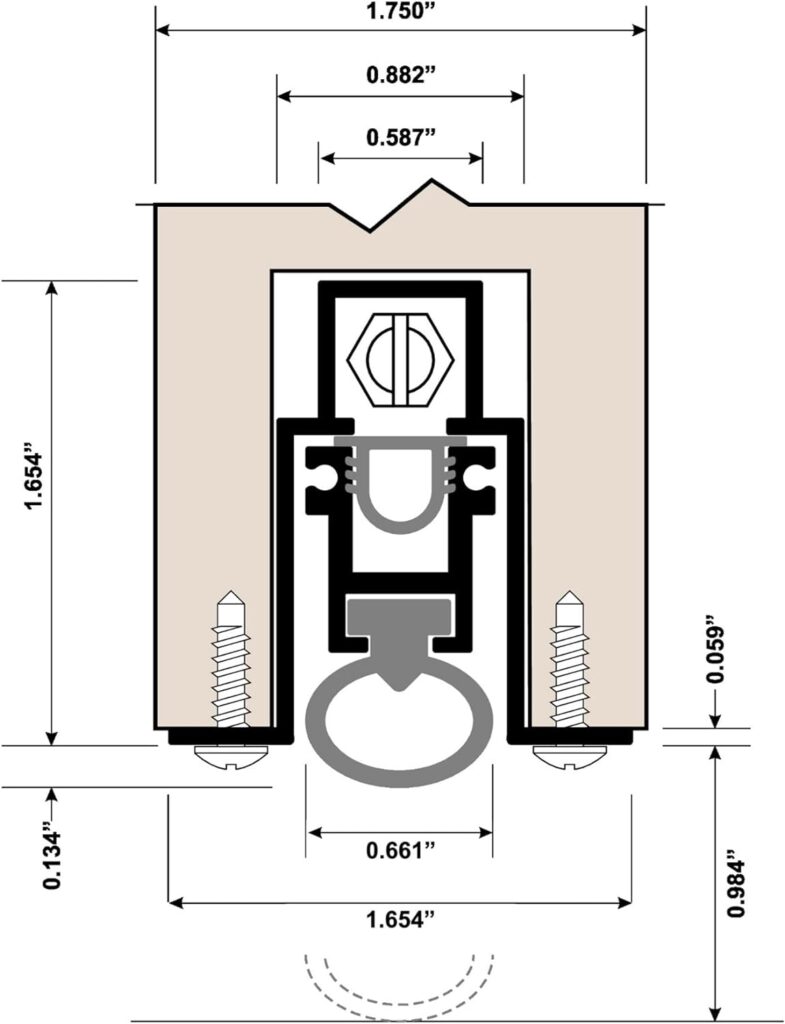
TMS Automatic Drop-Down Door Seal
The TMS automatic door bottom featured in the original version of this guide remains available.
It uses a neoprene sealing bulb inside an aluminum housing and is designed to drop automatically when the door closes.
The version linked here is a fully mortised model, meaning the housing is installed into the bottom of a compatible wooden door rather than simply being screwed onto the door face.
That produces a clean installation, but it also makes this a more involved DIY project than sticking weatherstripping around a frame.
Check the TMS Automatic Drop-Down Door Seal on Amazon
Best for
- Studios
- Home theaters
- Home offices
- Bedrooms
- Commercial rooms
- Doors where floor drag is undesirable
Main limitation
A mortised automatic door bottom requires careful fitting and cutting of the door. If you are not comfortable modifying the door, consider a surface-mounted automatic bottom or professional installation instead.
3. Soundproof Door Sweeps
A door sweep attaches to the bottom of the door and seals some or all of the gap beneath it.
This is often the easiest bottom-of-door retrofit.
Depending on the design, a sweep may use:
- Rubber
- Silicone
- Neoprene
- Brush material
- Multiple flexible fins
For sound control, the priority is a design that forms a good seal rather than merely brushing lightly against the floor.
Advantages
- Relatively inexpensive
- Simple installation
- Good option for renters or basic DIY projects
- Can also reduce drafts and light leakage
Limitations
A fixed sweep can drag against carpet or an uneven floor.
It may also leave small openings at the corners unless the perimeter seals and threshold are carefully coordinated.
4. Door Shoes and Threshold Seals
A door shoe wraps around or attaches to the lower edge of the door and uses one or more flexible seals against a threshold or floor surface.
A properly matched threshold gives the bottom gasket a consistent surface against which to seal.
This can be more effective than trying to make a flexible sweep follow a badly uneven floor.
The tradeoff is that thresholds affect the transition between rooms and must be selected with accessibility, floor clearance and the particular door system in mind.
5. Complete Acoustic Door Seal Kits
An acoustic door seal kit combines components intended to work together around the complete opening.
A typical system may include:
- Head gasket
- Hinge-side gasket
- Latch-side gasket
- Automatic door bottom or door shoe
- Corner pads or transition pieces
This approach is particularly useful when you need predictable sealing rather than assembling several unrelated weatherstripping products.
Commercial acoustic seal manufacturers offer tested sets for exactly this reason: sound leakage can occur anywhere around the opening, so the seals need to work as a system.
Automatic Drop Seal vs Door Sweep
| Feature | Automatic drop seal | Door sweep |
|---|---|---|
| Seal while door is closed | Yes | Yes |
| Retracts while opening | Yes | No |
| Floor drag | Minimal when adjusted correctly | Possible |
| DIY difficulty | Moderate to high depending on mounting style | Low |
| Cost | Usually higher | Usually lower |
| Good for carpet | Often better | Can drag |
| Professional acoustic applications | Common | Depends on the design |
For a frequently used studio, office or theater door, I generally prefer an automatic bottom when the budget and installation allow it.
For a basic residential retrofit, a well-fitted sweep can still be worthwhile.
Which Door Seal Should You Buy? Match the Gap to the Fix
For gaps around the top or sides: Start with a compression gasket sized for the measured clearance. Check that it contacts the door evenly without making the latch difficult to engage. If the door is sagging or misaligned, correct that first.
For a gap under a smooth, level door: A well-fitted sweep or door shoe can be a straightforward retrofit. Measure the clearance with the door closed, and check the sweep’s stated operating range before purchasing.
For a frequently used door, carpet or an uneven floor: Consider an adjustable automatic door bottom paired with a compatible threshold where needed. Verify whether the model is surface-mounted or requires mortising; do not assume a fully mortised unit is a simple screw-on retrofit.
For gaps at the lower corners: Check the junction of the perimeter gasket, door bottom and threshold. A small unsealed corner can undermine the rest of the installation.
For a door that closes tightly but still transmits speech: More weatherstripping may offer little benefit. Inspect the door leaf, frame-to-wall joint and adjacent wall, and consider whether a heavier or tested door assembly is necessary.
Safety check: Do not alter fire-rated door assemblies, required ventilation, accessible thresholds or emergency-egress hardware without confirming the applicable requirements and compatible components. Any new seal must allow the door to open, close and latch as intended.
How to Find Sound Leaks Around a Door
Before buying acoustic seals, determine where the gaps actually are.
Look for visible light
With one side of the room dark and the other brightly lit, inspect the perimeter of the closed door.
If you can see light through an unintended gap, there is also an open air path.
Inspect the perimeter
Look closely at:
- Top corners
- Latch side
- Hinge side
- Threshold
- Bottom corners
Check the existing weatherstripping
Old seals can:
- Harden
- Tear
- Compress permanently
- Detach from the frame
- Leave sections without contact
Check door alignment
If the door has dropped on its hinges or the frame is out of square, adding thicker gasketing may not solve the underlying fit problem.
How to Seal a Door for Sound
Step 1: Close the largest gaps first
Prioritize obvious open gaps around the door rather than adding random acoustic materials to the door face.
Step 2: Seal the top and sides
Install an appropriate compression gasket around the head and jambs.
The gasket should make continuous contact when the door closes.
Avoid making the seal so thick that:
- The latch will not engage
- The door becomes difficult to close
- The hinges are placed under unnecessary stress
Step 3: Treat the bottom gap
Use an appropriate:
- Automatic drop seal
- Door sweep
- Door shoe
- Threshold system
The choice depends on the door, floor surface and required level of performance.
Step 4: Check the lower corners
The junction between the vertical seal and the bottom seal is easy to overlook.
A tiny corner gap can leave a direct leakage path even when the rest of the installation looks excellent.
Step 5: Close and inspect the door again
Confirm that:
- The door latches normally
- The perimeter gasket is compressed consistently
- The bottom seal reaches the floor or threshold
- No hardware is binding
- No obvious gaps remain
How to Install Perimeter Door Seals
The exact installation depends on the product, but a typical adhesive-backed residential seal follows this general process.
1. Remove the old seal
Remove worn weatherstripping, loose adhesive and debris.
2. Clean the mounting surface
Adhesive gasketing needs a clean, dry and compatible surface.
3. Measure before cutting
Measure each side individually rather than assuming the opening is perfectly square.
4. Test the compression
Before committing to the entire frame, make sure the selected gasket allows the door to latch while still making contact.
5. Install continuously
Avoid unnecessary gaps between sections.
6. Check the corners
Fit the top and vertical seals carefully so sound does not have a path through the joints.
How to Install an Automatic Door Bottom
Automatic bottoms come in several mounting styles, including:
- Surface mounted
- Semi-mortised
- Fully mortised
The TMS model shown here is fully mortised.
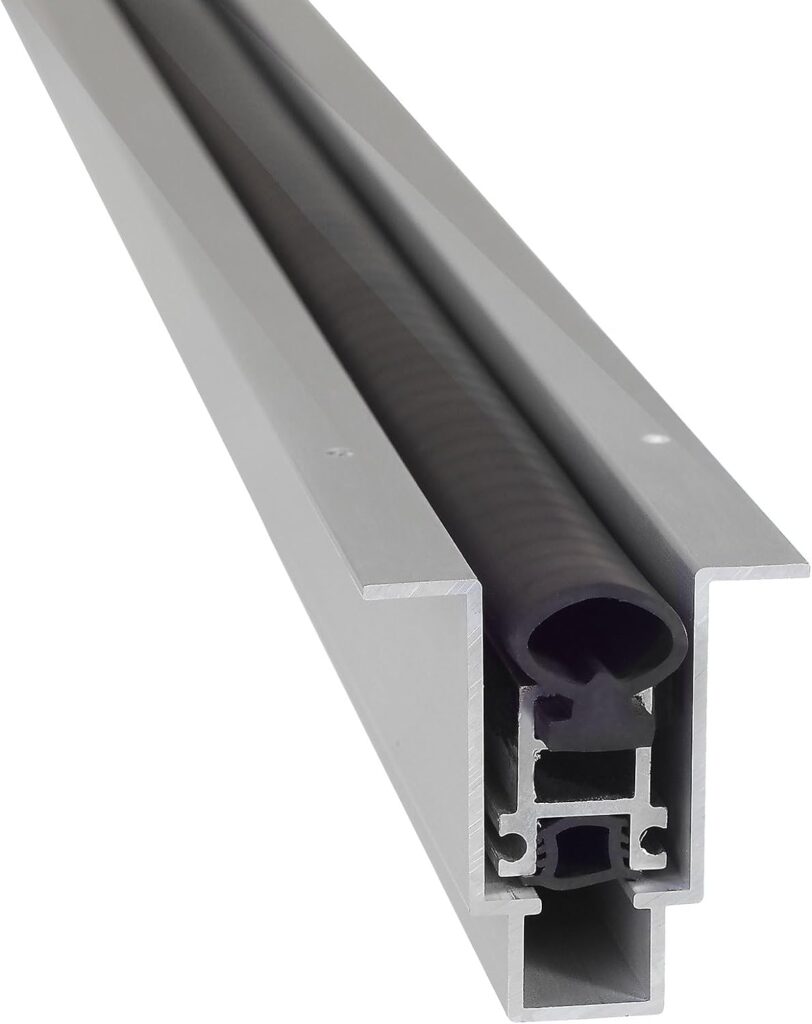
Installation typically involves:
- Confirming the door thickness and required seal length
- Removing the door where required
- Preparing the mounting recess or position
- Cutting the unit only if the manufacturer permits it
- Securing the housing
- Positioning the actuator against the jamb
- Adjusting the drop
- Checking that the seal contacts the floor or threshold evenly
- Testing the door through repeated opening and closing cycles
Follow the installation instructions for the exact automatic door bottom you purchase. Mortising dimensions, allowable trimming and adjustment procedures are product-specific.
View the TMS Automatic Door Bottom on Amazon
Acoustic Door Seal Kits vs Standard Weatherstripping
If you are choosing between common perimeter-sealing materials, see our UpinFun felt weather stripping vs TAROSE silicone door seal comparison for a direct look at how felt and silicone strips differ in material, dimensions, installation conditions, and suitable door or window gaps.
Both can seal air gaps, but they are not necessarily equivalent.
Standard weatherstripping
Advantages:
- Cheap
- Easy to find
- Easy to install
- Useful for small residential gaps
Limitations:
- Often designed primarily for drafts
- May not have tested acoustic data
- Can compress or wear
- Different products may not meet neatly at the corners
Dedicated acoustic seal system
Advantages:
- Designed specifically for acoustic openings
- Coordinates perimeter and bottom sealing
- Commercial systems may have tested acoustic performance
- Often better suited to studios, meeting rooms and other demanding spaces
Limitations:
- Higher cost
- May require mechanical fastening
- More careful adjustment
- Professional installation may be worthwhile
Soundproof Door Seal for a Bedroom
For a typical bedroom, start with the gaps rather than immediately replacing the entire door.
A practical sequence is:
- Adjust the door if it does not close squarely.
- Add compression weatherstripping around the top and sides.
- Seal the bottom with an appropriate sweep or automatic bottom.
- Check the corners.
- Then assess whether the door itself is still the weak point.
If the bedroom has a lightweight hollow-core door, upgrading the seals can still help, but replacing the door with a heavier solid-core model may provide a more complete improvement.
See our guide to soundproof and solid-core doors for more on choosing the right complete door option.
Acoustic Door Seals for Home Studios
A studio usually deserves a more complete approach than basic peel-and-stick weatherstripping.
Prioritize:
- Continuous perimeter gasketing
- A high-quality bottom seal
- A suitable threshold
- Careful treatment of the corners
- A sufficiently heavy door
- A well-built frame and surrounding wall
If significant sound isolation is required, tested acoustic door assemblies are a better benchmark than attempting to predict performance from an individual gasket.
Acoustic Door Seals for Home Theaters
Home theaters present two challenges:
- Keeping movie sound inside the room
- Keeping household noise out
The low-frequency energy from subwoofers can be particularly difficult to isolate.
Door seals eliminate leakage paths, but they do not add substantial mass to a lightweight door.
If bass transmission remains high after sealing the gaps, investigate the door leaf, frame, walls, ceiling and other flanking paths.
Acoustic Door Seals for Offices
Door sealing can improve speech privacy when conversation is leaking through obvious gaps around an office door.
For a meeting room or private office, pay particular attention to:
- The large gap underneath many commercial doors
- Perimeter seals that no longer contact the door
- Threshold alignment
- Door closers that prevent full latching
A seal only works when the door is completely closed.
Can You Soundproof a Hollow-Core Door With Seals?
You can improve a hollow-core door by sealing its gaps, but the seals do not change the lightweight construction of the door itself.
Once the perimeter leakage has been reduced, the door leaf may become the dominant transmission path.
If you need substantially better isolation, consider a heavier door.
Our guide to soundproof and solid-core doors explains the broader door options.
Does a Solid-Core Door Still Need Acoustic Seals?
Yes.
A heavier solid-core door can provide better transmission resistance than a lightweight hollow-core door, but an open perimeter gap can undermine that advantage.
For best results, the door leaf and the seals need to work together.
What About Acoustic Sealant?
Acoustic sealant and an acoustic door seal are different products.
Acoustic sealant is normally a flexible caulk-like material used for construction joints and gaps that are not supposed to move like an operating door gasket.
It may be useful around:
- Door-frame-to-wall joints
- Trim gaps
- Drywall perimeters
- Other fixed construction joints
Do not run acoustic caulk around the moving perimeter of a door where a compression gasket should be used.
Common Acoustic Door Seal Mistakes
1. Sealing Only the Bottom
A sweep cannot compensate for large gaps around the top and sides.
2. Using Foam That Is Too Thick
If the gasket prevents the door from closing or latching, the installation has failed.
3. Ignoring the Corners
The lower corners are common leakage points.
4. Installing Over Dirty Surfaces
Adhesive-backed seals need properly prepared surfaces.
5. Buying a Sweep Without Measuring the Gap
Measure the door width and bottom clearance first.
6. Expecting Weatherstripping to Fix a Hollow-Core Door Completely
Sealing and mass solve different weaknesses.
7. Choosing a Door Bottom That Drags Excessively
Too much friction makes the door unpleasant to use and accelerates wear.
8. Ignoring an Uneven Floor
A straight sweep may not seal consistently against a badly uneven surface.
9. Covering Up a Door-Alignment Problem
Repair loose hinges, sagging or frame problems before trying to compensate with thick gasketing.
10. Assuming Every Product Marketed as “Soundproof” Has an Acoustic Rating
Many consumer weatherstripping products make general noise-reduction claims without providing tested door-assembly performance.
How to Choose an Acoustic Door Seal
Measure the gaps
Measure rather than guessing.
Identify the floor surface
Carpet, hardwood, tile and thresholds present different bottom-sealing challenges.
Decide how frequently the door is used
A heavily used door may justify a retracting automatic bottom.
Check door thickness
This is especially important for mortised door bottoms.
Check the mounting style
Choose between:
- Adhesive
- Surface mounted
- Semi-mortised
- Fully mortised
Check whether tested acoustic performance matters
For a bedroom, general gap sealing may be sufficient.
For a recording studio, conference room or project with a required STC target, choose components designed and tested as part of an acoustic opening.
Acoustic Door Seal FAQ
What is an acoustic seal on a door?
An acoustic door seal is a flexible gasket or sealing system used to close gaps around the perimeter of a door and reduce airborne sound leakage.
Do acoustic door seals work?
They work when a meaningful portion of the noise is leaking through gaps around the door. They cannot completely compensate for a lightweight door or weak surrounding construction.
What is the best soundproof door seal?
There is no single seal for every part of the door. A complete setup normally uses perimeter compression gasketing around the top and sides plus an appropriate bottom seal.
What is an acoustic drop-down door seal?
It is an automatic door-bottom mechanism that lowers a flexible seal when the door closes and retracts it when the door opens.
Are automatic door bottoms better than sweeps?
They can be better where you want a strong bottom seal without continuous floor drag. Sweeps are cheaper and easier to retrofit.
How do you seal a door for soundproofing?
Seal the top, sides and bottom, make sure the door closes squarely, and check that the seals form continuous contact around the closed opening.
Can weatherstripping reduce noise?
Yes, if it closes an air gap that was allowing sound through. Standard weatherstripping may not offer the same tested performance as a dedicated acoustic gasket system.
Should a soundproof door be airtight?
Good acoustic door performance requires the unintended air gaps around the closed opening to be tightly controlled. The exact sealing system depends on the door design and any ventilation or building-code requirements.
How do I soundproof the gap under a door?
Use a properly fitted automatic door bottom, door shoe, sweep or threshold sealing system. The choice depends on the size of the gap and the floor surface.
Can I put two door sweeps on a door?
Adding more pieces does not automatically produce better sound isolation. A single well-designed bottom sealing system that makes continuous contact is preferable to stacking poorly fitted products.
Why can I still hear noise after sealing my door?
The remaining sound may be passing through the door leaf, frame, wall, ceiling, floor, ventilation system or another flanking path.
Do acoustic seals help with voices?
They can reduce voice leakage when the voices are passing through open gaps around the door. The total result depends on the rest of the door assembly.
Do door seals help with bass?
Closing air gaps is still important, but strong low-frequency bass is difficult to isolate and can also travel through the door, walls, floor and structure.
Final Recommendation
If you want to reduce sound coming through a door, start with the gaps.
The most useful approach is usually:
- Make sure the door is properly aligned.
- Install an appropriate acoustic or compression seal around the top and sides.
- Seal the bottom with an automatic drop seal, door shoe or suitable sweep.
- Check the corners and threshold.
- Close the door and look for any remaining leakage.
- Only then decide whether the door itself needs upgrading.
For a simple bedroom or office retrofit, good weatherstripping plus a quality bottom seal may be enough to make the room noticeably less vulnerable to noise leakage.
For a studio, theater or demanding acoustic room, use a coordinated acoustic door seal system and consider the performance of the complete door assembly.
Check the TMS Automatic Acoustic Door Bottom on Amazon
For more extensive upgrades, see our guide to soundproof and solid-core doors, or follow our How to Soundproof a Door guide if you want to improve the door you already have.
Good luck and happy soundproofing!