
A noisy door latch and a cabinet door striking its frame are two different problems. BrainExploder’s flexible strike-plate device is intended to soften the impact around a door latch. HushBumps’ self-adhesive gel bumpers cushion the point where an interior door, drawer or cabinet makes contact. Neither product turns an uninsulated door into a soundproof door or corrects a loose or misaligned latch.
What noise are you trying to stop?
Listen closely to the moment the sound occurs. A metallic clack while the latch enters the strike plate suggests a latch or strike-interface problem. A hollow thud as the entire door hits its stop suggests a contact or closer-adjustment problem. Drawers and cupboards often produce a sharp knock as the front meets the cabinet body. A flexible strike component and a compressible adhesive bumper address different parts of these events.
Before adding either accessory, check hinges, screws, latch alignment and door movement. A rattling or binding latch can require adjustment rather than simply a softer material.
BrainExploder Door Silencer: flexible strike-plate approach

The linked ASIN B0C72F7TJV is associated with the BrainExploder black single strike-plate configuration, model BEMHOME002, in available product records. The listing describes a flexible synthetic-rubber or polymer component and mounting hardware. It is a hardware replacement or adaptation at the latch/strike contact—not an adhesive pad for arbitrary cabinet surfaces.
Manufacturer-style marketing reproduced in retailer listings advertises “20 dB” reduction or “4× quieter.” The sources reviewed do not provide a controlled independent laboratory report, measurement distance, baseline latch, room conditions or test protocol for the exact linked variant. We therefore treat those figures as unverified promotional claims, not as measured performance that a particular door will achieve.
Confirm that the shape, mounting holes and latch engagement match your door. A strike component must not prevent secure latching, compromise the lock, cause rubbing or interfere with fire-rated/egress hardware. Never modify an approved fire door or required access-control system without the relevant professional authorization.
See the BrainExploder standalone overview or check the exact linked strike plate on Amazon.
HushBumps HP104: adhesive gel bumpers for many contact points
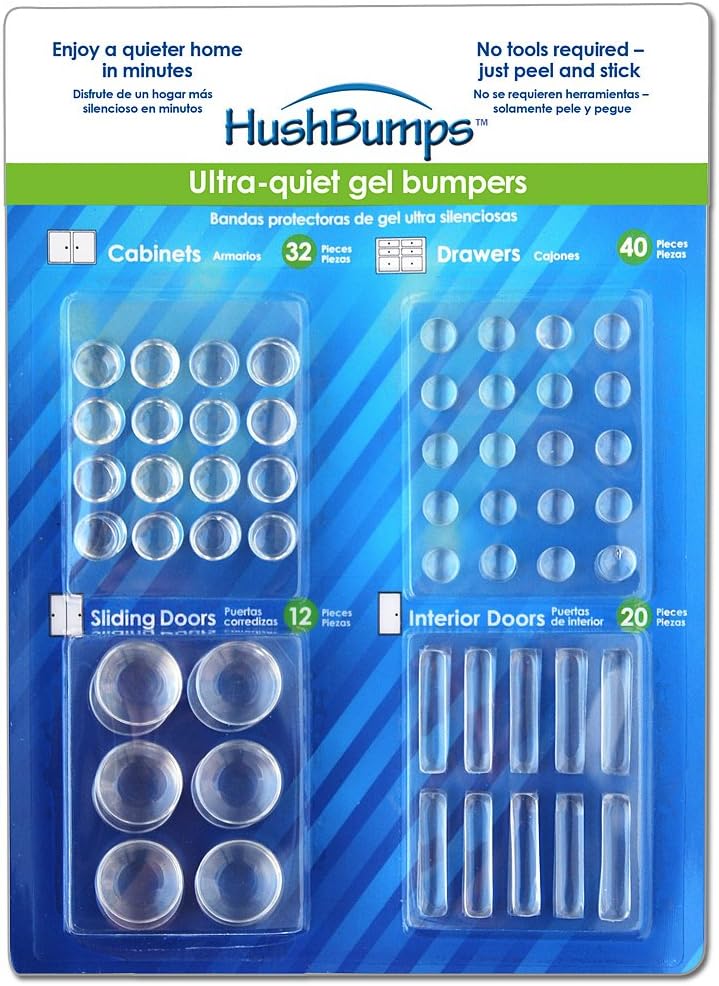
HushBumps’ manufacturer describes gel-compression bumpers that cushion the close of drawers, cabinet fronts and interior doors. Unlike a strike plate, they attach to a chosen contact surface. The exact linked ASIN B072F7NG2N is identified by an ASIN-specific retail record as the HP104 clear 104-piece assortment. The listed mix is 40 drawer, 20 interior-door, 32 cabinet and 12 sliding-door bumpers.
This makes HushBumps more flexible for a household with many small contact noises. It does not directly alter the metal latch’s behavior, and a poorly placed bumper can prevent a cabinet from closing flush. Clean and dry the chosen surface, position each bumper where the closing impact actually happens and verify the door still closes properly.
Read the HushBumps standalone review or inspect the HP104 assortment on Amazon.
Comparison table
| Factor | BrainExploder | HushBumps HP104 |
|---|---|---|
| Main target | Latch / strike interface on a compatible door | Door, drawer and cabinet contact impacts |
| Form | Single flexible strike-plate component | 104-piece adhesive gel-bumper assortment |
| Installation | Hardware fit and screws need checking | Peel-and-stick placement on suitable surfaces |
| Useful when | Latch clack is the dominant noise | Closing thud or cabinet knock is dominant |
| Does not solve | Misalignment, loose hinges, sound transmission through a door | Metallic latch noise, faulty closing mechanisms, sound transmission through a wall |
| Noise test evidence | Promotional 20 dB figure lacks independent method here | No equivalent independently verified dB comparison identified |
Practical decision examples
Bedroom door that clicks loudly at the latch: start by checking strike alignment and existing door hardware. If the strike interface is the source and the fit is compatible, the BrainExploder approach is more targeted.
Kitchen cupboard fronts that bang: place suitable HushBumps at the actual frame contact positions and test the alignment. Replacing a household door strike plate would not solve cabinet knocks.
Door that slams into its frame: inspect the closer, stop and seals. Soft contact bumpers may reduce the last impact but are not a substitute for adjusting an unsafe or excessively fast-closing door.
Noise from voices passing through a closed door: neither small accessory is a meaningful isolation solution. Door perimeter gaps, the door leaf and associated wall assembly need separate assessment.
Installation and safety boundaries
- Do not obstruct normal latching or locking with pads or altered strike hardware.
- Do not install on fire-rated, emergency-exit or controlled-access doors without the applicable approval.
- For adhesives, clean the surface and test one spot before fitting an entire pack.
- Recheck door clearance after installation. Too many or poorly located bumpers can leave a door ajar.
- Do not interpret a vendor’s decibel slogan as a guaranteed reduction in your room.
Frequently asked questions
Can I use both?
They can have complementary functions if a compatible door has both a latch clack and a separate frame impact. Verify closure and locking after each change rather than adding hardware and adhesive pieces all at once.
Is BrainExploder really 20 dB quieter?
That number appears in seller marketing, but we did not identify the comparative test method required to generalize it to a particular door. It is not a substantiated claim of whole-room sound isolation.
Do gel bumpers need special tools?
HushBumps markets the HP104 range as peel-and-stick. Prepare the surface and use the correct size and location; no drill is implied for the adhesive bumpers themselves.
Can these replace a perimeter door seal?
No. They deal with localized closing-contact sounds, not the continuous gaps around a door through which voices and other airborne sound can pass.
SPD’s recommendation
We would choose based on the sound event. For a defined latch clack and compatible hardware, consider the flexible BrainExploder strike device after checking alignment. For cabinet, drawer and interior-door contact knocks, the varied HushBumps gel assortment is a more direct tool. Fix mechanical defects first and treat both as small noise-control accessories, not general soundproofing products.
Sources and product-identity notes
BrainExploder B0C72F7TJV model and hardware listing; retailer reproduction of BrainExploder noise claims; HushBumps product and technology information; HP104 ASIN-specific package record. Promotional acoustic claims are not treated as independently tested findings.
Affiliate disclosure: This article includes Amazon affiliate links. As an Amazon Associate I earn from qualifying purchases.
Good luck and happy soundproofing!