
SoundSkins Silent Strip and Siless Professional Finishing Tape are not two versions of the same sound-deadening product. One is a narrow compressible foam strip for separating contact points; the other is a foil finishing tape for covering the joints between already-installed automotive damping sheets. Choosing between them starts with the job, not with a claimed decibel reduction.
What each tape is meant to do
SoundSkins Silent Strip is a rubber-based, closed-cell foam strip with a pressure-sensitive adhesive. The manufacturer’s SSK-STRIP specifications describe it as a decoupler between contacting automotive trim surfaces, for example behind a door card, at a glovebox interface or around a panel that rattles against another part. It offers a compressible buffer at that contact point. It is not a substitute for mass-loaded vinyl or a complete door-sealing system.
Siless Professional Finishing Sealing Tape has a different task. A foil face and adhesive backing cover seams where pieces of butyl/foil sound-deadening mat meet. Published Siless product instructions reproduced by retailers describe keeping moisture and dirt away from joints and helping contain exposed butyl. They explicitly say the finishing tape is not the sound deadener itself and should not be repurposed as an HVAC heat barrier.
SoundSkins Silent Strip: contact-noise treatment
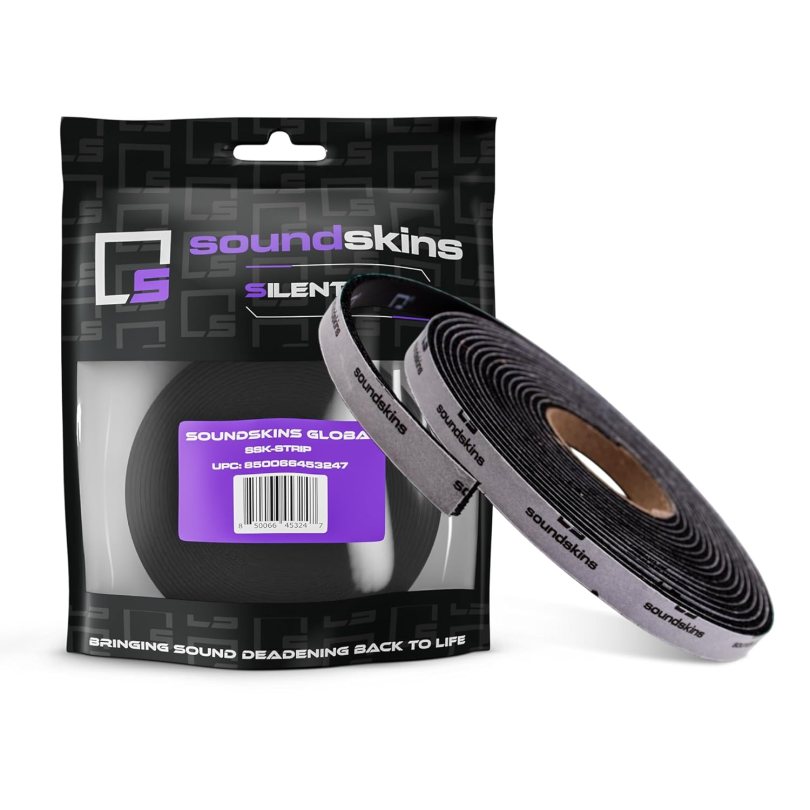
For the standard manufacturer-described SSK-STRIP roll, the published specifications give 3/8 inch width, 17 feet of length, approximately 0.12 inch thickness and a single self-adhesive roll. The manufacturer’s sheet also describes water, heat and flame resistance. Those are manufacturer statements, not independent certification of the particular retail unit or proof of suitability near hot exhaust components.
Important variant caution: the retailer records connected to the article’s linked Amazon ASIN B0DQVRKK2V do not describe the width consistently. One identifies SSK-STRIP at 3/8 inch, while another attributes a 1/2-inch variant to the same ASIN. That conflict means a buyer should verify the width and model printed on the actual offer before relying on a tight trim clearance. We are not silently treating both variants as identical.
SoundSkins is the more appropriate type of product when an interior plastic panel taps another hard surface or a trim piece needs a narrow cushioned interface. It will not necessarily silence a loose mounting clip, replace a missing fastener or prevent a badly adjusted door from vibrating.
Review the standalone SoundSkins Silent Strip guide or check the listed SoundSkins option on Amazon, confirming its width and quantity first.
Siless Finishing Tape: a joint-covering accessory

The linked Siless product B0CQDF8PS3 is associated with a silver three-pack of rolls advertised as 1-1/2 inches wide by 30 feet per roll. The ASIN-specific retailer listing supports the three-pack identification. Other Siless listings are for one or two rolls; their packaging must not be conflated with this destination.
Install the underlying butyl damping sheets according to their instructions before adding finishing tape over accessible seams. A foil seam cover can produce a neat installation and reduce exposed-edge contamination. It does not add the same metal-panel damping contribution as another sheet of butyl/foil material, and it is not a replacement for properly cleaning or rolling a damping mat.
Siless directs this type of finishing product to vehicle interiors. Do not assume it has a documented service temperature for engine exhaust areas or use it as a general thermal/fire barrier. Read the Siless finishing-tape overview, or inspect the linked three-pack on Amazon.
At-a-glance comparison
| Decision factor | SoundSkins Silent Strip | Siless Finishing Tape |
|---|---|---|
| Main function | Compressible interface that helps reduce contact rattles | Finishing cover for joints in installed sound-deadening sheets |
| Construction | Rubber closed-cell foam with pressure-sensitive adhesive | Foil-faced tape with adhesive and release liner |
| Manufacturer or listed format | Standard manufacturer SSK-STRIP: 3/8 in × 17 ft, one roll; linked variant width needs confirmation | Linked B0CQDF8PS3: three advertised 1-1/2 in × 30 ft rolls |
| Good locations | Plastic trim contacts, door-card contact points, glovebox interfaces | Interior damping-mat seams and accessible sheet joints |
| Not designed to replace | Metal-sheet damping mats, structural repairs, complete sound barriers | Actual damping mats, mass barriers or approved high-temperature shielding |
| Installation check | Correct width, clearance and clean adhesion surface | Completed mat installation, clean seams and suitable interior location |
Which should you choose?
Choose a foam strip when two interior components hit, squeak or chatter against each other. First check that the component is correctly secured. Adding foam where the real problem is a broken clip may only conceal the issue temporarily.
Choose finishing tape when the damping mat is already installed and you want to cover its exposed joints. If the underlying sheet is lifting or the panel has not been prepared, correct that installation rather than relying on tape to hold everything together.
Use both only when both problems exist. In a car-door project, finishing tape may belong over the seams of installed butyl sheets while a separate narrow foam strip may belong where the door card contacts the metal. They should not be layered at random or placed where they interfere with seals, drains, fasteners, wiring or airbags.
Installation and safety considerations
- Inspect mounting clips and panel fit first. Neither tape repairs failed mechanical hardware.
- Clean and dry the intended contact area; follow the product adhesive instructions.
- Avoid water-drain paths, moving window mechanisms and airbag deployment zones.
- Keep material away from unverified high-temperature or fire-exposure applications.
- Do not promise a cabin-wide decibel reduction without a controlled test of the complete vehicle.
Frequently asked questions
Does Siless finishing tape make a car quieter on its own?
It is a seam-finishing accessory, not a standalone vibration damper. Any audible change depends on the underlying installation, and no comparative vehicle-level test was identified for these two linked products.
Is the SoundSkins strip waterproof?
The manufacturer describes its closed-cell strip as waterproof, but suitability at a particular contact point still depends on surface condition, placement and the exact variant delivered.
Will these products stop road or engine noise?
Not as general-purpose barriers. The strip addresses local contact noise and the finishing tape addresses joints. Road and engine noise may require damping of resonant panels, barriers, sealing and other vehicle-specific work.
What is the main purchasing risk?
Variant confusion. Confirm the SoundSkins width and the Siless pack count on the live listing rather than relying on a generic product-family image or another retailer’s option.
SPD’s recommendation
At SPD we would diagnose the noise source first. For a rattling trim interface, the compressible SoundSkins type of strip is the functional match. For seams in a completed sound-deadening installation, the Siless finishing tape is the match. Neither deserves a ‘best sound deadener’ label because neither replaces the actual damping material.
Affiliate disclosure: The Amazon links in this article are affiliate links. As an Amazon Associate I earn from qualifying purchases, at no additional cost to you.
Good luck and happy soundproofing!