
Windows are often one of the weakest parts of a room when you are trying to reduce traffic noise, voices, barking dogs or other outdoor sound. If the window is only one possible path, our guide to soundproofing a bedroom helps compare it with the door, walls, floor, ceiling and vents before you spend on the wrong surface.
The good news is that you do not always need to replace the window.
If the existing frame and glass are in reasonable condition, you can often improve the result by sealing air leaks, adding a well-fitted interior insert or using a removable barrier when you do not need the view.
The important part is choosing the treatment according to the problem. Weatherstripping fixes air leakage. An interior insert adds another sealed layer. A window plug trades light and access for more mass. Heavy curtains are supplementary treatment rather than a replacement for those methods.
How to soundproof windows without replacing them
| Method | Best for | DIY difficulty | Main limitation |
|---|---|---|---|
| Seal air gaps | Drafty or poorly sealed windows | Easy | Does not change the glass itself |
| Repair weatherstripping | Operable windows with leaky seals | Easy | Only works where leakage is part of the problem |
| Interior window insert | Traffic, voices and general outdoor noise | Moderate | Requires accurate fit and a good perimeter seal |
| Removable window plug | Bedrooms, studios and windows where light is optional | Moderate | Blocks the view and usually blocks daylight |
| Professional secondary glazing | Stronger retrofit without replacing the original window | Low DIY / professional | Higher cost |
| Heavy acoustic curtains | Mild noise and supplementary treatment | Easy | Less effective than treating the window itself |
SPD’s approach: start with the cheapest weakness first. Fix obvious air leaks before spending hundreds of dollars on an insert. If the window is already well sealed and noise is still intrusive, adding a second sealed layer is normally a much more meaningful upgrade than hanging more soft material around the room.
First identify how the noise is getting through
Do not start by buying a product.
Close the window and listen around the perimeter. Check whether the sash closes firmly, whether weatherstripping is damaged or missing, and whether there are visible cracks between the window frame and surrounding trim.
Also pay attention to the character of the noise.
- Whistling, voices or high-frequency traffic that sounds especially strong around the edges can indicate an air-sealing problem.
- Noise that seems to come uniformly through the whole glazed opening points more toward the window assembly itself.
- Deep truck, aircraft or bass noise is harder to control and may also be entering through walls, vents, ceilings or structural paths.
A window treatment cannot fix a completely different noise path elsewhere in the room.
1. Seal cracks around the fixed window frame
Before adding another layer of glazing, deal with obvious air gaps.
For stationary cracks between the interior window frame or trim and the surrounding construction, use a suitable flexible sealant. The goal is to close the air path without interfering with any part of the window that needs to move or drain.
For an acoustic interior application, Green Glue Noiseproofing Sealant is one option specifically designed for filling gaps and joints. It should not be confused with Green Glue Noiseproofing Compound: the Compound is intended between rigid building layers, while the Sealant is the appropriate product for gaps.
Check Green Glue Noiseproofing Sealant on Amazon
For exterior cracks or locations exposed to water, use a sealant specifically rated for that environment rather than assuming an interior acoustic sealant is weatherproof.
2. Repair or replace weatherstripping on operable windows
Caulk and weatherstripping do different jobs.
Caulk is generally used around stationary joints. Weatherstripping is designed for the moving parts of operable doors and windows.
If the window closes against a worn, flattened or missing seal, replacing that weatherstripping can reduce the open air path around the sash.
The correct profile depends on the size of the gap and how the sash closes. A seal that is too thin may not make contact; one that is too thick can prevent the window from closing properly.
A peel-and-stick weather seal such as the existing D-profile product below can be useful where its dimensions match the gap:
Check D-profile window weather seal on Amazon
Do not cover drainage openings, locks or other parts of the window that need to operate normally.
3. Add an interior window insert
If the window is already reasonably airtight but outside noise remains prominent, an interior insert is one of the most useful retrofit options.
The idea is straightforward: add another transparent pane on the room side of the existing window and seal it around the perimeter.
This creates two useful changes:
- another physical layer between you and the source;
- an air space between the existing glass and the new interior pane.
The fit matters. A loosely placed acrylic sheet with gaps around all four sides will not behave like a properly sealed secondary window.
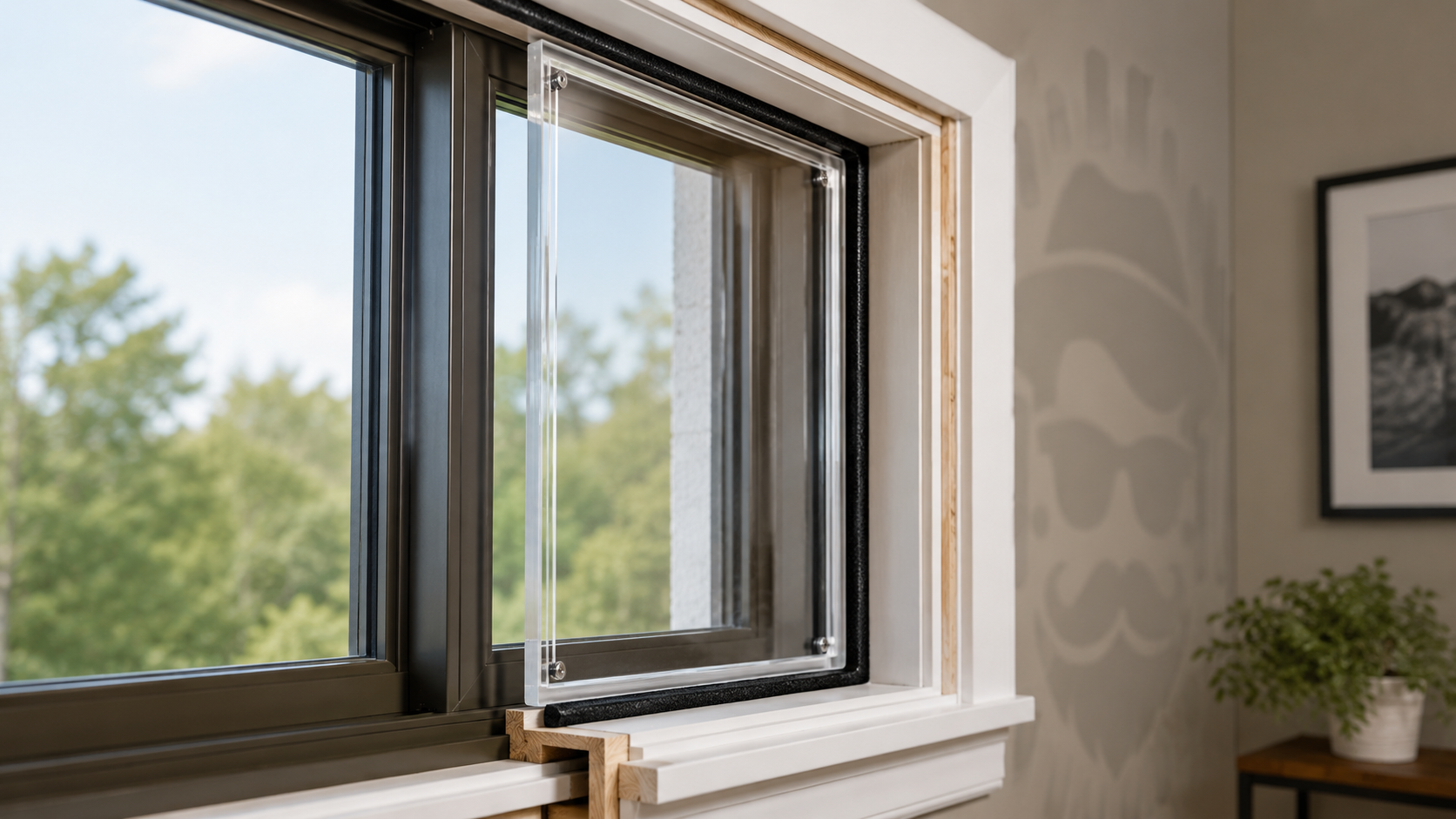
Commercial insert systems use this same principle. For example, current Indow Acoustic Grade inserts use acrylic glazing with compression tubing that presses into the existing interior frame. Their published performance varies according to the original window and installation, which is exactly why I would avoid promising one universal decibel reduction for every DIY insert.
DIY acrylic insert approach
If you are building your own removable insert, the general process is:
- Measure the inside window opening carefully at several points.
- Choose a rigid transparent acrylic or polycarbonate panel suitable for the size of the opening.
- Create a compressible perimeter seal around the insert.
- Fit the panel on the room side of the existing window.
- Check the entire perimeter for gaps rather than relying only on the center of the panel.
- Make sure the insert can be removed safely when you need access to the window.
The deeper the available interior reveal, the more flexibility you have to create separation between the original glazing and the new pane.
Do not permanently obstruct a window that is required for emergency egress, ventilation or access under local building rules.
4. Build a removable soundproof window plug
If you do not need daylight or a view through the window, a removable plug gives you more freedom than a transparent insert.
A basic plug can use a rigid backing, absorptive material inside the room-facing side where appropriate, and a compressible perimeter seal so that the assembly fits snugly into or over the window recess.
The advantages are simple:
- you can use opaque, denser materials;
- the plug can cover the complete opening;
- it can be removed when you want the window back.
The trade-off is equally obvious: while the plug is installed, you normally lose the view and most or all natural light.
A plug also needs to be manageable. There is little value in building an extremely heavy panel that you cannot safely install and remove.
5. Consider secondary glazing when DIY inserts are not enough
Secondary glazing is the more engineered version of the interior-insert idea.
A second glazed system is installed inside the existing primary window rather than removing the original window completely.
For acoustic work, the separation between the two glazing layers and the quality of the perimeter seals matter. Glass manufacturer Pilkington notes that larger gaps used with secondary glazing can materially affect acoustic performance and that the air gaps need to be sealed properly.
This can be particularly attractive for older or historic windows where you want to retain the original exterior appearance.
It is more expensive than weatherstripping or a basic DIY insert, but it remains less disruptive than replacing the complete window assembly.
6. Use heavy curtains as supplementary treatment
Heavy curtains can make a useful difference to the acoustic character of the room, and specialized multilayer acoustic curtains may also reduce some sound entering through the window area.
But curtains are not where I would start if substantial outdoor noise is entering through poorly sealed glazing.
A curtain hangs in front of the problem. It does not normally create the same sealed secondary layer as a properly fitted window insert.
If you want to use curtains:
- extend them well beyond both sides of the window;
- mount them above the top of the opening;
- use enough width for generous folds;
- minimize large gaps at the sides and center;
- use hardware rated for the curtain’s weight.
Our Best Noise-Reducing Blackout Curtains guide goes deeper into which curtain designs are genuinely useful and where their limits are.
7. Know when replacement is the better option
There is a point where continuing to add retrofit treatments stops making sense.
Replacement becomes more reasonable when:
- the existing frame is damaged or badly deteriorated;
- the sash cannot close and seal correctly;
- you need significantly better acoustic performance and cannot accommodate secondary glazing;
- the existing glass and frame are simply the dominant weak point;
- you are already planning a major window renovation.
Do not assume that adding another pane automatically makes a window acoustically excellent. Glass thickness, pane configuration, seals, frame construction and the complete installed assembly all affect performance.
If replacement is on the table, see our Best Soundproof Windows for Home guide rather than trying to turn this DIY page into a replacement-window buying guide.
Which method should you try first?
If the window is visibly drafty or poorly sealed
Start with sealing and weatherstripping.
This is the least expensive problem to eliminate, and there is little reason to build an elaborate insert while obvious gaps remain around the window.
If the window is well sealed but traffic and voices still come through
Look at a sealed interior insert or secondary glazing.
You are now addressing the performance of the glazed opening itself rather than merely plugging leakage around its edges.
If you need maximum DIY isolation and do not care about the view
Consider a removable window plug.
The opaque format lets you use materials you could not use in a transparent insert.
If you rent
Favor reversible treatments.
Replace worn weatherstripping where permitted, use a compression-fit removable insert, or add heavy curtains. Avoid permanent changes to the frame without permission.
If the problem is mild
Weatherstripping plus heavy curtains may be enough.
There is no reason to overbuild a window if you are only trying to soften occasional neighborhood noise.
Common DIY window soundproofing mistakes
Calling every foam product soundproofing
Foam may make a useful gasket or absorptive layer depending on the product, but lightweight foam does not suddenly give a window substantial sound-isolation performance.
Ignoring gaps around the edges
A large new acrylic panel can still disappoint if the perimeter is poorly sealed.
Sound does not care that most of the opening is covered if it still has an easy path around the treatment.
Expecting curtains to replace a second sealed pane
Curtains can be useful supplementary treatment. They are not acoustically equivalent to properly fitted secondary glazing.
Trusting universal percentage or decibel claims
Real results depend on the original window, frequency of the noise, surrounding wall construction, installation quality and other transmission paths.
A result measured for one tested product configuration should not be copied across every window or DIY setup.
Blocking a window that needs to open
A removable insert or plug should remain practical and safe for the room where it is installed. Do not create a noise-control improvement that interferes with required emergency escape or other safety functions.
SPD’s approach to soundproofing an existing window
I would work through the window in this order:
- Stop obvious air leakage.
- Make sure the existing window closes and seals properly.
- Add a sealed interior layer if the glass/opening remains the weak point.
- Use an opaque plug only when losing the view is acceptable.
- Add curtains for supplementary reduction and room comfort.
- Replace the window only when the existing assembly or project requirements justify it.
That order prevents you from spending heavily before solving the simplest weaknesses.
It also keeps the different acoustic jobs clear. Weatherstripping is a seal. An insert is an additional window layer. A plug is a removable barrier. Curtains are supplementary treatment. They should not all be presented as interchangeable “soundproofing materials.”
Frequently asked questions
Can you soundproof an existing window without replacing it?
You can often reduce noise through an existing window without replacing it. The best retrofit depends on the weakness of the window. Air sealing and weatherstripping help with gaps, while a properly sealed interior insert or secondary glazing addresses the glazed opening more substantially.
What is the cheapest way to reduce noise through a window?
If the window leaks air, repairing the seals and weatherstripping is usually the logical first step. It is inexpensive and should be done before considering a more complex insert.
Do acrylic window inserts reduce noise?
They can. A rigid interior pane combined with a good perimeter seal and separation from the original glazing creates a secondary window system. Performance depends heavily on fit, spacing and the original window.
Are soundproof curtains enough for traffic noise?
For mild traffic noise, a heavy well-installed curtain may make the room more comfortable. For intrusive road noise coming primarily through the window, treating the window itself with better sealing or a secondary pane is normally the stronger approach.
Should I use Green Glue around a window?
If you are sealing appropriate interior stationary gaps, use Green Glue Noiseproofing Sealant. Do not use Green Glue Noiseproofing Compound as caulk; the manufacturer specifically separates those two products and functions.
Is double glazing always best for noise?
No. Acoustic performance depends on the complete glazing configuration, pane thicknesses, spacing, seals and frame. Even triple glazing is not automatically better for noise simply because it has another pane.
What works best if I cannot permanently modify the window?
A compression-fit removable insert is one of the strongest reversible options. Heavy curtains and removable plugs are also possibilities depending on whether you need daylight and access to the window.
Final verdict
If you want to soundproof windows yourself, do not start by covering the glass with the first product marketed as “soundproof.”
Start with the actual noise path.
Seal leaks first. If the window itself remains the weak point, an accurately fitted interior insert or secondary glazing is the next serious step. Use removable plugs where blocking the window is acceptable, and treat curtains as supplementary rather than as a substitute for fixing the opening.
If those measures still cannot deliver the isolation you need, that is the point to investigate a properly specified replacement window rather than continuing to stack small fixes onto an inadequate assembly.
Good luck and happy soundproofing!