
Bottom line: Sonicism’s pyramid-style PVC wall tiles and TOUO’s wedge-profile acoustic foam are not substitutes for one another. Choose Sonicism if your priority is a textured decorative finish; consider TOUO if your priority is reducing some reflected sound inside a room. Neither is evidence of reliable sound isolation between rooms, and neither product’s fire or acoustic performance should be inferred solely from seller adjectives. We have not independently installed or laboratory-tested either exact product.
Review method and affiliate disclosure: Pack counts, dimensions and materials are listing-derived descriptions, not measurements performed by this site. The linked product pages use affiliate tracking; a qualifying purchase may support the site. We use specialist acoustic guidance and the published ASTM fire-test definition to distinguish material roles without transferring other products’ ratings to these two items.
Start with the outcome you actually need
Three different projects often get lumped together as “soundproofing.” First is visual wall treatment: covering a plain surface with a textured design. Second is room-acoustic treatment: altering how sound reflects within a space, potentially reducing flutter echo or reverberant buildup. Third is sound isolation: reducing transmission through a wall, door, floor or ceiling. A lightweight decorative tile is not automatically an absorber; a thin foam absorber is not automatically a wall barrier.
Acoustical Surfaces’ acoustics overview separates absorption and diffusion from techniques used to reduce sound leakage. That is the important framework for this comparison. A microphone recording that sounds less splashy inside a room does not prove that neighbors hear less sound through the partition.
At-a-glance comparison
| Question | Sonicism PVC 3D wall tiles | TOUO wedge acoustic foam |
|---|---|---|
| Primary product role | Decorative interior surface | Porous treatment for room reflections |
| Listing-described material | PVC | Polyurethane-based foam |
| Nominal pack | 16 tiles | 12 foam panels |
| Listed face size | 11.8 × 11.8 in each | 12 × 12 in each |
| Listed profile/depth | Conflicting 0.7-in and 2-in dimension descriptions | 1-in nominal thickness |
| Nominal face coverage | About 15.47 ft² from 16 × 11.8-in squares | 12 ft² from 12 × 12-in squares |
| Adhesive in pack | Not stated as included | Not stated as included |
| Verified NRC or isolation rating for exact listing | Not established | Not established |
The Sonicism review previously repeated a 15.36-ft² coverage figure, while multiplying the quoted 11.8 × 11.8-in face by 16 gives 2,227.84 in², or approximately 15.47 ft². The difference may reflect rounded dimensions or listing variation; confirm the selected option rather than treating either estimate as exact usable coverage. The conflicting 0.7-in and 2-in depth descriptions also need seller clarification. TOUO’s nominal 12-ft² calculation likewise excludes cuts and gaps.
Sonicism: a visual pyramid texture
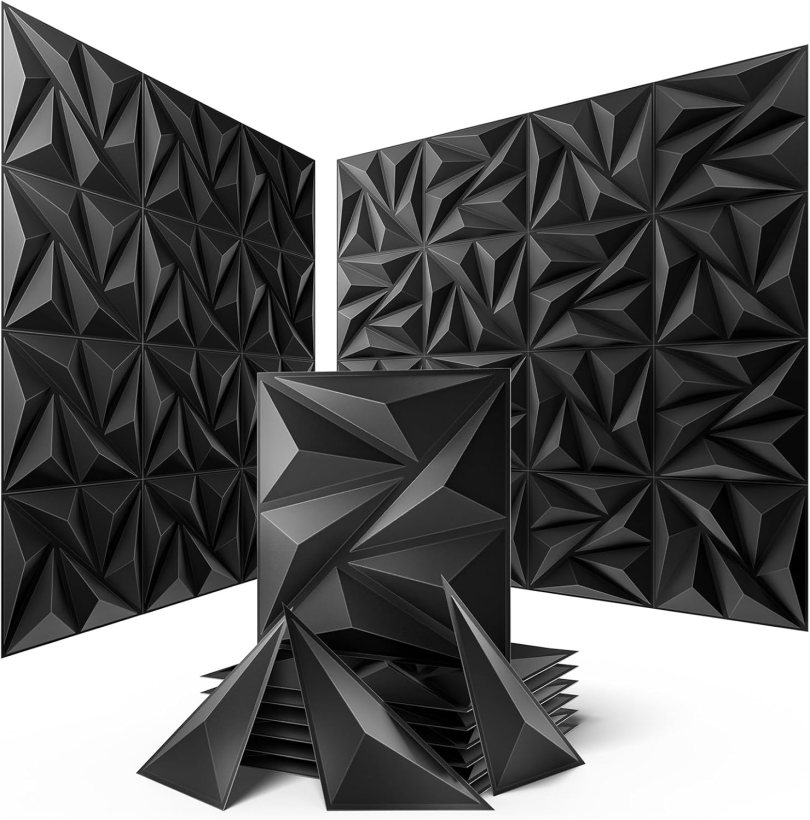
Sonicism is presented as a 16-piece set of charcoal-black, three-dimensional PVC tiles. The visual effect may work as an accent behind a desk, television, gaming setup or feature wall. The pyramid geometry creates visible relief, but appearance alone does not establish meaningful absorption, diffusion or transmission-loss performance. A decorative plastic tile may reflect much of the incident sound; its ridges do not turn it into a tested acoustic diffuser.
The practical buying questions are about the wall surface, tile edges, pattern alignment, paint compatibility and mounting. If the panels require separate construction adhesive, check that the adhesive is approved for both the tile backing and the painted or unfinished substrate. Removing a strongly bonded tile may damage drywall paper or paint. For a rented room, test whether the desired decorative effect justifies the mounting commitment before covering an entire wall.
Seller language about being fire-resistant, waterproof, formaldehyde-free or odorless is not a verified certification in this review. Do not assume suitability near a heater, stove, electrical equipment or an exit route from those descriptions. Ask for the relevant product-specific documentation where code compliance matters.
For the exact appearance and package variation, consult the Sonicism product listing and our published Sonicism vs Art3d comparison for a different decorative-PVC versus ceiling-tile decision.
TOUO: thin wedge foam for reflections

TOUO’s listing describes twelve nominal 12 × 12 × 1-in wedge panels. Open, porous foam can dissipate some incident acoustic energy, so this material category is more relevant than PVC décor for taming sharp reflections. It does not follow that every foam with a wedge shape has the same performance. Cell structure, thickness, density, mounting, air gap and the frequency spectrum all matter.
Acoustic Sciences Corporation’s discussion of room-boundary materials explains why porous treatment depth constrains lower-frequency usefulness. A one-inch foam layer is therefore a poor basis for promising bass control. Independent manufacturers publish frequency-by-frequency absorption tables for their own tested foams, as seen in Acoustical Surfaces’ polyurethane foam data; those numbers cannot be assigned to TOUO without its own applicable laboratory report.
A small 12-ft² pack is more useful as a trial for a specific reflection area than as a claim to fully treat an unknown room. A home-studio user might test a position near an early reflection or close to a source of flutter echo, then listen critically before expanding coverage. Thin foam can also change the perceived high-frequency balance without addressing low-frequency modal problems. If speech intelligibility or a measured reverberation target matters, plan the whole room rather than counting wedge pieces.
See the TOUO listing for the selected variant and our TOUO product review for context.
Neither option is a reliable room-to-room sound barrier
If your objective is to stop voices, television or footsteps crossing a boundary, inspect the actual transmission path: gaps around a door, an unsealed service penetration, a lightweight partition, structural coupling or a flanking route. Isolation designs involve mass, sealing, decoupling and appropriate construction details. Putting a few foam wedges or decorative PVC pyramids on an existing wall is not an evidence-based substitute for that work.
Even where a treatment improves the sound heard inside a room, the change should be described as a reflection or reverberation effect—not as an assumed STC improvement. Without product-specific absorption coefficients, neither product merits an invented NRC score. Without a tested wall assembly, neither merits a transmission-loss figure.
Fire claims require real documentation
The original listings use “flame-retardant” or “fire-resistant” terms. These are not interchangeable with a certified rating for a particular building application. ASTM E84 is a defined test method for comparative surface-burning behavior of building materials. The existence of that standard does not establish that Sonicism or TOUO passed it, let alone that an installation is approved under local code. Request the actual test report, product identity, thickness, installation condition and jurisdictional approval when using panels in public, educational, commercial or other regulated spaces.
Mounting choices also affect safety and maintenance. Do not obstruct smoke detectors, sprinklers, vents, outlets, switches or heat sources. Use only mounting methods approved for the substrate and product. Adhesive residue, foam dust, exposed edges and cleaning needs deserve consideration, particularly in shared spaces.
How to make a defensible purchase decision
- State the goal: visual décor, less reflection, bass control or less sound transmission. If it is bass or isolation, neither listing provides enough evidence for a confident solution.
- Measure the wall: sketch the actual zone and calculate face coverage from the chosen variant; allow for cuts, spacing, doors and obstacles.
- Check installation: find the substrate, acceptable adhesive or removable mounting scheme, and the manufacturer-supported maintenance approach.
- Ask for evidence: if acoustic performance matters, seek laboratory absorption coefficients by frequency; if fire safety matters, seek the applicable fire-test documentation.
- Trial a small area: look for a genuine change in reflections under the same listening conditions. Do not claim soundproofing from a subjective quieter impression.
Which should you buy?
Choose Sonicism when you want a charcoal pyramid accent wall and are satisfied that the tile dimensions, finish and attachment method suit your project. Treat acoustical benefits as unproven. Consider TOUO when you need inexpensive, thin porous material to experiment with room reflections and accept its limited low-frequency reach and lack of verified data for the exact product. If you need predictable studio treatment, prioritize products with usable frequency-specific absorption data; if you need isolation, investigate the wall or door assembly.
Neither choice should rest on a full product title repeated as a keyword or on an unverified fire label. The decision rests on material role, measured dimensions, safe installation and the problem you are solving.
FAQ
Will PVC pyramid panels stop echo?
Not on the evidence available for this listing. A three-dimensional appearance does not demonstrate useful absorption, and plastic surfaces can remain reflective.
Will one-inch foam stop my neighbor hearing me?
No reliable room-to-room isolation improvement can be claimed for these panels. They are intended primarily to affect reflections within a room.
Are either panels fire-certified?
We cannot confirm a product-specific certification from the inspected listing descriptions. Obtain relevant testing and local approval before a safety-sensitive installation.
Is adhesive included?
The compared listing descriptions do not establish included adhesive or mounting hardware for either product. Confirm current package contents and compatibility before checkout.
Good luck and happy soundproofing.