If you are comparing Soundsulate MLV vs Audimute Peacemaker, the important thing to understand is that these products are alternatives for adding mass to a wall, ceiling, or floor assembly—but they are not identical materials.
Soundsulate is conventional mass loaded vinyl (MLV), while Audimute Peacemaker 3 mm is a recycled-rubber sound barrier positioned as an alternative to MLV. Both are primarily intended to help reduce airborne sound transmission when properly incorporated into a building assembly.
For most people, the choice comes down to material preference, installation, environmental considerations, and the soundproofing assembly you are building—not simply which product is thicker or heavier.
Soundsulate vs Audimute Peacemaker: Quick Verdict
| Feature | Soundsulate MLV | Audimute Peacemaker 3 mm |
|---|---|---|
| Material | Mass loaded vinyl | Recycled-rubber sound barrier |
| Main purpose | Reducing airborne sound transmission | Reducing airborne sound transmission |
| Typical installation | Walls, ceilings, floors and other barrier applications | Between layers in walls, ceilings and floors |
| Environmental angle | Conventional MLV construction | Made with 90% post-consumer material |
| Best for | Those who specifically want traditional 1 lb MLV | Those who prefer a recycled-rubber alternative to MLV |
| Impact-noise solution? | No—not its primary purpose | 3 mm version is primarily for airborne sound; Audimute offers a separate 6 mm underlayment for impact applications |
Our verdict: Choose Soundsulate if you specifically want a traditional 1 lb mass loaded vinyl barrier. Choose Peacemaker 3 mm if you want an MLV alternative made largely from recycled material. In either case, installation and the complete wall, ceiling, or floor assembly matter more than the brand name alone.
What Is Soundsulate MLV?
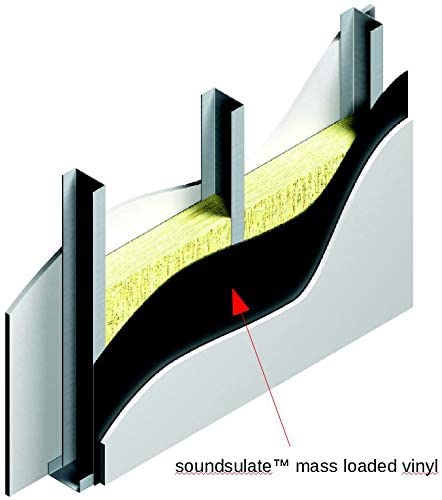
Soundsulate Mass Loaded Vinyl is a dense, flexible sound-barrier material designed to add mass without requiring the thickness of another full layer of drywall or similar rigid material.
The commonly sold 1 lb version weighs approximately one pound per square foot and is roughly 1/8 inch thick. Its current listing gives the material an STC rating of 27 when tested as a material, although the actual performance of your finished wall, ceiling, or floor will depend on the complete assembly.
Soundsulate is intended primarily to help control airborne noise such as voices, music, television and traffic noise. It should not be treated as a dedicated solution for footsteps, impacts, or structural vibration.
Check current Soundsulate MLV availability
What Is Audimute Peacemaker?
Audimute Peacemaker is a flexible recycled-rubber barrier offered as an alternative to conventional MLV.
The version most relevant to this comparison is Peacemaker Sound Barrier 3 mm. Audimute describes it as being made from 90% post-consumer material, including recycled tire rubber.
Like MLV, the 3 mm product is intended to add mass within walls, ceilings, and floors to help reduce airborne sound transmission.
Audimute also sells Peacemaker 6 mm Soundproofing Underlayment, but it serves a different purpose. The thicker flooring product is intended primarily to help control vibration and impact noise beneath finished floors. It should not be assumed that the thicker Peacemaker is automatically the better airborne sound barrier.
View Peacemaker Sound Barrier at Audimute
Soundsulate vs Peacemaker: The Main Differences
1. Material
The most obvious difference is construction.
- Soundsulate: conventional mass loaded vinyl.
- Peacemaker 3 mm: flexible recycled-rubber barrier.
Both are flexible mass barriers, but Peacemaker is not simply another brand of MLV. This distinction matters if material composition or recycled content is part of your buying decision.
2. Airborne Sound Control
Both products are intended primarily for airborne sound transmission when used in appropriate building assemblies.
Examples of airborne noise include:
- voices through a shared wall
- television or music from another room
- outside traffic noise entering through a building envelope
- general room-to-room noise transmission
Neither should be expected to solve every noise problem by itself. Gaps, doors, windows, electrical penetrations, flanking paths, framing, drywall layers and structural connections can all affect the result.
If you are working on a partition rather than comparing materials alone, see our guide to how to soundproof a wall.
3. Impact Noise and Vibration
This is where the distinction is especially important.
Soundsulate MLV is not intended as a dedicated impact- or vibration-control product. If footsteps, dropped objects, machinery vibration or other structure-borne noise are the main problem, simply hanging MLV is unlikely to address the root cause.
Similarly, Peacemaker 3 mm is Audimute’s airborne-sound barrier. For flooring applications where impact and vibration are the concern, Audimute instead offers its 6 mm Peacemaker underlayment.
For more on that type of treatment, see our guide to sound attenuation floor underlayment.
4. Environmental Considerations
This is Peacemaker’s clearest point of differentiation.
Audimute states that Peacemaker is made from 90% post-consumer material, including recycled tire rubber. That makes it appealing to buyers specifically looking for a recycled-material alternative to conventional MLV.
That does not automatically make it the better acoustic product for every assembly, but it is a legitimate difference between the two materials.
If environmental considerations matter to your project, you may also find our guide to eco-friendly soundproofing materials useful.
5. Thickness and Mass
Mass is an important part of sound isolation, but the common advice that “heavier or thicker is always better” is too simplistic.
The acoustic result depends on the entire construction: the barrier, drywall or other rigid layers, air cavity, insulation, decoupling, seams, penetrations and installation quality all influence transmission.
Audimute’s own Peacemaker range illustrates the point. Its 6 mm version is thicker, yet Audimute recommends the 3 mm Peacemaker Sound Barrier when the priority is airborne sound. The thicker product is instead designed as floor underlayment for impact and vibration control.
Is Peacemaker a Mass Loaded Vinyl Alternative?
Yes. Audimute specifically positions Peacemaker 3 mm as an alternative to mass loaded vinyl.
The concept is similar: introduce a flexible, relatively dense barrier into a wall, ceiling, or floor assembly to make airborne sound transmission more difficult.
The difference is that Peacemaker achieves this with a recycled-rubber formulation rather than conventional MLV.
If you are researching other MLV-type products, our AcoustiBlok MLV review covers another established flexible sound-barrier option.
Where Can Soundsulate and Peacemaker Be Used?
Walls
Both materials can be incorporated into wall assemblies to add mass and help reduce airborne sound transmission. They are normally most useful when combined with other sound-isolation principles rather than left exposed as a standalone treatment.
Ceilings
A flexible barrier can also be incorporated into a ceiling assembly where airborne noise between levels is the concern. If footsteps from above are the main complaint, however, the problem is partly impact noise and may require structural or flooring-side treatment as well.
Floors
Soundsulate MLV and Peacemaker 3 mm can form part of assemblies aimed at airborne sound transmission. For footsteps and impact noise, an appropriate resilient underlayment is usually a more relevant starting point.
Installation: What Matters Most
Regardless of which product you choose, careless installation can undermine the benefit of adding a sound barrier.
- Plan the entire assembly. Decide where the barrier will sit in relation to framing, insulation and finished surfaces.
- Maintain continuous coverage. Large untreated gaps create easier paths for sound transmission.
- Deal with seams carefully. Follow the manufacturer’s installation guidance for overlaps, joints or seam treatment.
- Seal penetrations. Electrical boxes, pipes and other openings can become weak points.
- Avoid unnecessary mechanical shortcuts. The barrier needs to remain secure and properly integrated into the construction.
- Consider flanking paths. Sound may bypass the treated surface through adjoining ceilings, floors, ducts or walls.
Remember that a flexible barrier is only one component of a sound-isolation system. Adding another product without addressing major gaps or flanking paths can produce disappointing results.
Soundsulate Pros and Cons
| Pros | Cons |
|---|---|
| Traditional 1 lb MLV construction | Heavy rolls can be awkward to handle |
| Thin relative to the amount of mass added | Not intended to solve impact or vibration noise |
| Flexible and can be cut for different installations | Requires careful installation and continuous coverage |
| Useful in walls, ceilings and floors | Does not replace good overall sound-isolation design |
Audimute Peacemaker Pros and Cons
| Pros | Cons |
|---|---|
| MLV alternative made largely from recycled material | Different thicknesses serve different purposes, which can be confusing |
| Flexible recycled-rubber construction | Rubber odor may be noticeable before the material is enclosed |
| 3 mm version designed for airborne sound barriers | Not a standalone solution for every soundproofing problem |
| Dedicated 6 mm option exists for floor impact/vibration applications | Must be selected according to the type of noise being treated |
Which One Should You Choose?
Choose Soundsulate MLV if:
- You specifically want conventional 1 lb mass loaded vinyl.
- You are building a wall, ceiling, or floor assembly aimed primarily at airborne sound.
- You prefer a well-established MLV format rather than a recycled-rubber alternative.
Check Soundsulate MLV availability
Choose Audimute Peacemaker 3 mm if:
- You want an alternative to traditional MLV.
- Using substantial post-consumer recycled content is important to you.
- Your primary problem is airborne sound transmission through a wall, floor, or ceiling.
Frequently Asked Questions
Is Audimute Peacemaker the same as mass loaded vinyl?
No. Peacemaker is a recycled-rubber sound barrier. Audimute positions the 3 mm version as an alternative to MLV, rather than as mass loaded vinyl itself.
What is Peacemaker Sound Barrier used for?
The 3 mm Peacemaker Sound Barrier is intended to help reduce airborne sound transmission when installed within walls, ceilings, and floors.
Is Peacemaker good for footsteps?
For footsteps and similar impact noise, Audimute’s 6 mm Peacemaker Soundproofing Underlayment is the more relevant version. The 3 mm product compared in this article is primarily an airborne-sound barrier.
Does Soundsulate stop impact noise?
Soundsulate’s current MLV product information specifically identifies it as an airborne-noise barrier, not a product intended to stop impacts or structural vibration such as footsteps from above.
What STC rating does Soundsulate MLV have?
The current 1 lb Soundsulate MLV listing gives the material an STC rating of 27. Do not assume that means your finished wall will automatically have an STC of 27; the final assembly has its own performance characteristics.
Is thicker Peacemaker better?
Not necessarily. Audimute specifically distinguishes the products by application: 3 mm Peacemaker is its airborne sound barrier, while 6 mm Peacemaker is designed primarily as flooring underlayment for impact and vibration control.
Final Verdict: Soundsulate vs Audimute Peacemaker
There is no universal winner between Soundsulate MLV and Audimute Peacemaker.
Soundsulate is the more straightforward choice if you specifically want traditional 1 lb mass loaded vinyl for airborne-noise control. Peacemaker 3 mm is compelling if you want a recycled-rubber MLV alternative with a high proportion of post-consumer material.
The more important decision is whether either material matches the type of noise you are treating and whether it is being installed as part of a well-designed sound-isolation assembly. Neither should be treated as a magic sheet that will soundproof a room by itself.
For airborne sound, compare the complete wall, ceiling, or floor design. For footsteps or structural vibration, look instead at decoupling and appropriate impact-noise treatments.
Good luck and happy soundproofing!