
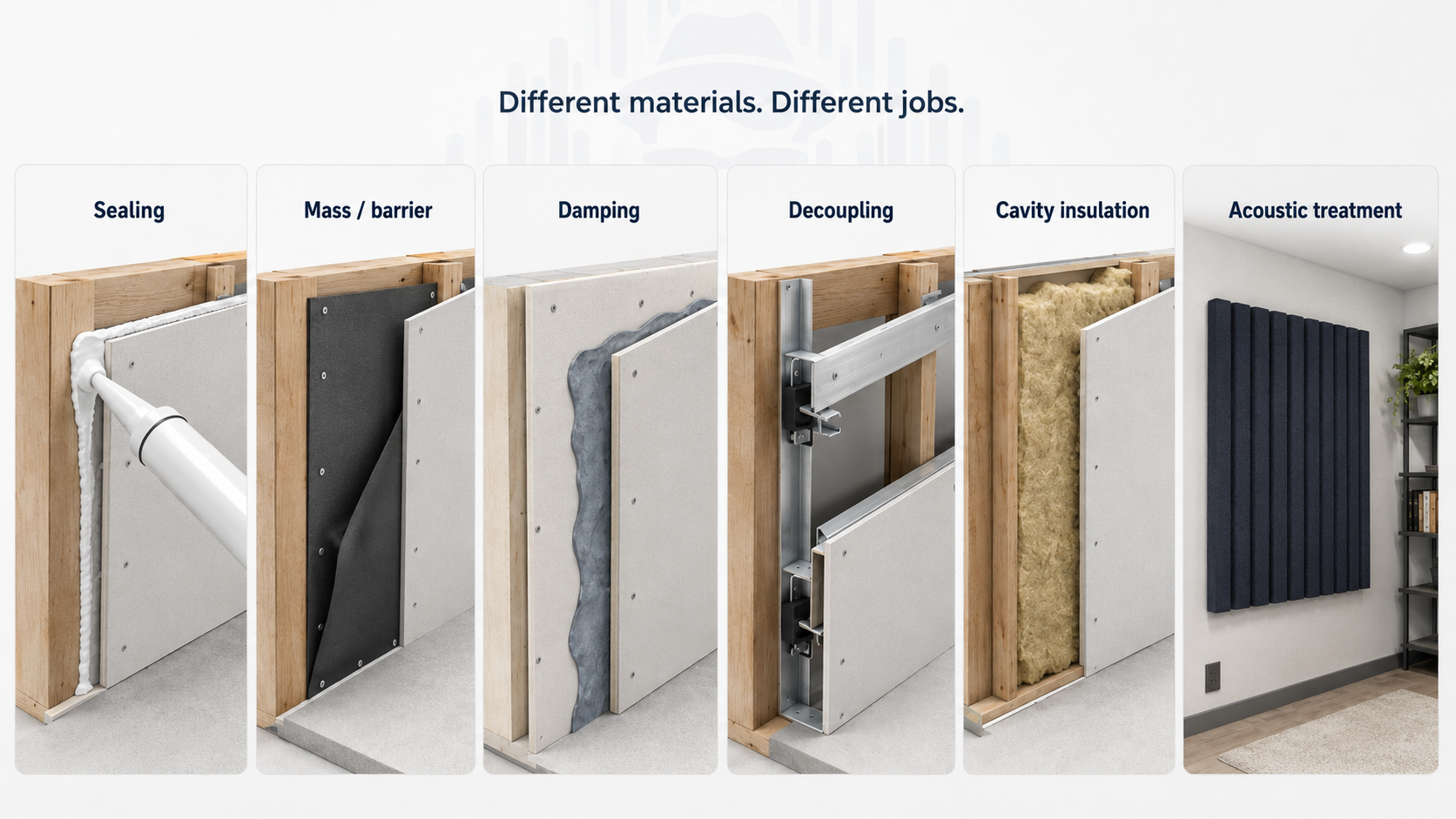
The best soundproofing material depends on what the noise is doing and which part of the building assembly you need to change. A sealant that closes an air gap, a dense barrier that adds mass, a damping compound between drywall layers and an acoustic panel on a finished wall all perform different jobs.
Start here: If the problem is echo within a room, compare absorptive panels. If voices or traffic are passing through a wall, investigate the complete wall assembly, including gaps, mass and flanking paths. If footsteps are the issue, examine the floor/ceiling impact path. Use the comparison table below to identify the appropriate material category before choosing a product.
That is the main point to understand before buying anything: soundproofing materials are not interchangeable.
If sound is leaking through gaps, you need sealing. If a lightweight wall needs more resistance to airborne sound, mass may help. If rigid layers are vibrating together, damping can be useful. If structure-borne vibration is passing directly through framing, decoupling may matter. If the problem is echo inside the room rather than sound passing through the wall, you are dealing with acoustic treatment instead.
SPD’s approach is therefore to choose the function first and the product second.
Soundproofing Materials at a Glance
| Material or method | Main acoustic job | Typical use | What it does not replace |
|---|---|---|---|
| Acoustic sealant | Seal air gaps | Drywall perimeters, penetrations, joints and small gaps | Mass, damping or decoupling |
| Mass-loaded vinyl or other dense barrier | Add mass against airborne sound | Walls, floors, ceilings and selected retrofit assemblies | Proper sealing or structural isolation |
| Damping compound | Reduce vibration between rigid layers | Between layers of drywall or other compatible rigid panels | Absorptive cavity insulation |
| Isolation clips / resilient channel | Reduce direct structural coupling | Walls and ceilings | Mass and sealing |
| Mineral wool or fiberglass | Absorb acoustic energy inside cavities | Stud walls, joist cavities and ceilings | A dense standalone sound barrier |
| Acoustic panels / foam | Reduce reflections and echo inside a room | Studios, offices, theaters and reverberant rooms | Structural sound isolation |
| Floor underlay | Reduce impact transmission and provide separation | Under finished flooring | Whole-room airborne soundproofing |
| Window inserts | Improve the weak window opening | Existing windows exposed to exterior noise | Treatment of walls, ceilings or other flanking paths |
The strongest sound-control assemblies normally combine several of these functions rather than asking one material to do everything.
1. Acoustic Sealant: Best for Air Gaps and Leakage
Sound can travel through surprisingly small openings. A wall assembly may contain substantial insulation and multiple drywall layers, yet gaps around the perimeter, electrical boxes, pipes or other penetrations can still provide an easier path for airborne sound.
Acoustic sealant is used to maintain flexible seals at those vulnerable joints.
Typical locations include:
- the perimeter of drywall assemblies;
- small gaps between building elements;
- service penetrations where the approved assembly allows sealing;
- joints around acoustic barriers;
- other leakage paths identified during construction.
The important boundary is that sealant closes gaps; it does not replace the mass or structural design of the wall.
A tube of acoustic sealant cannot turn a lightweight single-layer partition into a high-performance isolation assembly. But leaving critical gaps unsealed can undermine otherwise sensible construction.
2. Mass and Dense Barriers: Best for Resisting Airborne Sound
Adding mass is one of the fundamental tools used to reduce airborne sound transmission through building assemblies.
Examples include additional drywall layers and dense flexible barriers such as mass-loaded vinyl.
Mass-loaded vinyl, usually shortened to MLV, is useful because it provides substantial mass in a comparatively thin flexible format. That can make it attractive where adding another thick rigid board is difficult.
But MLV is not automatically the best choice for every wall.
It is:
- heavy;
- relatively expensive compared with some conventional construction materials;
- more difficult to handle as sheet size increases;
- dependent on sensible seams and perimeter detailing;
- only one part of the complete assembly.
In some projects, another layer of drywall may be more practical. In others, the thinner profile of a flexible barrier makes MLV useful.
If you are deciding whether MLV is the right material for your project, our Mass Loaded Vinyl guide explains weight per square foot, 1 lb vs 2 lb MLV, construction types, STC claims and installation factors.
For product-level comparisons, see our Best Mass Loaded Vinyl guide.
For a deeper look at where dense barriers belong in walls, floors and exterior noise-control systems, see our Sound Barriers for Homes guide.
3. Damping Compounds: Best Between Rigid Layers
Damping tackles a different problem from simply adding mass.
A viscoelastic damping compound used between compatible rigid layers is intended to reduce the vibration of those layers as sound energy passes through the assembly.
Green Glue Noiseproofing Compound is the best-known example in residential soundproofing, but its role is often misunderstood.
It is not acoustic caulk, and it is not normally used as a standalone exposed layer. Its intended role is between rigid construction panels such as layers of drywall.
That distinction matters because the old idea that a material can simply be labeled “soundproofing compound” and used anywhere is misleading.
A common practical assembly is:
existing or first drywall layer → damping compound → second drywall layer.
The added drywall supplies mass while the damping layer addresses vibration between the rigid sheets. Those are two different acoustic functions working together.
If you are deciding between conventional layered drywall and specialist acoustic boards, our Best Soundproof Drywall guide compares the main approaches.
4. Decoupling: Best for Reducing Structural Vibration Transfer
Even a heavy wall can transmit vibration efficiently when both finished surfaces are rigidly connected through the same framing.
Decoupling changes that structural path.
Common approaches include:
- resilient channel;
- isolation clips with compatible channel;
- double-stud construction;
- staggered-stud assemblies in appropriate designs.
The purpose is not to “absorb” sound in the way acoustic foam does. The aim is to reduce the direct mechanical connection through which vibration can pass from one side of an assembly to the other.
This is also one of the areas where installation quality matters greatly.
A resilient system can lose much of its intended benefit if rigid fasteners accidentally reconnect the isolated drywall to the framing or if the channel, clips and supported load are not installed according to the relevant system requirements.
So I would not choose resilient hardware merely because it appears to be the most technically advanced option. Use it when the assembly justifies decoupling and when it can be installed correctly. For ceiling-specific buying options, see our best ceiling sound isolation clips guide.
5. Mineral Wool and Fiberglass: Best Inside Wall and Ceiling Cavities
Mineral wool and fiberglass are widely used inside stud and joist cavities because fibrous insulation can absorb acoustic energy within the enclosed space.
That makes cavity insulation useful, but the description needs an important boundary:
cavity insulation is not the same thing as a heavyweight sound barrier.
Putting mineral wool between studs can improve the acoustic behavior of a wall assembly, but the finished result still depends on other variables including:
- the framing arrangement;
- drywall mass;
- decoupling;
- sealing;
- doors and windows;
- penetrations;
- flanking paths.
This is why SPD avoids describing a batt of mineral wool as though it independently “soundproofs a wall.” It contributes to the assembly.
For wall-specific product selection, see our wall soundproofing and insulation buyer’s guide.
6. Acoustic Foam and Panels: Best for Echo and Reflections
This is where one of the most persistent soundproofing misunderstandings appears.
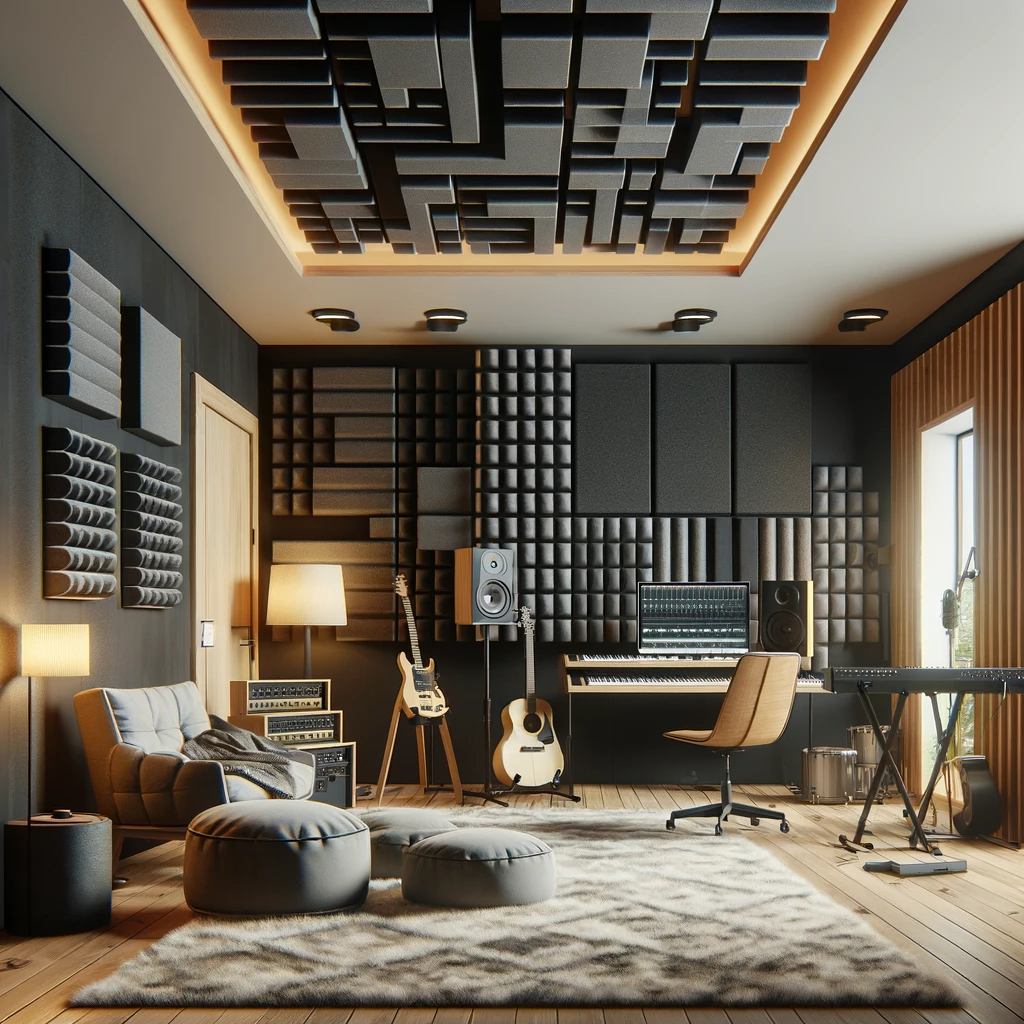
Acoustic foam and absorptive wall panels can be very useful materials—but their main job is usually room acoustic treatment.
They help control:
- reflections;
- flutter echo;
- excess reverberation;
- speech and recording clarity;
- the general acoustic character of the room.
That is valuable in studios, offices, home theaters, podcast rooms and other spaces where the sound inside the room needs improvement.
It is a different objective from stopping your neighbor’s television, traffic noise or music from traveling through the wall.
Thin foam attached to the visible surface of a wall does not suddenly give that wall the mass and structural isolation of a purpose-built sound-control assembly.
For a deeper explanation, see Do Soundproof Foam Panels Work?. If you are actually choosing acoustic foam for reflection control, our acoustic foam buyer’s guide covers that separate use case.
7. Floor Underlay: Best for Impact Noise
Floors introduce another type of noise problem: impact.
Footsteps, dropped objects and furniture movement can excite the structure directly. A suitable acoustic underlayment can help reduce the mechanical transmission between the finished flooring and the structure below.
Underlay products vary substantially by material, density, thickness, flooring compatibility and assembly design, so “soundproof underlay” should not be treated as one universal category.
The relevant question is usually:
>
What type of noise is the floor assembly trying to control, and which underlayment is approved for the finished flooring above it?
Impact-noise performance should also not be confused with complete airborne isolation between floors. A successful floor/ceiling system may need more than underlay alone.
8. Window Inserts: Best When the Window Is the Weak Point
Windows are often acoustically weaker than the surrounding wall because they contain relatively lightweight transparent elements, frames, seals and operable joints.
An interior window insert can improve that specific opening by introducing another sealed layer and additional separation from the existing glass.
That can be a much more targeted approach than adding material to an already adequate wall when the dominant noise is actually entering through the window.
But inserts do not fix every noise path.
If sound is flanking through walls, vents, the roof or other structural paths, upgrading only the window may leave a substantial amount of noise untouched.
What About Soundproof Curtains?
Heavy curtains are useful for privacy, light control, thermal comfort and some acoustic absorption, but the phrase soundproof curtain often creates unrealistic expectations.
A curtain is not a sealed, rigid building assembly.
Heavy multilayer curtains may:
- reduce some reflections inside a room;
- soften high-frequency energy around a window area;
- provide a modest supplementary layer over an opening;
- improve comfort alongside other window treatments.
They should not be treated as a direct substitute for a properly sealed acoustic window, secondary glazing or a high-mass wall system.
Sound Absorbing Materials vs Sound Blocking Materials
This distinction is worth making explicit because search results and product marketing often mix the two.
Sound-absorbing materials primarily reduce acoustic energy and reflections within a room or cavity.
Examples include:
- mineral wool;
- fiberglass;
- acoustic panels;
- acoustic foam;
- other porous absorbers.
Sound-blocking or sound-isolation assemblies rely more heavily on combinations of:
- mass;
- airtightness;
- damping;
- decoupling;
- careful construction detailing.
The two categories overlap in complete assemblies, but they are not synonyms.
A material can be excellent at absorbing reflections while being a poor standalone barrier against sound passing from one room to another.
Which Soundproofing Material Is Best for Walls?
For walls, I would not start by naming one product.
Start with the construction.
If you have an open stud wall, a strong system might combine:
- cavity insulation;
- appropriate framing or decoupling;
- substantial drywall mass;
- damping where justified;
- careful perimeter and penetration sealing.
If the wall is already finished and demolition is undesirable, the options narrow. Adding another rigid layer with damping may be more practical than rebuilding the framing. A surface-mounted acoustic panel may improve room reflections but will not perform the same job.
So the “best wall material” depends heavily on whether you are building, remodeling or treating an already finished room.
Which Materials Are Best for Ceilings?
Ceilings often require attention to both airborne and structure-borne transmission.
Depending on the construction and noise source, a ceiling project might involve:
- cavity insulation;
- isolation clips and channel;
- additional gypsum mass;
- damping between rigid layers;
- perimeter sealing.
Impact noise from the floor above is a different mechanism from airborne voices or television sound. In difficult cases, treating only the ceiling from below may also be less effective than addressing the floor assembly above.
If your goal is improving room absorption or choosing tiles for an existing suspended ceiling rather than rebuilding the isolation assembly, our Best Acoustic Ceiling Tiles guide compares tile types, NRC and CAC ratings, drop-ceiling options and where acoustic tiles can and cannot help.
Which Materials Are Best for Floors?
For floors, first separate impact noise from airborne noise.
Impact-noise treatment commonly involves resilient underlay or another suitable separation layer beneath the finished floor.
Airborne isolation may depend more heavily on the complete floor/ceiling assembly, including mass, cavities, insulation and decoupling.
Again, the correct answer is a system rather than one universally “best” roll or panel.
Which Soundproofing Materials Are Best for a Finished Room?
If you cannot open the walls, prioritize the changes that address the actual weak points.
That can include:
- sealing obvious gaps;
- improving doors and door seals;
- treating weak windows;
- adding another rigid wall layer where practical;
- addressing specific flanking paths;
- adding acoustic treatment only when room reflections are also a problem.
Before buying materials, our broader guide to soundproofing a room can help you identify where the noise is actually entering.
What Is the Best Soundproofing Material Overall?
There isn’t one.
If I had to reduce the decision to one rule, it would be:
Choose the material that performs the acoustic function your assembly is missing.
| Your problem | Start by investigating |
|---|---|
| Sound leaking through cracks or joints | Sealing |
| Lightweight partition transmitting voices or TV | Mass, sealing and complete wall construction |
| Rigid layers resonating | Damping |
| Vibration transferring through common framing | Decoupling |
| Empty wall or ceiling cavity | Cavity insulation as part of the complete assembly |
| Echo inside the room | Acoustic treatment |
| Footfall through a floor | Impact-isolation / underlay system |
| Exterior noise dominated by a window | Window sealing, secondary layer or insert |
Common Soundproofing Material Mistakes
The most common failures are usually not caused by buying a completely useless material. They happen because a useful material is assigned the wrong job.
- Using acoustic foam to block neighbor noise. Foam primarily treats reflections.
- Expecting mineral wool alone to soundproof a wall. It works inside an assembly.
- Installing damping compound as sealant. Damping compound and acoustic sealant perform different functions.
- Adding mass while leaving large air gaps. Leakage can undermine the assembly.
- Installing resilient channel incorrectly. Accidental rigid connections can compromise decoupling.
- Choosing MLV only because it is marketed as a sound barrier. Weight, cost, seams and installation practicality matter.
- Treating every noise problem as airborne noise. Impact and structure-borne vibration require different thinking.
SPD’s Approach to Choosing Soundproofing Materials
At SPD, I would build the material list only after answering three questions:
- What noise are we trying to control?
- How is it reaching the listener?
- Which acoustic function is missing from the existing assembly?
That keeps the project grounded.
If the weakness is an unsealed perimeter, seal it. If the partition is too light, investigate mass. If the layers vibrate, damping may help. If framing is carrying vibration directly, consider decoupling. If the room itself is too reflective, use acoustic treatment rather than pretending the problem is sound transmission.
It is usually more effective to combine a few correctly chosen functions than to buy a large quantity of one material and use it everywhere.
FAQ
What material blocks sound the best?
No single material can be identified as best without knowing the assembly. Dense materials can contribute strongly to airborne sound isolation, but real performance also depends on sealing, framing, damping, decoupling and flanking paths.
What is the best soundproofing material for a bedroom?
First identify the dominant path. Door gaps may need seals, a weak wall may need construction changes, a window may need an insert or improved sealing, and echo inside the room may need absorptive treatment. These are different problems.
Does acoustic foam soundproof a room?
No. Acoustic foam is mainly used to control reflections and reverberation inside a room. It can improve room acoustics without providing the mass and structural isolation needed to substantially stop sound transmission through walls.
Is mineral wool better than acoustic foam?
They usually serve different roles. Mineral wool is commonly used inside building cavities or in purpose-built absorptive panels, while exposed acoustic foam is primarily room treatment. One is not universally “better” than the other.
Is MLV better than extra drywall?
It depends on the project. MLV offers substantial mass in a thin flexible layer, while drywall can often provide mass more economically. Space, weight, cost, installation details and the complete assembly should determine the choice.
Do resilient channels absorb sound?
Their primary role is decoupling, not absorption. They are used to reduce direct mechanical connection between the finished surface and the supporting structure.
Can soundproofing materials completely eliminate noise?
No practical residential material guarantees complete silence. Sound can travel through multiple paths, including walls, floors, ceilings, doors, windows, ducts and structural connections. The realistic goal is meaningful reduction through a properly designed system.
Final Verdict
The best soundproofing material is the one that solves the acoustic problem you actually have.
Sealants close leakage paths. Dense barriers and drywall add mass. Damping compounds control vibration between rigid layers. Isolation hardware reduces structural coupling. Mineral wool and fiberglass manage acoustic energy inside cavities. Acoustic panels and foam control reflections inside the room.
Once those functions are separated, choosing materials becomes much easier—and you are far less likely to spend money asking the wrong product to do a job it was never designed for.
Good luck and happy soundproofing!