
TotalMass is a legitimate mass loaded vinyl (MLV) barrier, but it makes the most sense when you need a thin, heavy and flexible layer for reducing airborne sound transmission. It is not an echo absorber, it will not solve footfall noise, and adding it to an already well-decoupled wall does not automatically improve the result.
The current TotalMass range includes 1/2 lb, 1 lb and 2 lb versions. The important question is therefore not simply whether TotalMass “works,” but whether MLV is the right material for the assembly and noise problem you are trying to fix.
What Is TotalMass MLV?
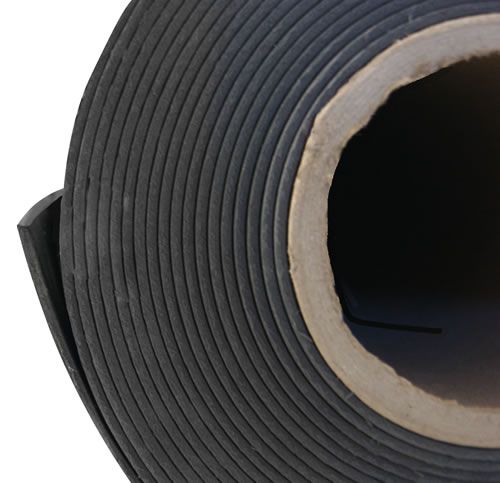
TotalMass is a flexible mass loaded vinyl barrier sold for sound-isolation applications. Instead of filling a cavity like insulation or treating reflections like an acoustic panel, MLV adds a relatively thin layer of mass while remaining flexible.
That flexibility is useful when ordinary rigid building materials are awkward to install. MLV can be incorporated into framed walls, wrapped around pipes or ducts, hung as a barrier, or used in other applications where a heavy sheet is easier to work with than another layer of board.
The key distinction is that TotalMass is a barrier material. It is not intended to absorb room echo in the way fiberglass, mineral wool, PET panels or acoustic foam do.
Current TotalMass MLV Specifications
The current product range is offered in three weight classes. These are not simply different roll sizes: increasing the weight per square foot also increases thickness, total roll weight and the amount of mass being added to the assembly.
| Version | Current listed size | Thickness | Approx. roll weight | Listed standalone STC |
|---|---|---|---|---|
| 1/2 lb MLV | 4 ft × 25 ft — 100 sq ft | 1/16 in (1.2 mm) | 52 lb | 22 |
| 1 lb MLV | 4 ft × 25 ft — 100 sq ft or 4 ft × 10 ft — 40 sq ft |
1/8 in (2.6 mm) | 102 lb or 42 lb | 27 |
| 2 lb MLV | 4 ft × 15 ft — 60 sq ft | 1/4 in (5 mm) | 122 lb | 32 |
The 1 lb version is the conventional middle ground and the one most people associate with standard MLV. The lighter 1/2 lb material makes more sense where handling weight and flexibility matter, while the 2 lb version provides substantially more mass but also becomes much heavier to move, support and install.
Understanding the TotalMass STC Ratings
This is the part of the product that is easiest to misunderstand.
TotalMass currently lists STC figures of 22 for the 1/2 lb material, 27 for the 1 lb material and 32 for the 2 lb material. Preserve those as source-published figures, but interpret them with the associated test method, specimen or construction rather than as universal standalone material ratings. They are not predictions for the finished STC of your wall, ceiling or floor.
A complete partition has its own framing, drywall, insulation, air cavity, fasteners, seams, penetrations and structural connections. Change any of those and the performance can change as well.
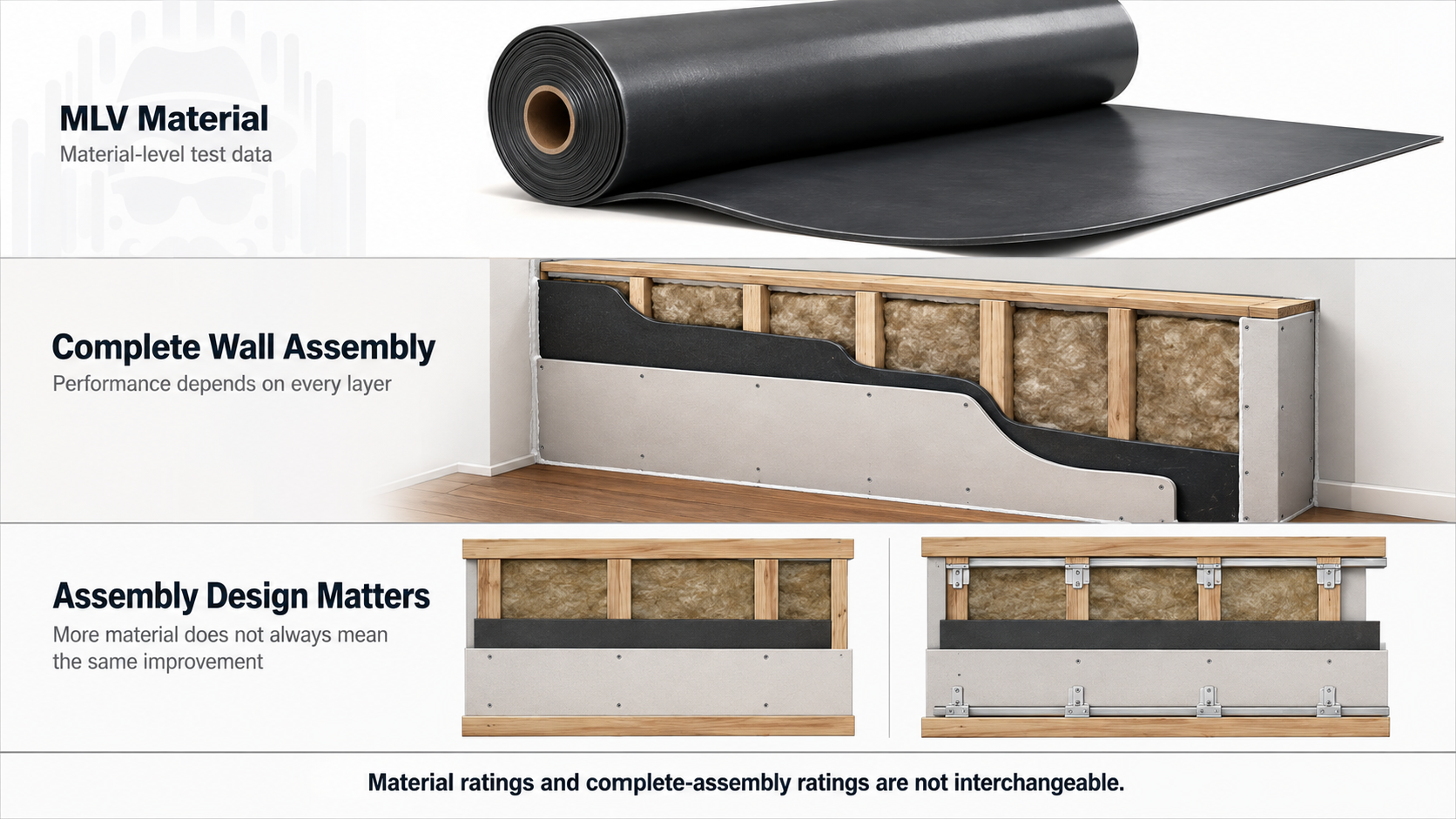
One wall test currently published for TotalMass illustrates this difference well. A wood-stud wall with R-13 insulation and one 5/8-inch drywall layer on each side was reported at STC 37. Adding 1 lb TotalMass to that specific assembly increased the reported result to STC 45.
That is useful evidence that MLV can contribute meaningfully in the right construction. It does not mean adding 1 lb MLV gives every wall eight STC points. The result belongs to that tested assembly.
Where TotalMass MLV Makes the Most Sense
Basic framed walls
TotalMass can be useful in a conventional stud wall when you want more acoustic performance without substantially increasing wall thickness. A continuous MLV layer introduces additional flexible mass to the construction; its primary role here is contributing to airborne sound isolation rather than acting as a dedicated vibration-damping treatment.
That can be attractive during a renovation where adding several more rigid layers would create problems around trim, electrical boxes, doors or available floor area.
Pipes, ducts and mechanical equipment
Flexible MLV is particularly useful where a rigid sheet material would be difficult to apply. Pipes, ductwork and some mechanical enclosures are good examples because the material can be wrapped or formed around irregular shapes.
That flexibility is one of the strongest practical reasons to choose MLV over simply adding more drywall.
Doors, windows and removable barriers
The lighter version can also be used where a hanging or removable barrier is more practical than permanent construction. The important requirement is still continuity: large gaps around an otherwise heavy barrier can undermine the benefit.
Fences and partitions
MLV can work as part of a solid outdoor or partition barrier when it is installed continuously and the overall structure is suitable for the weight and environment.
If you want the broader principles behind this type of application, see our guide to sound barriers for homes and outdoor noise.
Where TotalMass Is Not the Right Solution
Echo and room acoustics
TotalMass is not an acoustic treatment panel. If your problem is a room that sounds hollow, bright or reverberant, adding hidden MLV behind the wall is usually solving the wrong problem.
Echo control calls for absorptive treatment inside the room. MLV is aimed primarily at sound transmission through a barrier.
Footfall and impact noise
MLV should not be treated as an impact-noise underlayment. Footsteps and other impacts excite the building structure directly, so isolation and resilient flooring systems are normally more relevant than simply adding a heavy vinyl sheet.
The current TotalMass guidance specifically distinguishes these problems and does not position MLV as a solution for footfall isolation.
Concrete subfloors
Adding MLV over an already massive concrete slab is generally a poor use of the material. The slab already provides substantial mass, while common floor complaints often involve impact transmission rather than insufficient barrier weight.
Already-decoupled walls and ceilings
This is one of the most important limitations in the review.
If a wall or ceiling already uses properly designed isolation clips and hat channel, adding MLV may produce little or no meaningful improvement. In that type of assembly, the major gain is already coming from mechanical decoupling.
More layers do not automatically mean a better acoustic system. Once an assembly has been designed around decoupling, money may be better spent on appropriate drywall mass, damping, sealing or correcting flanking paths rather than adding MLV simply because there is room for it.
Which TotalMass Weight Should You Choose?
| Weight | Best reason to consider it | Main drawback |
|---|---|---|
| 1/2 lb | Lightweight, hanging, flexible or irregular applications | Less mass than the heavier versions |
| 1 lb | General-purpose MLV for walls and many conventional barrier applications | A full roll still weighs over 100 lb |
| 2 lb | Projects where substantially more mass is justified and can be supported | Heavy, harder to handle and not automatically better in every assembly |
SPD’s default starting point for a typical MLV application would usually be the 1 lb version. It gives you the conventional MLV density without immediately jumping to the handling burden of the 2 lb material.
The heavier material should be chosen because the assembly benefits from it, not because “2 lb” automatically sounds twice as effective.
Installation Considerations
MLV is flexible, but that does not mean a full roll is easy to handle. The 4-by-25-foot 1 lb roll is listed at roughly 102 pounds, while the 2 lb roll is about 122 pounds despite covering less area.
Plan the installation before lifting the material into place. Depending on the application, TotalMass can be secured mechanically with suitable fasteners. Wide washers or comparable support can help prevent the material from tearing around attachment points.
Continuity also matters. Avoid unnecessary gaps, tears and open seams. Where the design requires a continuous barrier, compatible seam treatment should be used so the installation does not become a heavy sheet surrounded by easy leakage paths.
Electrical boxes, vents, doors, framing transitions and other penetrations still matter. MLV cannot compensate for major untreated sound paths elsewhere in the room.
TotalMass vs Other Soundproofing Methods
| Method | Main job | Where it has an advantage over MLV |
|---|---|---|
| TotalMass MLV | Adds thin, flexible mass and helps resist airborne transmission | Irregular surfaces, thin-profile barriers and installations where rigid board is awkward |
| Additional drywall | Adds rigid mass | Often simpler and more economical when wall thickness is not a problem |
| Damping compound | Reduces vibration between rigid layers | Useful when building a layered drywall assembly |
| Isolation clips/channel | Decouples the finished surface from the structure | Can deliver much larger isolation gains in properly designed walls and ceilings |
| Cavity insulation | Absorbs energy inside the framing cavity | Addresses cavity resonance rather than adding barrier mass |
These materials are not interchangeable. A good soundproofing system uses each component for the job it actually performs.
For the broader material-selection picture, see our guide to soundproofing materials and where each type works best.
Is TotalMass MLV Worth It?
Yes, when the project genuinely benefits from thin, flexible mass.
TotalMass makes particular sense when wall thickness is constrained, when you are dealing with ducts or other irregular surfaces, when a hanging barrier is useful, or when you want to upgrade a relatively basic assembly without moving into a full decoupling rebuild.
It becomes much harder to justify when:
- impact or footfall noise is the real problem;
- the assembly already uses effective isolation clips or resilient decoupling;
- a concrete structure already provides substantial mass;
- ordinary drywall can add the required mass more economically;
- the actual weak path is a door, vent, opening or flanking route elsewhere.
If you want to check the current 1 lb, 4-by-25-foot marketplace listing, view TotalMass 1 lb MLV on Amazon. Check the current size, seller and availability before ordering because marketplace listings can change.
TotalMass vs Other MLV Brands
TotalMass should not be judged as though it uses a completely different acoustic principle from every other properly manufactured MLV product. Density, thickness, flexibility, roll dimensions, consistency, current pricing and reliable test information are more useful decision factors than branding alone.
TotalMass is marketed as particularly flexible compared with some stiffer generic MLV. That may matter during installation, especially around irregular surfaces, but flexibility should not be confused with proof of superior acoustic performance.
For a product-specific decision, our TotalMass vs TroyStudio MLV comparison explains the trade-off between TotalMass’s large rolls and TroyStudio’s compact fabric-backed sheets.
For a direct comparison with a compact 2 lb sheet and tile format, see our TotalMass vs ArrowZoom MLV comparison, including coverage, handling, installation and STC claim context.
If you are comparing TotalMass with other current options rather than deciding whether MLV itself is appropriate, use our Best Mass Loaded Vinyl guide. That broader buyer guide owns the brand-comparison decision; this page is specifically about TotalMass.
Frequently Asked Questions
Does TotalMass MLV absorb echo?
No. TotalMass is a barrier material used primarily to reduce sound transmission. Echo and reverberation inside a room are better addressed with absorptive acoustic treatment.
Does an STC 27 rating mean my wall will be STC 27?
No. The listed STC 27 figure should be interpreted with the associated test method, specimen or construction rather than treated as a universal rating for the 1 lb MLV material in every installation. Your completed wall has its own STC performance based on the entire construction assembly.
Will 2 lb TotalMass always outperform 1 lb MLV?
Not in every real-world assembly. It adds more mass, but the final result also depends on framing, existing mass, damping, decoupling, sealing and flanking paths. More material can also deliver diminishing returns.
Can TotalMass reduce footstep noise through a floor?
It is not the material we would choose specifically for impact or footfall isolation. Resilient underlayments and structural isolation are generally more relevant to that problem.
Should I add MLV to a wall that already uses isolation clips?
Usually not as the first upgrade. Current published testing for TotalMass indicates little or no additional STC benefit when MLV is added to properly decoupled clip/channel systems.
Can TotalMass be used around pipes and ductwork?
Yes. This is one of the applications where flexible MLV can be particularly practical because it can conform to shapes that would be awkward to treat with rigid sheet materials.
Can TotalMass completely soundproof a room?
No single MLV sheet can do that. Sound can travel through walls, ceilings, floors, doors, windows, vents, structural connections and other flanking paths. TotalMass can contribute to a good system, but it does not eliminate every transmission route.
SPD’s Verdict on TotalMass MLV
TotalMass is a credible MLV option, but its value comes from using it where flexible mass actually solves a problem.
We like it most for conventional wall upgrades, thin-profile barrier applications, ducts and pipes, removable or hanging barriers, and other situations where rigid mass is impractical.
We would not buy it simply because an STC number looks impressive. We would first identify the noise path and the existing assembly. If the project really needs impact isolation, stronger decoupling or better sealing, spending the same budget on MLV may do very little.
That is SPD’s approach: choose the acoustic function first, then choose the material.
Good luck and happy soundproofing!
Comments are closed.