
Table of Contents
Introduction
When selecting a mass loaded vinyl (MLV) solution for construction-based soundproofing, both AcoustiBlok MLV and TotalMass MLV emerge as prominent options. This comparison explores the factual differences and specific use-case considerations based on verified manufacturer-sourced documentation and product reviews. Each product serves industrial or structural use, yet differs in composition, flexibility, and application context.
How This Comparison Was Built
This article draws solely from verified, source-locked material, including the original AcoustiBlok MLV review and the TotalMass MLV review. Where relevant, factual corroboration was cross-checked for explicit alignment and product scope clarity. No inferences or assumptions beyond the original content have been included.
Key Decision Factors Identified From the Source Content
Several primary factors emerged as critical for evaluating these two MLV products:
- STC rating at specific weight and thickness levels
- Material composition and chemical properties
- Fire and temperature ratings
- Installation method and suitability for different wall constructions
- Product availability and form factors
AcoustiBlok MLV Overview

AcoustiBlok MLV is a viscoelastic construction polymer produced in two formats: Blok16 (1 lb/ft², ⅛” thick) and Blok32 (2 lb/ft², ¼” thick), with corresponding STC values of 26 and 32. Manufactured using recycled plastics and benign minerals, it is black in color, UV-resistant, and non-supportive of fungal or algal growth. AcoustiBlok is used in heavy-duty architectural applications and supports UL-rated wall assemblies in U300, U400, and L500 series. The material is flexible and customizable in roll lengths up to 350 feet. It is positioned as a professional-use-only product requiring expert installation in pre-construction stages.
TotalMass MLV Overview
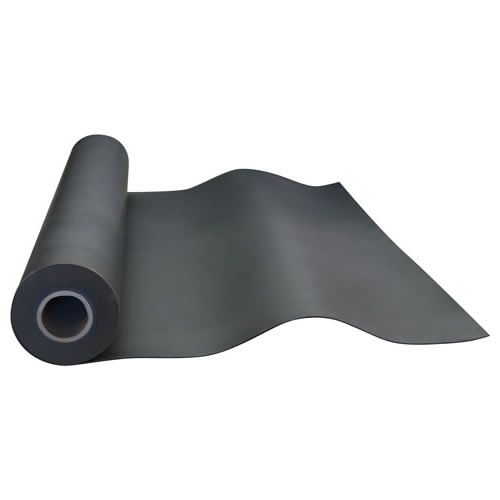
TotalMass MLV offers an EVA-based vinyl sheet with a focus on structural soundproofing. It is available in 0.5, 1.0, and 2.0 lb/ft² formats with thicknesses of 1/16″, ⅛”, and ¼”, respectively. Corresponding STC values range from 21 (0.5 lb) to 31 (2 lb). The material is UL-rated for U300 and U400 wall assemblies and supports a broad temperature range of -40°F to 180°F. It is known for its pliability and ease of installation using adhesives, screws, or staples. Standard roll dimensions vary based on weight class, and the product is specified for permanent interior use in rooms, not vehicles.
Head-to-Head Comparison: What the Evidence Shows
Both AcoustiBlok and TotalMass offer STC values above 25 in their 1 lb/ft² configurations, with higher ratings at greater thicknesses. AcoustiBlok’s Blok32 reaches STC 32, slightly above TotalMass’s maximum stated STC of 31. Material-wise, AcoustiBlok emphasizes a proprietary mineral-plastic blend with anti-fungal and UV-resistant properties, while TotalMass uses a recycled EVA compound. Fire safety compatibility is confirmed for both, though AcoustiBlok uniquely supports floor and ceiling assemblies (L500 series) alongside wall assemblies. In terms of application, AcoustiBlok is designed specifically for professional construction environments, while TotalMass offers more flexible DIY options for residential interior walls.
At-a-Glance Comparison Table
| Feature | AcoustiBlok MLV | TotalMass MLV |
|---|---|---|
| Material Type | Recycled plastics + benign minerals | Recycled EVA-based polymer |
| Available Weights | 1 lb/ft² (Blok16), 2 lb/ft² (Blok32) | 0.5, 1, 2 lb/ft² |
| STC Ratings | 26 (Blok16), 32 (Blok32) | 21 (0.5 lb), 26 (1 lb), 31 (2 lb) |
| Fire Rating | UL U300/U400/L500 compliant | UL U300/U400 compliant |
| Installation Type | Professional install over studs | Cut and attach using screws, staples, or adhesive |
| Use Case | Construction/remodeling only | Interior residential walls |
| Roll Dimensions | 54″ x 30′ standard, up to 350′ | Varies by weight (4’ x 5’ to 4’ x 25’) |
Which One May Be the Better Fit for Different Situations
AcoustiBlok MLV may be more suitable for commercial or new residential construction projects where wall structures are open and sound isolation must be built into the framing. Its support for ceiling and floor assemblies also broadens its structural integration options. On the other hand, TotalMass MLV may be a better fit when a flexible, temperature-resistant, and user-installable solution is needed within existing residential spaces. Its support for multiple fastening methods and cut-to-size formats provides adaptability in controlled room environments.
Frequently Asked Questions
Can AcoustiBlok be used in cars or boats?
No. The product is explicitly stated as not suitable for personal or non-construction use.
Is TotalMass suitable for ceiling applications?
While TotalMass is UL-rated for wall assemblies, no source confirmation is available for L500 ceiling/floor systems.
Can either product be used alone for high STC assemblies?
No. Both products benefit from additional construction elements (e.g., double drywall, insulation, steel framing) to reach composite STC values like 66 as stated in AcoustiBlok’s extended use case.
Closing Guidance
This comparison surfaces the factual distinctions between two heavyweight MLV options tailored for different levels of structural integration. Readers looking for detailed performance characteristics, STC modeling in context, and installation insights should read the full AcoustiBlok MLV review or explore the full TotalMass MLV review to assess fit based on project scope and use-case environment.