
The best RV soundproofing materials depend on the type of noise you are trying to control. Butyl damping mat is useful for resonant sheet metal, cavity insulation can help inside walls and ceilings, thin decoupling layers can separate rigid surfaces, and a dense barrier such as mass-loaded vinyl can help with airborne road noise when the extra weight is justified.
The mistake is treating all of these materials as interchangeable “soundproofing.” They perform different jobs.
SPD’s approach: identify the dominant noise path first, then build the lightest practical material system around it. In an RV or campervan, every unnecessary layer costs payload, space and installation complexity.
Best RV soundproofing materials at a glance
| Material type | Main job | Useful RV locations | Important limitation |
|---|---|---|---|
| Butyl damping mat | Reduces resonance in sheet metal | Floor, doors, wheel wells, large body panels | Does not replace insulation or a sound barrier |
| Automotive fiber insulation | Fills cavities and provides absorption plus thermal insulation | Walls, roof, doors and cavities | Does not add the mass of a true barrier |
| Closed-cell foam / decoupling layer | Separates surfaces and reduces contact between layers | Floors, trim interfaces and selected wall assemblies | Thin foam alone will not block substantial road noise |
| Dense flexible barrier | Adds mass against airborne noise | Floor, wheel-well zones and selected walls | Heavy and difficult to install correctly |
| Seals and gaskets | Reduces sound leakage through gaps and rattling contact points | Doors, hatches, cabinets and penetrations | Cannot compensate for a weak panel or open ventilation path |
Why an RV needs more than one type of soundproofing material
An RV is a lightweight vehicle body, not a conventional room. Road vibration, tire noise, engine noise, wind, rain and interior rattles can reach the cabin through different mechanisms.
That is why one material rarely solves everything.
A broad steel panel that rings when tapped has a different problem from airborne tire noise passing through the floor. A hollow wall cavity has a different problem again, and an air gap around a door seal needs yet another solution.
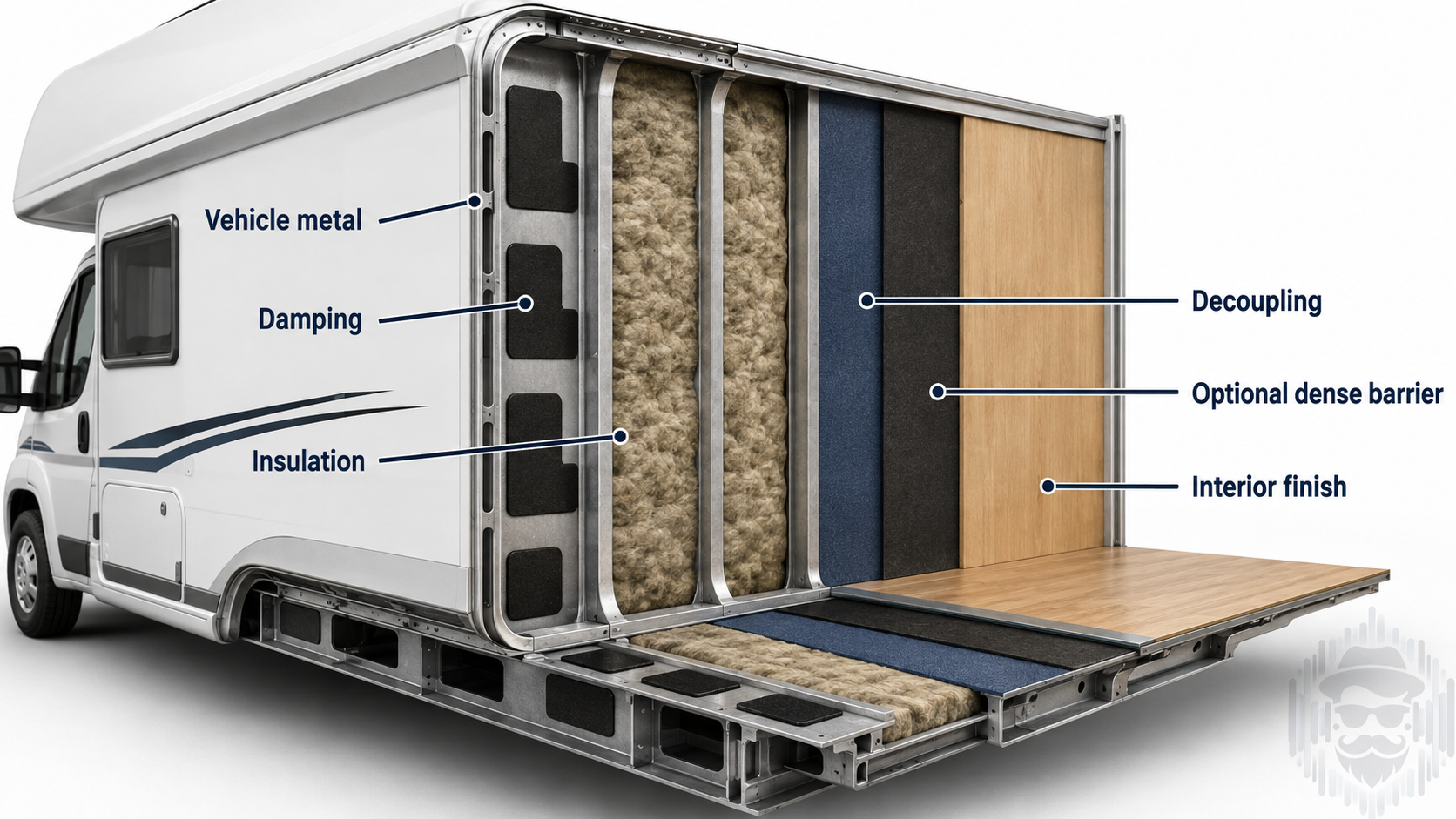
The diagram shows a maximum set of possible functions, not a mandatory recipe. A particular wall, roof or floor may need only some of these layers.
1. Butyl damping mat for panel vibration
For most metal-bodied RVs and campervans, damping mat is the logical place to start when large panels resonate.
Butyl-based damping material adheres directly to sheet metal. Its job is to reduce the tendency of that panel to flex and ring when excited by the road, engine, speakers or external impacts.
Good locations to inspect include:
- large floor sections;
- wheel wells;
- sliding or rear doors;
- broad wall panels;
- roof sections;
- cab and bulkhead panels.
You do not necessarily need to cover every square inch of metal. The useful amount depends on the panel’s size, stiffness and resonance. More material also means more weight.
A common mistake is assuming damping mat is a sound-blocking barrier. It is not. Its strength is controlling structure-borne vibration and panel resonance.
If you want the full installation sequence rather than material selection, see our campervan sound-deadening guide.
Example butyl damping mat: Check Siless 80 mil on Amazon. Use it as a vibration-damping layer on suitable metal panels; it is not a substitute for an airborne-noise barrier.
2. Automotive fiber insulation for wall and roof cavities
Once the metal shell is under control, open cavities may benefit from a suitable automotive insulation material.
Fibrous products can provide thermal insulation while also absorbing some acoustic energy inside the wall or ceiling cavity. This makes them especially useful in conversions where temperature control and noise reduction need to be considered together.
But insulation should not be described as though it were a heavy sound barrier.
Its main acoustic role is different from MLV or another dense layer. It can reduce cavity resonance and help manage sound within the construction, but it does not provide the same mass-based resistance to airborne road noise.
For the wider thermal side of a conversion, including how insulation choices interact with comfort and moisture planning, see our van insulation and soundproofing guide.
3. Closed-cell foam and other decoupling layers
A thin foam layer is often useful because two rigid surfaces touching each other can transfer vibration or create squeaks and rattles.
Closed-cell foam can act as a separator beneath trim, under a floor component or between materials where direct contact is undesirable.
This is a decoupling and interface-control role, not evidence that a thin sheet of foam can independently soundproof an RV.
That distinction matters because marketplace listings often call almost any foam product “soundproofing.” In practice, thin foam does not provide the mass needed to stop substantial low-frequency road and tire noise.
4. Mass-loaded vinyl and other dense barriers
When vibration has been controlled but substantial airborne noise is still coming through a surface, a dense flexible barrier may be useful.
Mass-loaded vinyl is one example. Its acoustic purpose comes primarily from adding mass without requiring a rigid masonry-style wall.
The trade-off is obvious in a vehicle: mass is weight.
An RV build has payload limits, floor-height constraints, doors, wiring, plumbing, service panels and furniture to accommodate. Installing a heavy barrier everywhere simply because it is acoustically useful on paper can be a poor vehicle-design decision.
SPD would therefore reserve dense barriers for areas where the remaining airborne-noise problem justifies the weight and installation effort.
If you are considering MLV for an RV, our Mass Loaded Vinyl guide explains 1 lb vs 2 lb MLV, construction types, acoustic claims, installation factors and the added-weight trade-offs to consider before choosing a barrier.
The floor is one of the clearest examples. Our van floor sound-deadening guide explains how damping, optional MLV, underlayment and the structural subfloor perform separate jobs.
Example 1 lb MLV: Check current Soundsulate 1 lb MLV availability. For an RV, account for the added weight and installation space before using a dense barrier extensively.
5. Seals, gaskets and anti-rattle materials
Sometimes the most annoying RV noise does not require another large sheet of material at all.
Door seals, hatch gaskets, cabinet interfaces and trim contact points can create either direct sound leakage or mechanical rattles.
A suitable automotive weather seal, gasket or thin anti-rattle material may therefore solve a very specific problem more efficiently than covering another wall with damping mat.
Check:
- entry and sliding doors;
- rear doors and storage hatches;
- cabinet doors;
- removable trim panels;
- service penetrations;
- pipe and cable openings;
- areas where two hard surfaces touch and vibrate.
Do not obstruct drainage, ventilation, fire-safety systems or required service access merely to chase a tighter acoustic seal.
Which RV areas should you soundproof first?
If you are trying to control driving noise, SPD would normally prioritize the areas producing or transmitting the most obvious noise rather than treating the RV uniformly.
Wheel wells
Wheel wells sit close to tire impact and road spray, so they can be major contributors to road noise. Vibration damping on appropriate metal surfaces can help, while additional barrier treatment may be worth considering where construction and payload permit it.
Floor
The floor can carry tire, drivetrain and road noise across a large surface area. Start by identifying resonant metal, then decide whether the remaining problem warrants additional mass and underlayment.
Doors
Doors combine thin metal, large cavities, seals, trim panels and multiple mechanical components. They may benefit from targeted damping, cavity treatment and attention to rattles or worn seals.
Walls
Large metal wall panels can resonate, while empty cavities can amplify some interior sound. A combination of targeted damping and appropriate cavity insulation is often more logical than simply covering the entire wall in one product.
Roof
The roof can transmit rain impact and panel vibration, while also being one of the most important thermal surfaces in the vehicle. Material choice here needs to consider heat, condensation, headroom and roof-mounted equipment as well as sound.
Cab, firewall or bulkhead
Engine and drivetrain noise can make the forward section especially demanding. Only use materials appropriate for the temperature, construction and safety requirements of the exact location. A generic interior foam should not be assumed safe for a high-heat area.
Best material setup for common RV noise problems
| Noise problem | Start with | Consider next |
|---|---|---|
| Metal panel ringing | Butyl damping mat | Nothing else unless another noise path remains |
| Road and tire noise through floor | Damping where the floor resonates | Underlayment and/or dense barrier if justified |
| Hollow wall or roof cavities | Suitable automotive insulation | Targeted damping on resonant exterior metal |
| Trim rattles and squeaks | Foam, felt or anti-rattle interface material | Repair loose fasteners or clips |
| Air leakage around doors | Inspect and repair seals | Additional panel treatment only if needed |
| Persistent airborne noise | Identify the transmission surface | Dense barrier where payload and space allow |
What not to use as your main RV soundproofing solution
Several materials that make sense in buildings or studios are poor default choices for an RV.
Studio acoustic foam
Wedge and pyramid foam are designed primarily to manage reflections inside a room. They are not a substitute for vehicle damping, cavity insulation or a dense sound barrier.
QuietRock and other specialty drywall
Specialty acoustic drywall can be useful in buildings, but it is heavy, rigid and designed around wall assemblies very different from a moving vehicle. It should not be treated as a normal campervan noise-control layer.
Resilient channels
Resilient channels are building components designed for framed wall or ceiling assemblies. They are not a practical default vehicle-conversion solution.
Green Glue Noiseproofing Compound as a gap sealant
Green Glue Noiseproofing Compound is a damping compound intended between rigid building layers. It is not ordinary acoustic caulk and should not be used in an RV article as though it were a general sealant for doors, trim or penetrations.
Weight matters more in an RV than in a room
Building sound isolation often benefits from more mass. A vehicle cannot adopt that principle without limits.
Quick weight check before ordering: Calculate the actual area you intend to cover in square feet and multiply it by the material’s stated weight per square foot. For example, 40 sq ft of a nominal 1 lb/sq ft barrier adds approximately 40 lb (18 kg) before adhesive, trim or fasteners; a nominal 2 lb/sq ft barrier over the same area adds approximately 80 lb (36 kg). These are illustrative material weights, not a recommendation to install either assembly. Check the specific product’s published weight and your vehicle’s remaining legal payload.
Every layer competes with:
- passenger and cargo payload;
- water and fuel;
- batteries and electrical systems;
- cabinetry;
- appliances;
- floor and wall thickness;
- vehicle handling and legal weight limits.
That is why SPD would not recommend a maximum-material assembly simply because it looks impressive in a diagram.
Use mass where it solves an identified problem. Use damping where metal resonates. Use insulation where cavities and thermal needs justify it. Use decoupling where surfaces need separation.
Moisture, heat and safety considerations
An acoustically useful material can still be the wrong material for a vehicle if it creates another problem.
Before installing any layer, consider:
- moisture and condensation;
- drainage paths;
- temperature exposure;
- flammability requirements;
- wiring and electrical access;
- plumbing;
- airbags and safety equipment;
- factory ventilation;
- seat and structural mounting points;
- future service access.
Do not bury a moisture problem or unsafe electrical installation behind an acoustic layer.
Do you need to soundproof the entire RV?
Usually not.
Start by driving the vehicle on the surfaces that produce the problem and listen for where the noise is strongest. Tap large metal panels while the interior is accessible. Check wheel wells, floor sections, doors, seals and loose trim.
Then treat the strongest paths first.
This targeted approach can save weight and money while giving you better information about what the next layer—if any—actually needs to accomplish.
RV soundproofing materials: SPD’s recommended approach
For most RV or campervan conversions, we would think about the material system in this order:
- Control resonant metal with targeted damping where it is actually needed.
- Use suitable cavity insulation where thermal and acoustic goals overlap.
- Separate rigid surfaces where foam or another interface layer can reduce contact and rattles.
- Add a dense barrier selectively only where airborne noise remains important enough to justify the weight.
- Fix seals and rattles rather than assuming another large material layer will solve them.
The goal is not to turn an RV into a recording studio. It is to reduce the dominant road, vibration and living-space noise enough to make driving, sleeping and spending time inside the vehicle more comfortable.
Frequently asked questions
What is the best soundproofing material for an RV?
There is no single best material because different noise problems require different functions. Butyl damping mat is particularly useful for resonant metal, while insulation, decoupling layers, dense barriers and seals address other transmission paths.
Does sound deadening mat block road noise?
Its main job is reducing vibration and resonance in sheet metal. It can improve the overall noise environment, but it is not the same thing as a dense airborne-noise barrier.
Is mass-loaded vinyl good for RVs?
MLV can add useful mass against airborne noise, but it is heavy. In an RV or campervan, its benefit should be balanced against payload, floor height, installation difficulty and the specific noise path being treated.
How much sound-deadening mat does a campervan need?
There is no universal coverage percentage. Treat the panels that actually resonate and reassess before adding unnecessary material and weight.
Can I use acoustic foam in an RV?
Acoustic foam can absorb reflections in an interior, but it should not be treated as a substitute for proper vehicle damping, insulation or a sound barrier.
Should I soundproof the RV floor first?
If tire and road noise are dominant, the floor and wheel-well areas can be high priorities. If the main problem is wind leakage, doors or interior rattles, another location may deserve attention first.
Is RV insulation the same as RV soundproofing?
No. Some insulation products provide useful acoustic absorption, but thermal insulation and sound isolation are not the same function. A good conversion may use one material for both goals while still requiring other layers for vibration or airborne-noise control.
Good luck and happy soundproofing!
Working on generator noise? Material choice is only part of the job. See our soundproof generator enclosure guide for the safer overall approach to barriers, mass, vibration control, airflow and exhaust.
Comments are closed.