
If you’re comparing Kilmat vs HushMat for car sound deadening, both are self-adhesive automotive damping materials designed to reduce panel vibration and improve the acoustic environment inside a vehicle.
But they take noticeably different approaches.
Kilmat 80 mil is a 2 mm butyl-and-foil damping mat supplied in relatively small sheets, while HushMat Ultra is a thinner, highly flexible self-adhesive damping material supplied in larger sheets and promoted for both vibration and thermal control.
That means the best choice isn’t simply the thicker product. Coverage, sheet size, flexibility, installation style, current price, and where you plan to use the material are more useful deciding factors.
Kilmat vs HushMat: Quick Verdict
Choose Kilmat if:
- You want an affordable 80 mil / 2 mm butyl-and-foil damping mat.
- You prefer smaller sheets that are easy to position around complicated vehicle panels.
- You like having an embossed installation indicator that shows when the material has been rolled down properly.
- Current cost per square foot makes it the better-value option for your project.
Choose HushMat if:
- You value flexibility and easy molding around curves and irregular surfaces.
- You prefer larger individual sheets.
- You want a product with a manufacturer-stated wide operating temperature range.
- You need a larger bulk pack for a more extensive vehicle treatment.
My overall view: Kilmat is especially attractive for budget-conscious DIY installations, while HushMat’s flexibility, larger sheets and established thermal positioning make it appealing for users who prioritize ease of conforming the material to complex surfaces.
I would not choose Kilmat simply because it is thicker. Thickness is only one specification, and the materials aren’t identical enough for “thicker equals better” to be a reliable buying rule.
Kilmat vs HushMat at a Glance
| Feature | Kilmat 80 Mil | HushMat Ultra Bulk Kit |
|---|---|---|
| Material type | Self-adhesive butyl with aluminum foil | Self-adhesive damping material with foil facing |
| Thickness | 80 mil / 2 mm | Approx. 1.5 mm |
| Coverage compared | 36 sq ft | 58.1 sq ft |
| Number of sheets | 34 | 30 |
| Sheet size | 15.7 × 9.8 in | 12 × 23 in |
| Approx. weight per sq ft | 0.5 lb | Approx. 0.47 lb |
| Installation indicator | Embossed foil rolled smooth | No comparable embossed indicator required |
| Manufacturer-stated temperature range | Check current product guidance for your application | -30°F to 550+°F |
| Best suited to | Budget DIY work and detailed areas | Flexible installation and larger treatment areas |
The headline difference is straightforward: Kilmat gives you more, smaller pieces, while HushMat gives you fewer, longer pieces and emphasizes flexibility.
The Biggest Difference: Thickness Isn’t the Whole Story
One of the problems with older Kilmat vs HushMat comparisons is the assumption that Kilmat must perform better simply because its 80 mil material is thicker than HushMat Ultra.
That is too simplistic.
Kilmat 80 mil is approximately 2 mm thick. HushMat Ultra is approximately 1.5 mm thick.
Those figures are useful specifications, but they don’t independently tell you which product will provide the better result in your vehicle.
Automotive damping materials work by adding damping to resonant panels. Their effectiveness depends on more than nominal thickness, including the formulation of the damping layer, mass, adhesion, constraining layer, installation quality and how much treatment the panel actually requires.
So I would use thickness as one comparison point, not as the verdict.
Kilmat 80 Mil Review
Kilmat 80 mil is a self-adhesive butyl-and-aluminum automotive damping mat aimed heavily at DIY users.
The current 36 sq ft pack contains 34 individual sheets measuring approximately 15.7 × 9.8 inches. The material is 80 mil, or approximately 2 mm, thick.
Those relatively small sheets are one of Kilmat’s most useful practical characteristics.
Instead of wrestling with a large piece around wiring, brackets, wheel arches or complex door structures, you can work with smaller sections and build coverage piece by piece.
Kilmat also uses an embossed pattern on the aluminum surface. During installation, the embossing is rolled until it becomes smooth, giving you a visual indication that sufficient pressure has been applied.
For a deeper look at the brand and product range, see our Kilmat Review.
Kilmat Pros
- 80 mil / 2 mm butyl-and-foil construction.
- 36 sq ft coverage in the pack compared here.
- Small sheets are convenient around curves and irregular panels.
- Self-adhesive and suitable for DIY installation.
- Embossed foil helps indicate whether the material has been rolled correctly.
- Often competitively priced compared with premium automotive damping brands.
Kilmat Cons
- Covering a large flat area may require more individual pieces and more joins.
- You will still need a roller or equivalent tool to apply firm, even pressure.
- The 80 mil thickness should not be treated as automatic proof that it performs better than every thinner product.
- Current pricing changes, so Kilmat isn’t automatically the cheapest option at all times.
HushMat Ultra Review
HushMat Ultra is another peel-and-stick automotive vibration-damping material, but its installation characteristics are noticeably different from Kilmat.
The current HushMat 10500 Bulk Kit covers approximately 58.1 sq ft and contains 30 sheets measuring 12 × 23 inches.
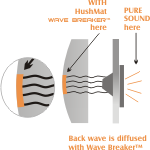
HushMat emphasizes that the material is flexible and moldable, which can be valuable when applying sound-deadening material to contoured vehicle surfaces.
The larger, longer sheets also make HushMat quite different to Kilmat’s smaller-piece layout.
HushMat currently states an operating temperature range from approximately -30°F to over 550°F for the product. That doesn’t mean it will magically turn a damping treatment into a complete thermal barrier, but it is useful information when material temperature tolerance is important to your installation.
HushMat Pros
- Flexible and moldable material.
- Large 58.1 sq ft bulk pack available.
- Larger individual sheets than the Kilmat pack compared here.
- Self-adhesive peel-and-stick installation.
- Manufacturer states a wide operating temperature range.
- Suitable for doors, floors, firewalls, trunks and other vehicle panels.
HushMat Cons
- The larger bulk pack may be more material than you need for a small job.
- Higher initial pack cost may make Kilmat more attractive for smaller projects.
- Its thinner nominal profile means buyers shouldn’t compare the products purely on thickness.
- Value depends heavily on how much coverage your project actually requires.
Which Is Easier to Install: Kilmat or HushMat?
Both products are aimed at relatively straightforward peel-and-stick installation, but they suit slightly different working styles.
Kilmat: Smaller Pieces and a Clear Installation Indicator
Kilmat’s smaller pieces can make detailed areas easier to manage.
This is particularly helpful around:
- Door structures
- Wheel arches
- Curved panels
- Seat mounts
- Transmission tunnels
- Wiring and brackets
The embossed foil also gives you a useful visual installation cue: once the pattern is rolled smooth, you know you’ve applied firm pressure across that section.
HushMat: Flexibility and Larger Sheets
HushMat’s main installation advantage is its flexibility.
The sheets are considerably longer than Kilmat’s, so you can cover more area with each individual piece while still molding the material around curves and contours.
That can reduce the number of seams across floors, trunks and other relatively large sections.
For small, complicated areas: I lean Kilmat.
For larger areas where flexibility and fewer joins matter: I lean HushMat.
For the full installation process, see our guide on how to install automotive sound-deadening material.
Kilmat vs HushMat for Car Doors
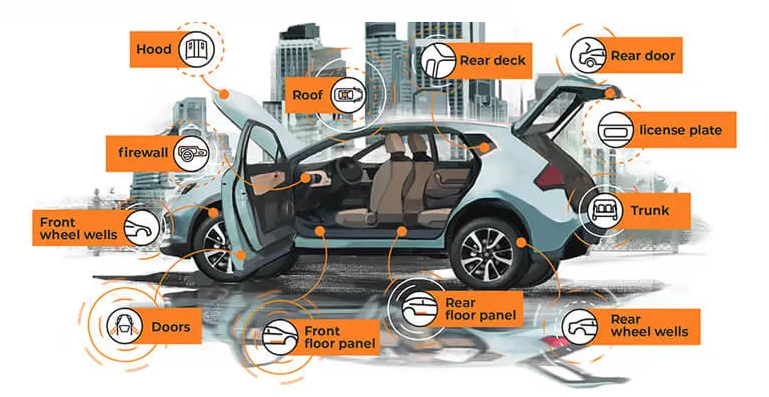
Doors are a particularly good use case for damping material because large, relatively thin metal panels can vibrate and resonate.
Both Kilmat and HushMat can be used successfully here.
Kilmat’s advantage is sheet size. Its smaller pieces are easy to work around window mechanisms, wiring, braces, locks and speaker openings.
HushMat’s advantage is flexibility. The longer sheets can be shaped around curves and provide more continuous coverage with fewer joins.
The better option comes down largely to your preferred installation style.
For a detailed guide, see our DIY car door sound damping tutorial.
Kilmat vs HushMat for Floors
On a vehicle floor, the balance shifts somewhat toward larger coverage areas.
HushMat’s 12 × 23-inch sheets can reduce the number of individual sections required across the floor pan.
Kilmat’s smaller pieces can still work very well, especially around transmission tunnels, seat mounting points and complex floor contours, but you’ll have more joins.
If you’re treating an entire floor, calculate the total square footage first.
Kilmat’s pack compared here gives you 36 sq ft, while the HushMat Bulk Kit gives you approximately 58.1 sq ft.
For a practical installation example, see our guide on installing sound-deadening material on a car floor.
Kilmat vs HushMat for Trunks
Trunks combine large flat sections with wheel arches and irregular body panels, so both installation styles can be useful.
HushMat’s larger flexible pieces may be convenient across broad trunk floors and quarter-panel areas.
Kilmat’s smaller pieces are helpful around wheel wells, corners and recessed sections.
There’s no universal winner here. I would choose based on how much cutting you want to do and which pack gives you the right amount of material without excessive leftovers.
See our guide on how to soundproof a car trunk for more detail.
Which Is Better for Vibration and Road Noise?
Both Kilmat and HushMat are primarily useful because they add damping to vehicle panels.
That means they can help control:
- Panel resonance
- Door vibration
- Trunk rattles
- Speaker-induced panel vibration
- Some structural noise transmitted through treated panels
But neither product should automatically be treated as a complete solution for every type of road noise.
Airborne tire, wind and exterior noise can require additional sound-control layers depending on the severity of the problem and the part of the vehicle being treated.
For a deeper explanation of layered automotive noise treatment, see our guide to automotive sound barriers and their benefits.
Is Kilmat Better Because It Is Thicker?
No — not automatically.
Kilmat 80 mil is approximately 2 mm thick, while the HushMat Ultra product compared here is approximately 1.5 mm thick.
That makes Kilmat nominally thicker, but it doesn’t prove that Kilmat will outperform HushMat in every real-world installation.
Thickness is only one part of a damping material’s construction.
A useful comparison should also consider:
- Damping compound formulation
- Mass per square foot
- Adhesion
- Flexibility
- Constraining layer
- Panel coverage
- Installation quality
Interestingly, the products’ listed weights per square foot are relatively close, which is another reason not to treat nominal thickness as the entire story.
Which Is More Flexible?
HushMat is the product I would favor when flexibility is a major priority.
HushMat specifically emphasizes its ability to mold to surfaces, and its longer sheets can be useful over curved or irregular areas.
Kilmat is perfectly workable, but its design strength is somewhat different: lots of manageable small pieces that can be positioned individually.
So this really becomes a preference between:
molding larger pieces versus building coverage with smaller pieces.
Which Is Better Value: Kilmat or HushMat?
I would not permanently label either product with a fixed price per square foot because prices change.
Instead, compare the current price against the coverage you’re actually getting.
The basic calculation is:
Current pack price ÷ total coverage = cost per square foot
For Kilmat:
Kilmat pack price ÷ 36 sq ft
For HushMat:
HushMat pack price ÷ 58.1 sq ft
But there’s another consideration.
If you only need enough material for two doors, a large 58.1 sq ft HushMat Bulk Kit may not be the economical choice even if its calculated square-foot price looks reasonable.
Conversely, if you’re treating a large part of the vehicle, buying multiple small packs can increase your overall project cost.
So compare total project cost, not just the sticker price.
Check the current Kilmat price on Amazon
Check the current HushMat price on Amazon
Kilmat vs HushMat FAQs
Is Kilmat Better Than HushMat?
Not universally.
Kilmat is an appealing choice for budget-conscious DIY work and gives you small, easy-to-position 80 mil sheets.
HushMat is especially attractive when flexibility, larger sheets and broader pack coverage are priorities.
Is HushMat Thinner Than Kilmat?
Yes, for the products compared here.
Kilmat is approximately 80 mil / 2 mm thick, while HushMat Ultra is approximately 1.5 mm thick.
That difference should not be interpreted as automatic proof that Kilmat performs better.
Is Kilmat Butyl Based?
Yes. Kilmat 80 mil uses a self-adhesive butyl damping layer with aluminum foil.
Is HushMat Self-Adhesive?
Yes. HushMat Ultra uses a peel-and-stick installation system and is designed to conform to vehicle panels.
Do I Need a Roller for Kilmat?
A roller is strongly recommended.
Kilmat’s embossed aluminum surface is specifically designed to be rolled until the pattern becomes smooth, helping you check that firm pressure has been applied.
Do I Need a Roller for HushMat?
HushMat markets Ultra as a straightforward peel-and-stick product and emphasizes that specialized installation tools are not required.
However, applying firm and even pressure across any self-adhesive damping material remains important for good surface contact.
Which Is Better for Hot Cars?
HushMat currently publishes an especially wide operating temperature range for Ultra, which may make that specification attractive in high-temperature environments.
However, vibration damping and thermal insulation are not exactly the same job. If major heat reduction is your objective, consider the complete insulation system rather than choosing a vibration damper solely from its maximum temperature rating.
Which Is Easier to Cut?
Both can be cut for DIY installation.
Kilmat arrives in smaller pieces, so less cutting may be necessary in detailed areas. HushMat’s larger sheets may need more trimming but can reduce the number of joins across broad areas.
Can I Use Kilmat or HushMat Under Carpet?
Both can be applied to suitable vehicle floor panels beneath the interior trim and carpet system, provided the installation does not interfere with mounting points, wiring, drainage or other vehicle components.
Kilmat vs HushMat: Final Verdict
Kilmat and HushMat are both credible automotive vibration-damping options, but they suit slightly different buyers.
I would choose Kilmat if value and manageable sheet size are my main priorities. Its 80 mil / 2 mm construction, smaller sheets and embossed installation indicator make it especially approachable for DIY projects involving doors, wheel arches and other complicated surfaces.
I would choose HushMat if flexibility and larger-area coverage matter more. Its larger, moldable sheets, 58.1 sq ft Bulk Kit and wide manufacturer-stated operating temperature range make it attractive for broader treatments.
My decision breakdown would be:
- Budget-focused DIY installation: Kilmat
- Small and complicated areas: Kilmat
- Flexible material for curves and contours: HushMat
- Larger bulk coverage: HushMat
- Best simply because it is thicker: Neither
Before buying, estimate how many square feet you actually need and compare the current total project cost.
Good luck and happy soundproofing!