Introduction
When selecting a mass loaded vinyl (MLV) solution for noise control, understanding the differences between options like AcoustiBlok and TroyStudio is essential. Both aim to reduce sound transmission, but their intended applications, physical specifications, and installation requirements differ significantly. The key differences are weight options, installation difficulty, how each product fits into a larger sound-control assembly, and the kinds of projects each is best suited to.
What Matters Most When Choosing
The main differences to compare are:
- STC rating and soundproofing effectiveness
- Installation complexity and intended environment (construction vs. personal use)
- Product form factor and customization options
- Material composition and safety characteristics
AcoustiBlok MLV Overview

AcoustiBlok is a viscoelastic construction polymer available in two variants—Blok16 (1 lb/sqft) and Blok32 (2 lb/sqft). Blok16 is approximately 1/8 inch thick, while Blok32 is approximately 1/4 inch thick. It is designed for sound-isolation assemblies in walls, ceilings, floors, and other construction applications, and is often easiest to install during construction or renovation. The manufacturer describes the material as being made from recycled plastics and non-toxic minerals. AcoustiBlok publishes approximate STC figures of 26 for Blok16 and 32 for Blok32. Those figures should be read with the associated test specimen or construction rather than as universal material ratings; complete assembly performance depends on the surrounding construction.
TroyStudio Mass Loaded Vinyl Sound Proof Barrier Overview
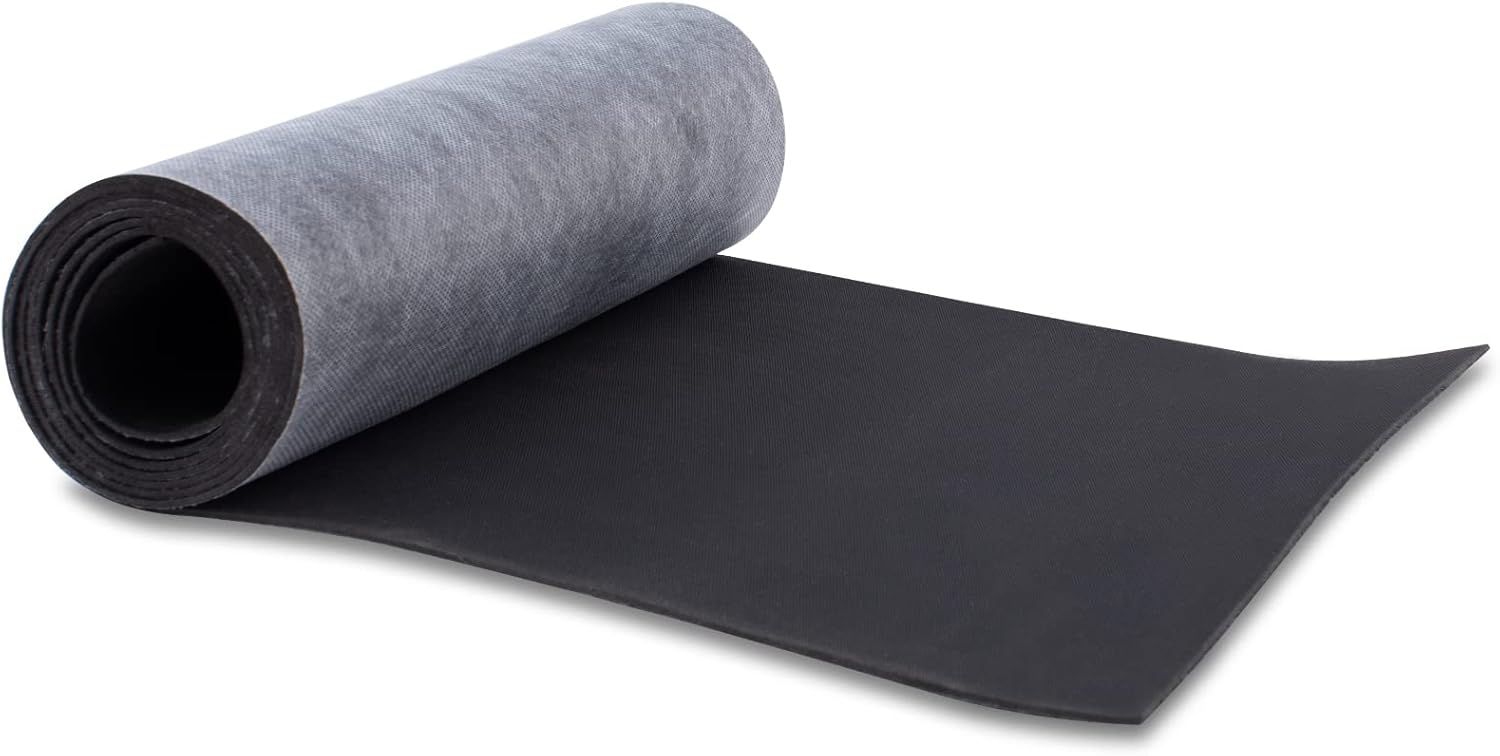
The TroyStudio MLV product is a dense barrier designed to add flexible mass in layered sound-control assemblies. As MLV, its primary acoustic role is helping reduce airborne sound transmission through added mass; it should not be treated as equivalent to a dedicated vibration-damping treatment for a resonating panel. It weighs 1 lb per square foot and is listed with an STC value of 28 for layered use. That STC figure requires its associated test specimen or construction and should not be interpreted as a universal material or finished-assembly rating. The material uses high-damping rubber, dense polymer metal powder, and a nonwoven fabric backing. It is described as waterproof and flame retardant with a B1 rating, and it can be cut with a utility knife and attached using construction adhesive, screws, roofing nails, or similar fasteners. Interested users can view the product here on Amazon.
AcoustiBlok vs TroyStudio: Key Differences
Both products are available in 1 lb/sqft options, but they differ in format and intended use. AcoustiBlok is a construction-focused membrane system available as Blok16 and the heavier Blok32, while TroyStudio is a 1 lb/sqft barrier intended for layered sound-control use and can be attached to studs, joists, or solid surfaces. The surrounding wall, ceiling, floor, or enclosure assembly matters more than the membrane specification alone.
In contrast, TroyStudio is a 1 lb/sqft barrier with a listed STC value of 28 for layered sound-control use; the associated test specimen or construction is needed before applying that figure to a finished assembly. It can be cut with a utility knife and attached with construction adhesive or mechanical fasteners, and it is listed for applications including walls, ceilings, floors, doors, fences, HVAC systems, ductwork, pipes, and mechanical enclosures. To see full details or to purchase, visit the Amazon listing.
AcoustiBlok is the more construction-focused option and can be demanding to handle, especially overhead or in Blok32 form. An experienced DIYer may be able to install Blok16 on a straightforward exposed wall, while large ceilings, complicated assemblies, electrical penetrations, and Blok32 may justify professional help. TroyStudio is easier to cut and can be mounted with construction adhesive or mechanical fasteners.
At-a-Glance Comparison Table
| Feature | AcoustiBlok | TroyStudio |
|---|---|---|
| STC Rating | Published figures of approximately 26 for Blok16 and 32 for Blok32; verify the associated test specimen or construction, and complete assemblies vary | Listed STC value of 28 for layered sound-control use; verify the associated test specimen or construction |
| Weight & Thickness | Blok16: 1 lb/sqft and about 1/8 inch; Blok32: 2 lb/sqft and about 1/4 inch | 1 lb/sqft |
| Installation | Experienced DIY may be possible for a straightforward Blok16 wall; ceilings, complex assemblies, and Blok32 may justify professional help | Cuttable and mountable with construction adhesive or mechanical fasteners |
| Material Composition | Recycled plastics and non-toxic minerals according to the manufacturer | High-damping rubber, dense polymer metal powder, and nonwoven fabric backing |
| Product Options | Blok16 and heavier Blok32 variants | 1 lb/sqft barrier |
| Use Context | Walls, ceilings, floors, and construction or renovation assemblies | Walls, ceilings, floors, doors, fences, HVAC systems, ductwork, pipes, and mechanical enclosures |
Which One May Be the Better Fit for Different Situations
AcoustiBlok may be more suitable for new builds or major renovations where the membrane can be planned as part of the complete wall, ceiling, or floor assembly. Blok16 is the more practical starting point for many residential projects, while Blok32 makes more sense when additional mass is deliberately required and the structure and installation method can support it.
TroyStudio may offer a better fit for projects that need a 1 lb/sqft barrier that can be cut and mounted with construction adhesive or fasteners. It is listed for walls, ceilings, floors, doors, fences, HVAC systems, ductwork, pipes, and mechanical enclosures.
Frequently Asked Questions
Is TroyStudio MLV suitable for new construction? It can be used as part of a layered sound-control assembly and attached to studs, joists, or solid surfaces. Its listed applications include walls, ceilings, floors, doors, HVAC systems, ductwork, pipes, and mechanical enclosures.
Can AcoustiBlok be used in personal DIY projects? Yes, in some cases. An experienced DIYer may be able to install Blok16 on a straightforward exposed wall. Large ceilings, complicated wall assemblies, electrical penetrations, and Blok32 are much more demanding and may justify professional help.
Which product includes installation adhesive? Do not assume adhesive is included with either product. TroyStudio can be mounted using construction adhesive, screws, roofing nails, or similar hardware. AcoustiBlok installation difficulty depends on the project; straightforward Blok16 wall work may be manageable for an experienced DIYer, while large ceilings, complicated assemblies, and Blok32 may justify professional help.
Closing Guidance
AcoustiBlok and TroyStudio serve distinctly different use cases despite their shared foundation as MLV products. Readers interested in a construction-focused membrane intended for use within a larger sound-control assembly can explore the full AcoustiBlok review. For compact, user-friendly applications requiring flexibility and minimal tools, the TroyStudio product overview provides more detail to guide purchase decisions. For current pricing and availability, check this Amazon link.