
Looking for a soundproof dog crate to help your dog cope with fireworks, thunder, barking or noisy neighbours? The key is to separate products designed to reduce sound from ordinary crates that simply provide a sheltered place to rest. No ventilated dog enclosure should be assumed to make every noise disappear, and a quieter enclosure is not a treatment for severe noise fear.
Our quick take: Compare purpose-built options such as the ZenCrate, Tailody Mute Square and Prestige Quiet Kennel if physical noise reduction is your main goal. If your dog already feels safe in a conventional crate, an ordinary crate plus carefully chosen environmental changes may be the more practical option. Check the buying status and dimensions directly with each seller before ordering.
Buying-status check: October 2026. Product availability, prices, delivery and specifications can change. Manufacturer claims below are identified as claims, not independent test results.
Best soundproof dog crates and noise-reducing options at a glance
| Option | Best suited to | What the design offers | Important limitation |
|---|---|---|---|
| ZenCrate | Owners considering a smart den with sound masking | Manufacturer describes sound dampening, vibration-dampening feet, a fan and motion-activated music | Official product pages currently show preorder/availability messaging. Confirm lead time, delivery, returns and support before paying. |
| Tailody Mute Square | Owners considering a purpose-built enclosed acoustic pet house | Manufacturer describes acoustic panels, door-gap sealing and air circulation | International orders require a quote for final shipping and lead time. Sound-reduction figures are manufacturer-reported, not independently verified by SPD. |
| Prestige Quiet Kennel | Buyers seeking a specialist, made-to-order kennel in Great Britain | Manufacturer describes acoustic-filled walls, a layered door and dual-fan ventilation | Made to order; request current pricing, dimensions, lead time and delivery details. |
| Amazon Basics heavy-duty kennel | Owners who need a conventional crate, not an acoustic enclosure | Conventional kennel format for a familiar crate or a broader DIY noise-management setup | Not a purpose-built soundproof crate. Verify the current listing, size and suitability for your dog. |
We do not name a universal “quietest” model because SPD has not found independent, comparable testing of these products under the same conditions. A ranking based on unmatched manufacturer decibel numbers would create false precision.
What does a soundproof dog crate actually do?
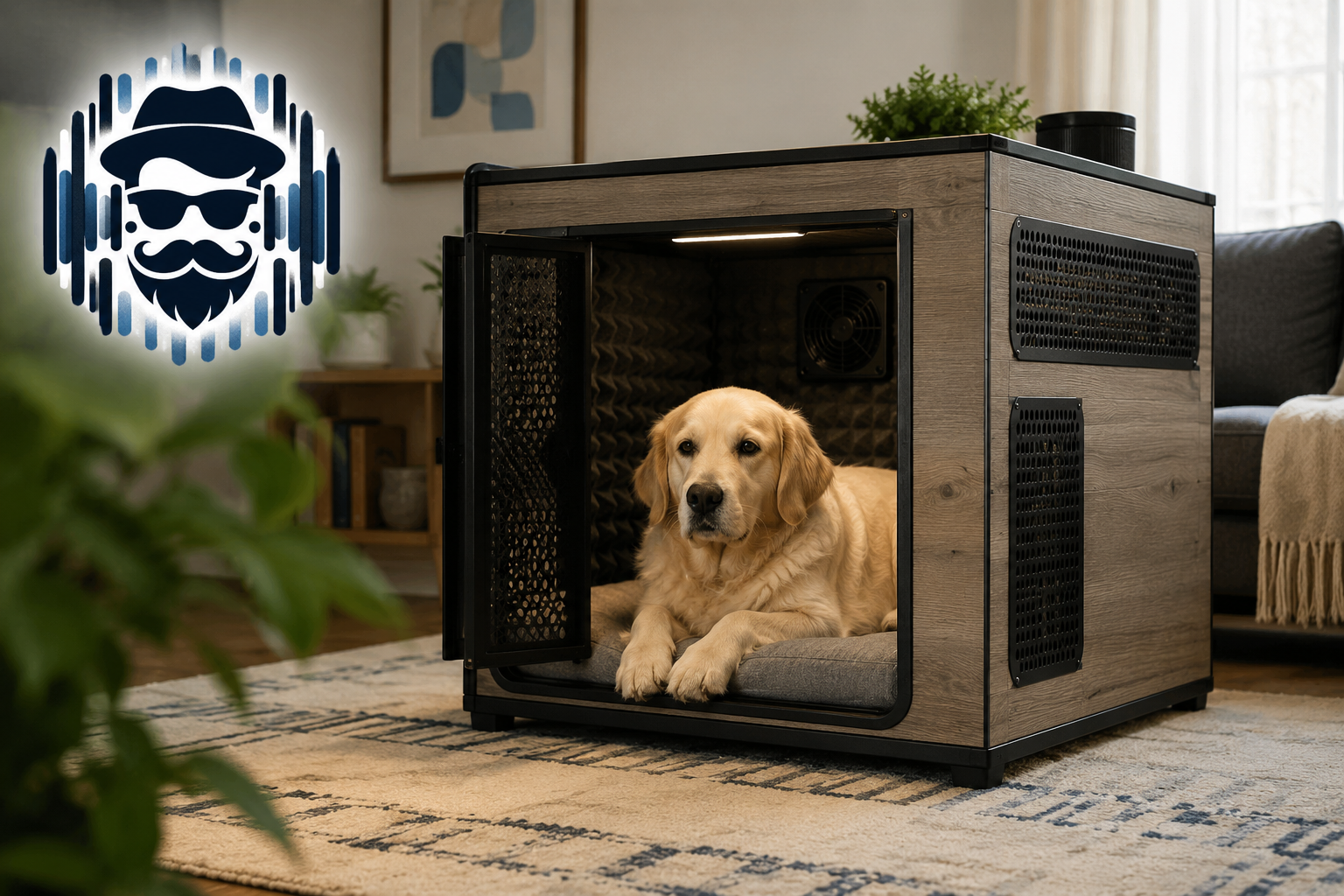
The phrases soundproof dog crate and noise-cancelling dog crate are often used loosely. Before buying, work out which function a product actually provides:
- Sound transmission reduction: A substantial enclosure, door construction and careful treatment of gaps can reduce some sound passing through the structure. Doors, seams and ventilation openings remain potential weak points.
- Sound absorption: Acoustic lining can reduce reflections inside an enclosure. Absorption is not the same as stopping outside sound from entering.
- Vibration isolation: Resilient feet or other isolation features may reduce some vibration transmitted through the floor or support. They do not eliminate airborne noise.
- Sound masking: A fan, music or white noise adds background sound that can make sudden noises less noticeable. Masking changes the sound environment; it does not physically block the source.
These functions can work together, but no single feature guarantees that a dog will feel calmer. Dogs respond differently to noises, confinement and changes in their environment.
1. ZenCrate: a smart den with sound dampening and masking
The official ZenCrate product page describes a smart dog den combining sound dampening, a fan, vibration-dampening feet and motion-activated music. These features address different issues: the enclosure is intended to reduce some sound, the feet target vibration, and the fan/music provide airflow and masking.
Availability needs checking. At the time of this review, the official store showed preorder/availability messaging rather than an unambiguous in-stock purchase. That does not prove the product cannot be obtained, but buyers should confirm fulfilment date, shipping destination, returns policy and support directly before ordering. Do not treat old reviews or former affiliate links as proof of current availability.
Consider ZenCrate if: you want an enclosed den with integrated sound-masking features and are comfortable confirming preorder details with the seller.
Check before buying: measure usable interior space against your dog, confirm the current door/accessory configuration, and ask how ventilation operates and what is included with the base product. SPD has not independently measured its noise reduction or verified an anxiety-treatment effect.
2. Tailody Mute Square: a purpose-built enclosed acoustic pet house
The Tailody Mute Square is marketed as a rigid, enclosed pet house rather than an ordinary wire crate with a cover. Its manufacturer describes high-density compressed polyester acoustic panels, door-gap sealing, double-layer glazing and an air-circulation system. It is offered in multiple sizes, with final international shipping and lead time confirmed through a quote.
These construction details are relevant when comparing acoustic enclosures: the panels, door, gaps and air path should be considered as a whole. Tailody also publishes specific decibel-reduction figures. SPD has not independently verified those figures, and results should not be assumed to apply to every model, sound frequency, installation or real home.
Consider Tailody if: you want a purpose-built enclosed acoustic pet house and can obtain a clear quote for the exact size and destination.
Check before buying: request written confirmation of internal dimensions, total assembled dimensions, ventilation operation, power requirements, delivery costs, lead time, return exclusions and warranty/support. Do not select a size from breed names alone; assess your dog’s actual height, length and resting posture.
3. Prestige Quiet Kennel: a made-to-order specialist option
The Prestige Quiet Kennel manufacturer describes acoustic-filled walls, multiple ventilation openings, a dual-fan circulation system and a spring-loaded layered door intended to close behind the dog. Its website states that the kennel is made to order in Great Britain.
The design is worth comparing because it considers the enclosure, access door and ventilation together rather than presenting acoustic foam alone as a complete solution. SPD has not independently tested the product’s acoustic performance.
Consider Prestige if: you are in Great Britain or can arrange a specialist order and want to discuss construction details with the maker.
Check before buying: ask for current dimensions, a specification of the wall and door construction, fan noise and airflow details, price, manufacturing lead time, delivery/installation arrangements and after-sales support. Request test data and its measurement conditions if sound-reduction performance is a deciding factor.
4. A conventional heavy-duty crate: when DIY noise management may make more sense
A conventional kennel such as the Amazon Basics heavy-duty kennel is not an acoustic enclosure. It may still suit a dog that already uses and tolerates a conventional crate, especially when the main goal is to provide a familiar resting space rather than to buy a specialist sound-control product.
Before replacing a crate your dog likes, consider the surroundings. A room farther from the noise, closed windows, curtains, a comfortable bed and moderate background sound may improve the environment without confining the dog in an unfamiliar structure. Any cover must leave adequate airflow and must not create a heat hazard or be something the dog can chew or pull inside.
For step-by-step ideas, read SPD’s guide to soundproofing a dog crate for fireworks and storms. That article covers the setup around a conventional crate; this guide focuses on comparing products and enclosures.
What happened to Ford’s Quiet Kennel?

Ford’s 2018 Quiet Kennel concept is relevant history because it explored active noise control using microphones and opposing sound waves. It is different from the commercial products above, which chiefly describe passive enclosure construction, vibration isolation and/or sound masking.
Ford presented it as a prototype rather than an ordinary product available for purchase. It belongs in the article as context, not in a current “best crates to buy” ranking.
How to choose the right noise-reducing dog crate
Choose size and access first
Your dog needs enough room to stand naturally, turn around and lie down comfortably. Use the actual internal dimensions, not only a breed or weight guide. Check the door opening and whether your dog can enter and leave without awkward movement.
Inspect the whole acoustic design
Ask what the walls, seams, door and ventilation openings are made of and how they work together. Acoustic foam can absorb reflections, but a lining by itself does not make a thin, open crate soundproof.
Check airflow and temperature management
Do not seal ventilation openings or improvise a tight covering in pursuit of more noise reduction. Ask how airflow is maintained, whether the system relies on power, how fan noise is handled and what to do if power fails. Stop using an enclosure if the dog appears overheated or uncomfortable.
Separate verified tests from marketing claims
A decibel figure only allows a useful comparison when the measured sound, microphone position, background conditions, product configuration and test method are clear. Figures from different sellers and test setups should not be compared as if they came from one independent laboratory. SPD has not performed a side-by-side laboratory test of the products in this guide.
Confirm the complete purchase terms
For made-to-order or international products, obtain the total cost, currency, shipping, delivery estimate, returns policy and warranty/support terms in writing. A product page or preorder listing is not by itself confirmation of immediate stock or a delivery date.
Can a soundproof dog crate help during fireworks or thunderstorms?
A quieter enclosure may be one part of a plan, but the dog must be comfortable with the enclosure. Cornell University’s College of Veterinary Medicine recommends using a crate during loud events only when the dog is already accustomed to it and treats it as a safe place. Some dogs become highly stressed when confined and may do better with a larger safe area or support from a qualified professional.
Read Cornell’s guidance on fear of fireworks and thunderstorms and how to choose and use dog crates. Introduce a new crate gradually and positively before a noisy event, not for the first time while the dog is frightened.
If your dog trembles, pants, drools, paces, attempts to escape or shows other signs of severe distress, do not force them to remain confined. Speak with a veterinarian or qualified veterinary behaviour professional. A sound-reducing enclosure does not diagnose or treat an anxiety disorder.
Frequently asked questions
Are soundproof dog crates completely soundproof?
No. Ventilation paths, doors and other openings limit sound isolation. A well-designed enclosure may reduce some noise, but performance depends on the design, noise and installation. Complete silence should not be promised.
What is the difference between soundproofing and noise masking?
Soundproofing aims to reduce sound transmission through a structure. Absorption reduces sound reflections, vibration isolation targets structure-borne vibration, and masking adds background sound. A product may use more than one method, but the terms are not interchangeable.
Which soundproof dog crate is the quietest?
We cannot name a proven quietest model because SPD has not independently tested ZenCrate, Tailody Mute Square and Prestige Quiet Kennel side by side under identical conditions. Compare construction, ventilation, sizing, current buying terms and independently documented test methods rather than relying on unmatched headline decibel numbers.
Should I cover a wire dog crate during a storm?
A suitable cover may make some dogs feel more sheltered, but never obstruct airflow or allow the dog to chew or pull fabric into the crate. Monitor comfort and temperature. If your dog is distressed by confinement, a covered crate may not be appropriate.
Can a quieter crate cure noise anxiety?
No crate should be presented as a cure. A safe resting area and background sound may help some dogs, but severe or worsening fear calls for veterinary guidance and an appropriate behaviour plan.
Our verdict
Choose a noise-reducing dog crate by matching the dog’s needs to the actual construction, not by trusting the word “soundproof.” ZenCrate is worth evaluating as a smart den, but confirm its preorder and delivery terms. Tailody Mute Square and Prestige Quiet Kennel are purpose-built options to investigate with their makers. A conventional crate may be the sensible choice if your dog already feels safe in it and the surrounding environment can be improved.
The priorities are a comfortable fit, deliberate ventilation, clear product information and realistic expectations about noise reduction. When it comes to a frightened dog, safety and familiarity matter as much as the enclosure.
For a broader home strategy, see SPD’s soundproofing guide for pet owners.
Comments are closed.