
Affiliate disclosure: This article contains affiliate links. We may earn a commission if you purchase through them, at no additional cost to you.
Quick verdict: The original Stinger Audio Silencer kit and Kilmat’s identified 80-mil, 36-sq-ft butyl mat are similar automotive vibration-damping product categories, but they divide the same advertised area into different sheet formats. Stinger STMT8036 uses 27 sheets at 12 × 16 inches; Kilmat KLM8036 uses 34 sheets at approximately 15.7 × 9.8 inches. For complex doors, floors and trunks, cutting access matters as much as advertised total coverage. Neither maker’s sales description is a head-to-head acoustic test of these two kits.
Disclosure: As an Amazon Associate I earn from qualifying purchases. The original Stinger ASIN B0D9BYQQVB Amazon destination below is a sponsored tracked link. There is no independently verified original Kilmat-specific affiliate route saved for this comparison, so the Kilmat product is linked to its manufacturer’s information without creating a new commercial identifier.
Stinger Audio Silencer STMT8036: original affiliate-linked product
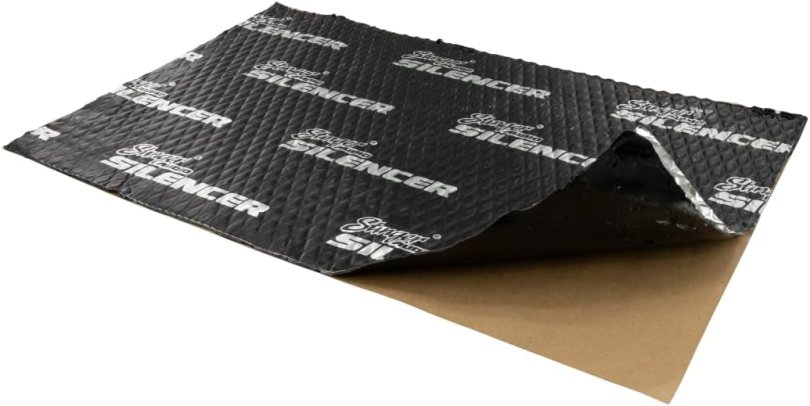
Stinger’s official 36-square-foot product page identifies model STMT8036, black aluminum/butyl rubber, 27 self-adhesive 12 × 16-inch sheets and an installation guide. The exact original Stinger Amazon ASIN B0D9BYQQVB is independently cross-referenced to that SKU in an original-ASIN retailer record. The nominal area works out as 27 × 12 × 16 / 144 = 36 sq ft, before cutting and trimming.
One measurement deserves special care. The Stinger manufacturer’s product page simultaneously labels the mat “80 mil” nominal and gives 1.6 mm overall thickness. Eighty mil is 0.080 inch, or about 2.03 mm, so those figures are not mathematically equivalent. This could be a different measurement basis, version or error, but neither should silently replace the other. Confirm the present kit and material thickness with the maker if a build specification depends on it.
The Stinger source photo above is an existing site-owned source review attachment, also associated with the published SPD Stinger Audio Silencer overview. It is not a performance test or proof of packaging size by itself.
Kilmat 80 mil 36 sq ft: documented comparison model
For a defined comparison rather than an ambiguous Kilmat brand-wide range, this article uses Kilmat’s manufacturer-listed KLM8036 model. The maker specifies 34 pieces, approximately 15.7 × 9.8 inches each, nominally 80 mil / 2 mm thick, with butyl adhesive and aluminum foil. The official advertised total is 36 sq ft. Thirty-four × 15.7 × 9.8 / 144 gives about 36.33 sq ft; that small difference may reflect rounded nominal sheet dimensions, not a promise of extra usable installed area.
The manufacturer specifies approximately 0.5 lb/sq ft material weight and describes a foil embossing pattern meant to show where the mat has been rolled firmly against the vehicle panel. That is a manufacturer’s installation and material claim, not independent measured noise-control performance. Kilmat also sells 50-mil 25/50-sq-ft and 80-mil 18-sq-ft options. Those are other products and are not conflated with the KLM8036 reference.

SPD’s older Kilmat review provides related brand and installation background. Its generic brand artwork is included solely to illustrate why reducing vibration on a metal panel differs from eliminating tire, engine or traffic noise along every cabin transmission path. Kilmat’s own current product page should be used for exact product imagery and dimensions.
Comparison table: same advertised area, different sheet choices
| Factor | Stinger Silencer STMT8036 | Kilmat KLM8036 |
|---|---|---|
| Original tracked route | Amazon ASIN B0D9BYQQVB, preserved | No original Kilmat ASIN or tracked destination verified |
| Maker-listed pack area | 36 sq ft | 36 sq ft |
| Sheet count | 27 pieces | 34 pieces |
| Nominal sheet dimension | 12 × 16 inches | 15.7 × 9.8 inches |
| Material type | Black foil-faced butyl damping mat | Foil-faced butyl damping mat |
| Thickness specification | 80 mil nominal; also 1.6 mm listed by maker (inconsistent figures) | 80 mil / approximately 2 mm, maker-listed |
| Weight stated by manufacturer | Not independently locked for the exact Stinger pack here | Approximately 0.5 lb per square foot |
| Installation focus | Compact sheets, hand roller and careful metal-surface preparation | Smaller rectangles for trimming; flatten embossed foil |
| Verified improvement in vehicle noise or resonance | Not independently tested head-to-head | Not independently tested head-to-head |
Where sheet size makes a real difference
Doors and complex trim: narrower and shorter pieces can reduce the amount of wasted material around access holes, speaker openings and mechanical linkages. Kilmat’s 34 narrower pieces might suit tight shapes; Stinger’s 27 larger pieces may mean fewer seams on uninterrupted door skins. Whether this is faster depends on the car, the access and the installer, not an absolute brand advantage.
Floor and trunk: a large uninterrupted metal sheet often benefits from fewer cuts, but coverage needs to be planned around wiring, seat mounts, drains and hidden future service access. Both packs advertise the same nominal 36-square-foot area, so an area-only price comparison needs the current selected pack price, shipping and genuine sheet dimensions before a cost-per-area calculation is meaningful.
Roof or large flat panels: avoid choosing thickness based solely on competing marketing units. Stinger’s published 80-mil versus 1.6-mm discrepancy should be clarified before treating nominal thickness as a differentiating feature. Different materials and installation temperatures can also affect adhesive handling; check a product’s current installation documentation.
What this material can—and cannot—do
Foil-faced butyl mats are primarily constrained-layer damping treatments for suitably prepared metal panels. They address vibration and panel resonance, which can be one source of perceived vehicle noise. They do not by themselves seal door gaps, replace a structural barrier layer, block all low-frequency road noise or guarantee any decibel reduction. Installation conditions and actual dominant noise paths matter much more than a bare “soundproofing” label.
Do not place an adhesive automotive mat against exhaust pipes, unshielded hot engine parts or safety-critical components solely on the strength of a generic heat-resistance claim. Ensure access to drain openings, airbags, seat-belt anchors, wiring and maintenance points. Always follow the latest manufacturer surface preparation and rolling instructions, using gloves and proper cutting tools where recommended.
Original purchase-route and selection caution
The Stinger original-ASIN destination is preserved exactly, with no substituted SKU or tag. The Kilmat model is identified by its manufacturer’s KLM8036 specification; there is no new or inferred Kilmat Amazon tracking link. PADO’s stored ACTIVE status for the original Stinger route is a site data-integrity receipt, not verification of live inventory, selected checkout option, price, commission or shipping.
Verdict: Choose by where the metal panels are and whether you want Stinger’s 27 larger rectangles or the Kilmat KLM8036 reference’s 34 narrower ones. Confirm the model, actual sheet sizes, adhesive surface requirements and Stinger’s thickness discrepancy with the seller or maker. Neither kit can be named the better acoustic performer from these product descriptions alone.
Good luck and happy soundproofing!