
Car soundproofing works best when you first identify what is making the cabin noisy, then treat the specific path that noise is using to reach you. Road and tire rumble, vibrating sheet metal, wind leakage, engine noise and interior rattles are different problems. They do not all need the same material.
If your goal is simply to make your car quieter inside, SPD’s approach is to diagnose first and add material second. A damping mat can calm a resonant door or floor panel, but it cannot repair a worn wheel bearing, seal a leaking door gasket or act like a heavyweight airborne-noise barrier.
This guide explains the main types of vehicle noise, where to treat them, what the common sound-deadening materials actually do, and how to prioritize a whole-car project without covering every visible surface simply because you can.
Car Soundproofing: Quick Diagnosis Guide
| What you hear | Likely path | Areas to investigate | Typical treatment |
|---|---|---|---|
| Low road and tire rumble | Structure-borne and airborne noise | Floor, wheel wells, trunk, rear quarters | Damping where panels resonate, then selective absorption or dense barrier treatment where appropriate |
| Metallic ringing or booming | Panel resonance | Doors, floor, trunk, roof, quarter panels | Butyl-based damping material on the resonant sheet metal |
| Wind hiss | Air leakage | Door seals, window seals, mirror area, body gaps | Repair, adjustment or replacement of the leaking seal or component |
| Engine or drivetrain noise | Firewall, floor and body structure | Firewall, front floor, hood and nearby structures | Location-appropriate damping, absorption or insulation after identifying the transmission path |
| Buzzes and rattles | Loose or contacting components | Trim, clips, wiring, speakers, panels, cargo area | Repair the loose part, then use anti-rattle or decoupling material where appropriate |
The important point is that car soundproofing is a system of different functions. Before buying rolls of material, work out whether the problem is vibration, airborne noise, leakage or a mechanical rattle. If you have identified resonant panels as the main issue, use our automotive sound-deadening product comparison to compare suitable damping options and their intended uses. For seals, barriers or cavity insulation, choose a product designed for that different function rather than assuming one mat solves every noise path.
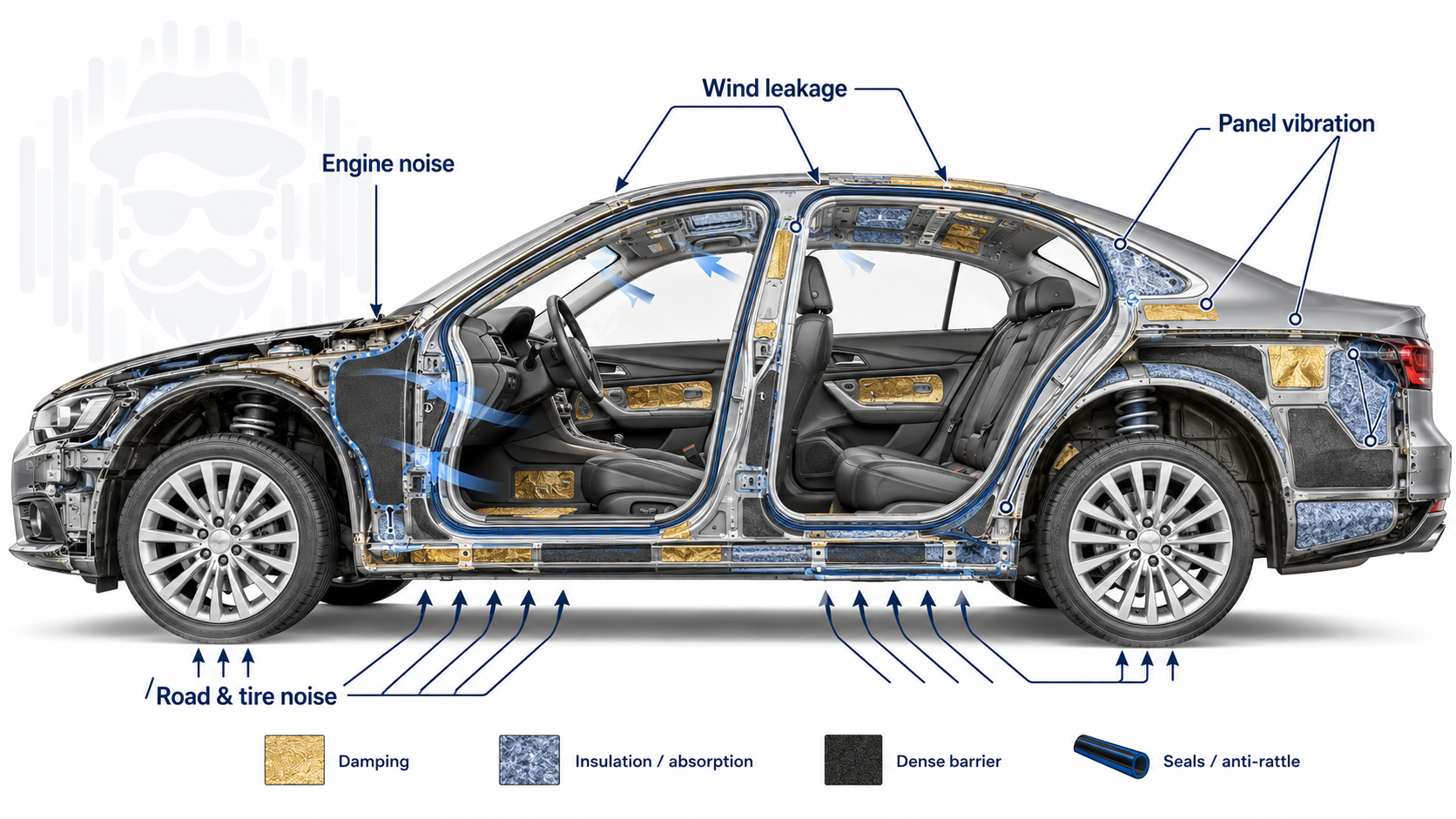
Start by Identifying the Noise Inside Your Car
A common mistake is to start with a product instead of the problem.
Before removing trim, take the car for a normal drive on several surfaces and listen carefully. A rough asphalt road can reveal tire and floor noise. A smooth road at highway speed is better for identifying wind leakage. Accelerating through different engine speeds can help separate drivetrain noise from road noise.
Also listen for changes when:
- the road surface changes;
- vehicle speed increases but engine speed stays similar;
- engine speed increases while vehicle speed changes very little;
- you press lightly on a trim panel;
- the trunk or cargo area is empty versus loaded;
- the ventilation system is on or off.
If you hear an abnormal grinding, bearing, exhaust, suspension or tire noise, diagnose the mechanical problem before trying to cover it acoustically. Sound-deadening material is not a substitute for vehicle repair.
The Four Main Material Functions in Car Soundproofing
The words soundproofing, sound deadening and insulation are often used interchangeably in automotive marketing. In practice, the materials can perform very different jobs. Our automotive sound-deadening product reviews and comparisons cover these different material types, intended functions and installation contexts in more detail.
1. Damping: Control Vibrating Sheet Metal
For an example of this material type, see our Stinger Audio Silencer 80 mil sound-deadening mat review. It covers the construction, sheet format, coverage, and vehicle areas associated with a butyl-and-aluminum damping product.
Butyl-based constrained-layer damping material is primarily used to reduce resonance in relatively thin metal panels.
Doors, floors, trunk panels and roof skins can flex and ring as the vehicle moves or as speakers energize the structure. A properly bonded damping sheet changes the way that panel vibrates and makes it less prone to resonance.
That does not mean damping mat is a complete airborne-noise barrier. It is very useful when the metal itself is part of the problem, but another treatment may be needed if substantial tire or road noise is still passing through the completed assembly.
If you are choosing between a spray-applied supplemental treatment and a sheet-based damping material, see our ATAC vs NVX SDRF20 vehicle noise-control comparison. It explains the differences in material format, installation, thermal role, and documented noise-and-vibration functions without treating the two products as identical substitutes.
For a focused door project, see our DIY car door sound deadening guide.
2. Insulation and Absorption: Manage Sound Within Cavities
Automotive fiber absorbers and other suitable insulation materials can help manage acoustic energy within cavities and can also provide thermal benefits depending on the product.
The important boundary is that a lightweight absorber should not automatically be described as a heavy sound blocker.
A soft insulation layer in a door, quarter panel or other appropriate cavity performs a different job from a dense barrier laid across a floor. Choose it because that function is useful in the assembly, not because the word “soundproof” appears in the product description.
One example of that insulation-focused role is Super Shield EZ Cool vehicle insulation. It uses a lightweight closed-cell polyethylene core and is positioned primarily as a thermal and vapor-barrier layer with supplemental sound-reduction use. It should not be treated as a direct substitute for a bonded vibration-damping mat or a heavyweight airborne-noise barrier.
3. Dense Barriers: Add Mass Against Airborne Noise
A dense flexible barrier such as mass-loaded vinyl can be useful where airborne road noise remains a significant problem and the vehicle has enough space and weight capacity for the additional layer.
Barriers become more practical on large, relatively continuous surfaces such as floors than inside every small cavity. They also have installation consequences: added weight, thickness, difficult seams, seat and trim clearance, and the need to preserve access to mounting and service points.
SPD would therefore treat a dense barrier as a selective second-stage treatment, not something that automatically belongs over every piece of metal in the vehicle.
4. Seals and Anti-Rattle Materials: Stop Leakage and Contact Noise
Sometimes the best acoustic improvement does not come from adding more mass at all.
Wind noise around a door or window may point to a worn, damaged or poorly seated seal. Buzzing trim may need a new clip, properly routed wire or a thin anti-rattle interface between contacting parts. For localized door-lock contact noise, our AUTOXBERT door-lock damper review covers a small TPE buffer designed to reduce closing impact, rattling, squeaks and vibration at the latch interface.
Adding damping mat elsewhere in the car will not solve an actual air leak at the top of a door frame.
Where Should You Soundproof a Car First?
There is no universal first location. Start with the area that matches the noise you actually hear.
Floor and Wheel-Well Areas
The floor is a major path for tire, suspension and road noise, particularly when the cabin has relatively little factory treatment.
Once the carpet and factory underlay are removed, exposed sheet metal can be inspected for resonance and treated where necessary. If more airborne-noise control is justified, the floor is also one of the more practical locations for a secondary insulation or barrier layer because it offers larger continuous surfaces.
Do not cover seat mounting holes, drains, wiring, service access or safety-system components.
If you are specifically installing Dynamat on the floor, use our step-by-step Dynamat floor installation guide.
Doors
Doors can contribute several different noises at once:
- outer-skin resonance;
- speaker-related vibration;
- trim rattles;
- wind leakage;
- road noise entering through the door assembly.
Damping the correct metal surfaces can reduce resonance, while suitable absorbers or decouplers may help elsewhere in the assembly. Weather seals and trim rattles should be dealt with separately.
Never obstruct window mechanisms, locks, wiring, side-impact equipment or the drainage path at the bottom of the door.
Trunk and Rear Quarter Panels
The trunk is often worth investigating when rear-tire noise, exhaust noise or large resonant body panels are prominent inside the cabin.
Remove loose cargo first. A jack, tool kit, license-plate frame or trim panel can create an irritating rattle that sounds much more serious than it is.
Once those simple causes are eliminated, inspect the trunk floor, wheel-well structures and large side panels for resonance. Hatchbacks and SUVs can be especially sensitive because there is less separation between the rear structure and passenger compartment.
Firewall and Engine-Bay Path
If the cabin gets noticeably louder as engine speed rises, the firewall and front floor deserve attention.
Engine-bay treatment requires more caution than ordinary cabin work. Temperature, moving components, ventilation, hood clearance and material approval all matter.
Do not assume an ordinary interior damping mat or foam is suitable under the hood simply because it works inside a door or trunk.
For that job, use our engine bay sound deadening guide.
Roof
A broad roof skin can resonate and can also transmit rain and exterior noise.
Damping may help where the sheet metal itself is ringing, while a suitable lightweight insulation layer can serve a different role between the roof structure and headliner.
The roof is also an area where added weight and adhesive reliability matter. There is little value in installing an unnecessarily heavy assembly overhead simply because heavier material exists.
Door and Window Seals
If your main complaint is a whistle or hiss that becomes stronger as speed rises, inspect sealing before dismantling the entire cabin.
Look for damaged weatherstripping, flattened seals, door-alignment problems and obvious gaps. Replacement or adjustment can sometimes address the actual noise path more directly than adding acoustic material inside the door. For truck, RV, tailgate and tonneau-cover gaps, our MEIZHJJU triple-bulb EPDM seal overview shows one purpose-built weatherstrip format intended to reduce wind intrusion, road noise and vibration around vehicle openings.
How to Make Your Car Quieter: SPD’s Step-by-Step Approach
- Drive and diagnose. Identify whether the dominant problem is road noise, wind, engine noise, panel resonance or rattling.
- Fix abnormal mechanical noise first. Tires, bearings, exhaust components, suspension and loose hardware should be repaired rather than acoustically hidden.
- Rank the remaining noise sources. Start with the loudest or most intrusive path instead of stripping the whole vehicle at once.
- Choose the material function. Use damping for resonant metal, absorption or insulation where that function is useful, dense barriers selectively for airborne noise, and seals or anti-rattle materials for leakage and contact problems.
- Expose only the area you are treating. Work methodically rather than dismantling the complete cabin unnecessarily.
- Clean and inspect the surface. Deal with moisture, corrosion, loose wiring and damaged clips before covering the area.
- Apply damping to the panels that need damping. Firm surface contact matters more than simply piling up layers.
- Add a second layer only when it solves a remaining problem. More material is not automatically a better acoustic system.
- Preserve safety and service access. Keep seat mounts, airbags, wiring, drains, ventilation paths, fasteners and moving mechanisms accessible and functional.
- Reassemble and road-test. Listen again before deciding where the next stage of treatment should go.
If you need the general installation process for peel-and-stick automotive damping materials, see our sound-deadening material installation guide.
Choosing products for the next step? Compare automotive sound-deadening products to see SPD’s dedicated buyer-focused guide before choosing a damping, insulation or barrier product.
How to Reduce Road Noise in a Car
Road noise is one of the reasons whole-car soundproofing is more complicated than applying a single damping product.
The noise can include:
- tire tread interacting with the road;
- vibration entering through suspension and body mounting points;
- resonance in floor and wheel-well panels;
- airborne sound passing through the vehicle structure;
- secondary rattles excited by the vibration.
If a floor panel is resonating, damping that panel makes sense. If substantial airborne tire noise remains afterward, another layer may be appropriate. If the actual problem is an unusually noisy or worn tire, however, adding another acoustic layer may be treating the symptom rather than the cause.
This is why SPD prefers a staged approach: treat one known mechanism, reassess, then add the next function only when the remaining noise justifies it.
How Much Sound Deadening Does a Car Need?
There is no reliable universal percentage that every vehicle should receive.
Vehicle construction varies too much. A large unsupported door skin behaves differently from a deeply stamped floor pan, and a lightly treated economy car may have very different factory insulation from a luxury vehicle.
For damping material in particular, the objective is to control problematic panel resonance—not to win a contest for the greatest number of square feet covered.
Measure the actual surfaces you intend to treat, account for waste and awkward shapes, and base the installation on the material manufacturer’s application guidance and the needs of the specific vehicle.
Can Acoustic Foam Make a Car Quieter?
Lightweight foam can have useful automotive roles, but it should not be treated as a universal soundproofing layer.
Depending on its construction and intended use, a foam may serve as:
- a decoupling layer;
- a thermal insulator;
- an absorber in a suitable cavity;
- an anti-rattle interface between trim pieces.
Those functions are different from adding substantial mass against airborne road noise and different again from damping a vibrating metal panel.
Ordinary studio acoustic foam is also not a substitute for purpose-appropriate automotive materials.
What Car Soundproofing Cannot Do
A well-planned project can make the cabin more comfortable, reduce resonance and rattles, and reduce some unwanted exterior and vehicle-generated noise. It cannot make a normal road vehicle completely silent.
Be especially cautious of claims suggesting that one thin material can independently block road noise, stop panel vibration, provide major thermal insulation and eliminate rattles everywhere in the vehicle.
Car soundproofing also cannot:
- repair worn tires or wheel bearings;
- fix an exhaust leak;
- correct a damaged suspension component;
- repair a badly aligned door;
- turn untreated glass into a massive acoustic barrier;
- eliminate every structure-borne vibration path;
- remove all engine and road feedback from a moving vehicle.
The realistic objective is a quieter, less resonant and more comfortable cabin, not silence.
Best Order for a DIY Car Soundproofing Project
If you do not want to dismantle the entire vehicle at once, I would normally work from the easiest confirmed problem toward the more invasive jobs.
- Remove loose objects and fix obvious rattles.
- Inspect worn or leaking door and window seals.
- Treat clearly resonant doors or trunk panels.
- Move to the floor and wheel-well path if road noise remains dominant.
- Investigate firewall and engine-related paths only when engine noise is genuinely the problem.
- Add heavier secondary barrier treatment only where the remaining noise and available space justify the added weight and work.
This approach also makes it easier to tell which change actually helped.
Car Soundproofing FAQ
What is the best way to make a car quieter inside?
Start by identifying the dominant noise source. Fix mechanical problems and air leaks first, then use damping on resonant metal and add absorption, decoupling or a dense barrier only where those functions address the remaining noise.
Does sound deadening reduce road noise?
It can contribute to reducing perceived road noise when vibrating body panels are part of the transmission path. But road noise can also be airborne or structure-borne, so damping material alone may not solve the complete problem.
Where should I put sound deadening in my car?
Apply it to panels that actually benefit from vibration damping. Common areas include doors, floor sections, trunk panels, wheel-well structures and some roof panels. The correct location depends on the noise source and the construction of the specific vehicle.
Should I cover every metal surface with sound-deadening mat?
No. Complete blanket coverage is not automatically necessary. Damping should be used to control resonant sheet metal, while other noise mechanisms may require different treatments.
Can I soundproof my car myself?
Many damping, trim and insulation projects are achievable for an experienced DIYer, but the difficulty varies greatly by vehicle. Seats, airbags, seatbelts, electrical connectors, door mechanisms and other safety-related components require the correct vehicle-specific service procedure.
What causes excessive road noise inside a car?
Possible causes include tire design or wear, road surface, wheel-well and floor transmission, suspension and body vibration, limited factory insulation, panel resonance and sometimes mechanical faults. Diagnose unusual noise before adding acoustic material.
Is mass-loaded vinyl good for cars?
A dense flexible barrier can be useful for airborne-noise control in suitable locations, but it adds weight and thickness and can be difficult to integrate around seats, trim, wiring and service points. It is best used selectively rather than automatically throughout the vehicle.
Will soundproofing make my car completely silent?
No. A vehicle still has glass, ventilation openings, tires, suspension connections, an engine or electric drivetrain and numerous structural paths. A good project aims for worthwhile noise reduction and a more comfortable cabin, not complete isolation.
Final Verdict
The best car soundproofing project is not the one with the most material. It is the one that treats the right noise path with the right material.
Start with diagnosis. Calm resonant metal with damping, manage cavities with appropriate absorbers or insulation, use heavy barriers only where airborne noise and the vehicle layout justify them, and fix actual air leaks or rattles directly.
For most DIY projects, I would rather treat one noisy area properly, road-test the result and continue from there than strip the whole car and install the same material everywhere.
Good luck and happy soundproofing!